
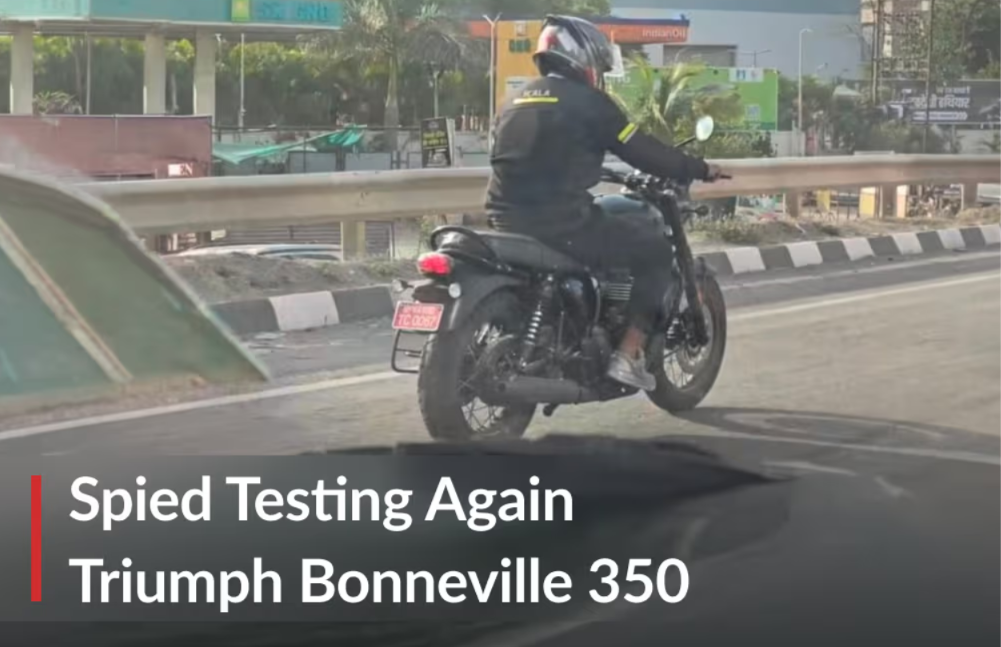
The first sighting of Triumph’s small-capacity Bonneville on Indian roads was significant because it suggested that the British brand was preparing to enter a part of the modern-classic motorcycle market where it had not yet offered a direct, traditional roadster. The early test motorcycle looked very different from the Speed 400 and Scrambler 400 X. Its teardrop tank, long mudguards, round headlamp, wire-spoke wheels, twin rear shock absorbers and peashooter-style exhaust pointed towards a more faithful interpretation of the Bonneville family design.
At the time of that first sighting, the motorcycle was widely referred to as the Triumph Bonneville 350 or Bonneville 400. The exact name, final engine tune, feature list and price were not confirmed. Those uncertainties have since been resolved. On 6 October 2026, Triumph introduced three India-market motorcycles: the Bonneville T40, T40 Black and Bonneville T4. All use a 349cc version of the TR Series engine, and all retain the classic Bonneville styling that was visible on the test mule.
That development changes how the original spy story should be read. The prototype photographs were useful because they showed the design direction and unusual hardware choices before the official reveal. They were not a complete specification sheet. This article revisits what the first test sighting told us, explains which details were confirmed in production, and examines what the new T40 family means for Indian buyers looking at the Royal Enfield Classic 350, Bullet 350, Honda CB350 and Jawa 350.
The first spy sighting: a different kind of Triumph 400
The first widely reported Indian test sighting appeared in April 2026. BikeWale’s 3 April report described the motorcycle as a Bonneville 400, while the India-specific expectation was that it would use a sub-350cc engine. A further sighting was reported on 14 April, and Autocar India published details of the revised chassis, twin-shock arrangement and traditional cycle parts on 16 April. The reports collectively established that Triumph was developing a roadster with a more traditional visual identity than the existing Speed and Scrambler models.
The prototype’s most obvious feature was its large, teardrop-shaped fuel tank. Its proportions, rounded side panels and long mudguards gave the motorcycle a fuller, more substantial appearance than the relatively compact Speed 400. The tank shape was important not only for visual identity but also because the Bonneville name is closely associated with a clean, uninterrupted tank profile. The production motorcycle retains that central design element, adding rubber knee pads, a three-bar Triumph tank badge and heritage-inspired paint finishes.
The front end used a round headlamp rather than the more contemporary styling seen on the Speed family. The production model has a full-LED headlight with a distinctive daytime-running-light signature. The circular lamp is therefore not simply a styling accessory: it combines the traditional outline with current lighting technology. The test mule also showed compact round indicators and a small, classic-looking tail lamp, details that help establish a coherent period-inspired appearance.
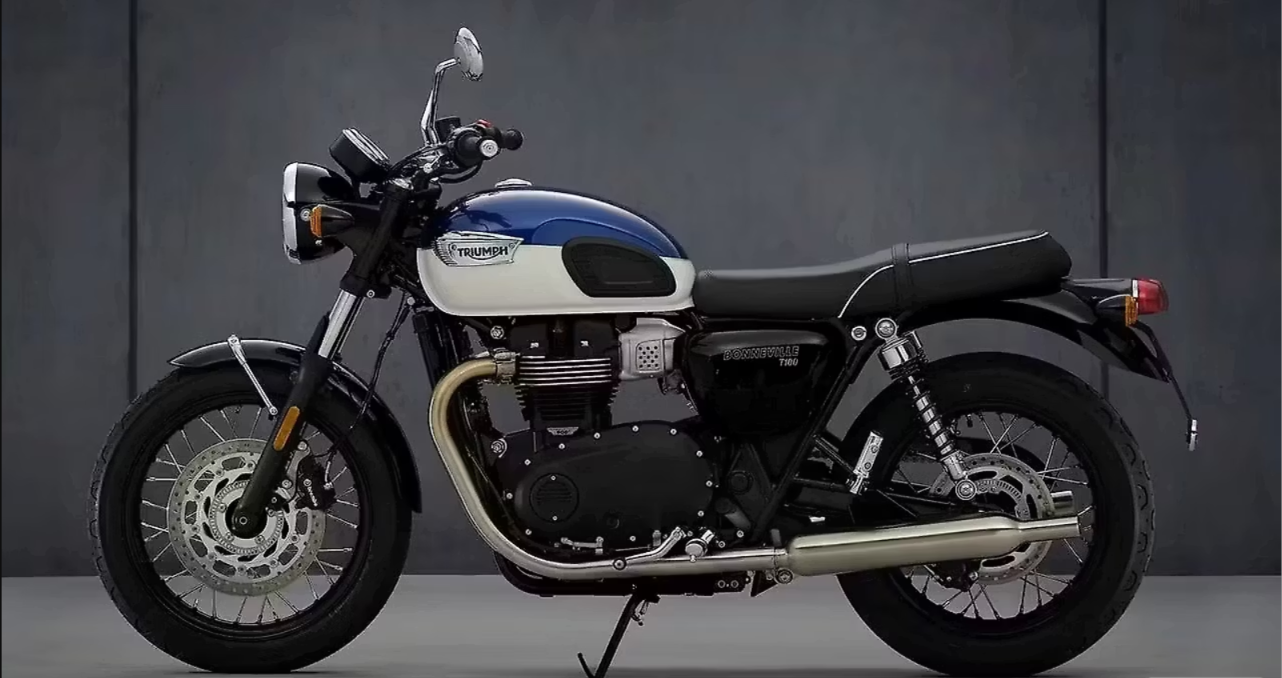
The long front and rear mudguards were another strong clue. They visually connect the motorcycle to older British roadsters and help distinguish it from scrambler-inspired products, which generally use shorter or higher-mounted mudguards. The production models preserve the longer, flowing fenders and combine them with a bench-style seat, a sculpted tank and a peashooter silencer. The result is intended to look like a smaller member of the Bonneville family rather than a Speed 400 wearing retro accessories.
Twin rear shocks and a revised chassis were the biggest hardware clues
The first test images showed a conventional telescopic front fork and twin rear shock absorbers. This was a notable departure from the USD fork and monoshock arrangement used by several motorcycles in Triumph’s small-capacity range. The choice makes visual sense for a Bonneville: twin shocks leave the rear wheel and frame area more open and recreate the silhouette associated with classic roadsters. Triumph confirmed the twin-shock layout in its October launch announcement.
The prototype also appeared to use a revised rear subframe. This was necessary to accommodate the flatter, longer bench seat and the traditional rear bodywork. Autocar India’s April report specifically noted a new subframe for the twin-shock arrangement. Later spy reports described a revised swingarm and a longer rear section. These observations suggested that the Bonneville was not merely a cosmetic conversion of the Speed 400. The production motorcycle’s distinct proportions and chassis presentation support that interpretation.
The front suspension uses traditionally styled forks, with the prototype wearing gaiters that reinforced the retro theme. Triumph’s official launch material confirms classically styled front forks and twin rear shocks, although the press release does not publish every internal suspension specification. It is therefore safer to describe the visible architecture rather than claim an unverified fork diameter, travel figure or adjustment range.
The production motorcycles use 18-inch front and 17-inch rear wheels. Triumph specifies lightweight aluminium rims with traditional steel spokes. This combination is important because it retains the open, classic appearance of wire-spoke wheels while using modern rim construction. Buyers should nevertheless confirm tyre type and puncture-repair implications with the dealer. A spoke-wheel appearance alone does not establish whether a particular tyre is tubed or tubeless; that must be checked against the final market specification and tyre markings.
The peashooter exhaust and engine detailing complete the retro look
The test mule’s single peashooter-style silencer was one of its most recognisable features. It is a compact, rounded exhaust design associated with classic British motorcycles. The production T40 and T4 use a brushed steel exhaust system, while the T40 Black receives blacked-out finishes. Triumph says the engine and silencer have been developed to produce a distinctive exhaust note, with clear firing pulses from the single-cylinder engine and a lower idle speed contributing to the relaxed character.
The engine itself is visually treated as part of the design. Triumph highlights bright machined cooling fins on the cylinder head, large finned header roses and classically shaped clutch and alternator covers. These details give the liquid-cooled single-cylinder engine a more traditional appearance without pretending that it is an old air-cooled unit. The production motorcycle combines modern liquid cooling and fuel management with exterior detailing that references earlier Bonnevilles.
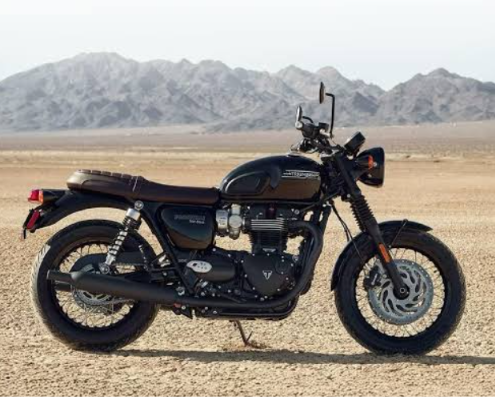
Early spy reports showed prototypes with different engine and exhaust finishes. One test motorcycle appeared largely blacked out, while another had polished metal surfaces. That variation was a reminder that test vehicles may represent different trim levels or development stages. The final line-up makes the finish distinction clearer: the T40 and T4 use chrome-finished mirrors and grab hoop with brushed aluminium heel guards and a brushed steel exhaust, while the T40 Black has black-painted or powder-coated components.
The 349cc engine: what Triumph confirmed
The most important mechanical detail is the engine displacement. The production Indian motorcycles use a 349cc, liquid-cooled, single-cylinder, four-valve, DOHC engine from Triumph’s TR Series family. This explains why early coverage alternated between the terms Bonneville 350 and Bonneville 400. Triumph’s wider small-capacity range is commonly grouped under the 400 series, but the Indian-market Bonneville’s actual displacement is 349cc. The official Indian product page describes it as a 349cc engine.
Triumph has not simply described the Bonneville engine as an unchanged Speed T4 motor. Its launch release says the Bonneville receives a dedicated version of the 350cc TR Series engine, with a revised cylinder head and a unique engine tune. The stated objective is a relaxed, torque-rich delivery, with stronger response lower in the rev range. Autocar India’s later comparison report also notes a revised camshaft, cylinder head and narrower throttle bodies. The manufacturer’s own description is the primary basis for the article’s performance explanation.
Peak power is 29PS at 7,000rpm, while peak torque is 31Nm at 5,500rpm in the launch announcement. The official product page lists 31.2Nm for the T40, while some launch summaries round the figure to 31Nm. The small difference is a rounding or presentation issue rather than evidence of a different engine tune. For clarity, the article uses 31.2Nm where the product page provides the more precise figure and 31Nm when referring to the manufacturer’s rounded launch headline.
The torque peak arrives at a relatively modest engine speed, consistent with the intended relaxed roadster character. Peak power is not especially high for the broader 350-400cc performance category, but the Bonneville is not being positioned as a sharp, high-revving streetfighter. Its focus is accessible everyday performance, manageable throttle response and a more traditional riding experience. Actual acceleration, roll-on response and refinement should be assessed in a road test rather than inferred solely from peak figures.
The engine is paired with a six-speed gearbox and a slip-and-assist clutch, according to the published T40-versus-T4 comparison. A slip-and-assist clutch can reduce lever effort and help manage rear-wheel behaviour during aggressive downshifts. Triumph’s official announcement emphasises the torque-rich character but does not include a full technical data table in the press-release summary. The six-speed and clutch details are cross-checked against established automotive reporting and dealer-published specifications.
Why the Indian Bonneville uses a 349cc engine
The decision to use a 349cc engine is connected to India’s tax structure. Reports before launch noted that Triumph was reducing the displacement of its 400-series motorcycles to below 350cc for the Indian market. That is why the early test bike was expected to use a 350-class engine even though overseas versions were discussed with a larger displacement. The final Indian product confirms the 349cc figure.
It is important not to overstate the tax explanation. The manufacturer’s public launch release identifies the Indian engine as a 350cc TR Series unit but does not provide a detailed tax calculation or say that a particular tax saving has been passed directly to customers. The sub-350cc positioning is widely reported in the Indian motorcycle industry, but a buyer should compare the actual ex-showroom price and total on-road quote rather than assume a specific saving from engine capacity alone.
The naming can also create confusion. The global or family-level 400 designation does not mean that every India-market motorcycle carrying a 400-series association has a 398cc engine. Triumph has used 400 branding for motorcycles whose Indian-market engines have been downsized. In this case, the official India product page calls out 349cc. Editorially, Bonneville 350 is a useful descriptive phrase for the spy-story subject, but the production product names are T40, T40 Black and T4.
The production range: Bonneville T40, T40 Black and T4
Triumph’s 6 October 2026 announcement confirmed three motorcycles rather than one: Bonneville T40, T40 Black and Bonneville T4. The T40 and T40 Black are priced at ₹2,79,999 ex-showroom Delhi, while the T4 is priced at ₹2,54,999 ex-showroom Delhi. The ₹25,000 gap separates the more comprehensively equipped T40 models from the more affordable T4. These are Delhi ex-showroom prices, not on-road prices for every city. Registration, insurance, accessories and local charges will change the final amount.
The T40 and T40 Black are the more technology-rich versions. They receive a four-inch circular full-colour TFT display, full smartphone connectivity, map navigation, phone and music controls, five riding modes, cruise control, lean-sensitive Optimised Cornering ABS and Optimised Cornering Traction Control. The T4 retains the same basic Bonneville silhouette and engine concept but uses a colour LCD with turn-by-turn navigation, three riding modes and dual-channel ABS.
This split is significant because the original spy shots showed a single circular instrument pod without enough detail to establish whether it was a TFT or LCD. Reports speculated about smartphone connectivity and turn-by-turn navigation. The production specification now confirms that the T40’s circular unit is a four-inch TFT with full map navigation, while the T4 receives a colour LCD and turn-by-turn navigation. The two screens should not be described as identical.
Triumph has also confirmed that bookings opened online from 7 October 2026 at 4:30pm. Deliveries of the T40 and T40 Black are scheduled to begin in the second week of November 2026, while T4 deliveries are scheduled from the second week of January 2027. As of 4 November 2026, the T40 delivery window is imminent, but the T4 remains a later delivery proposition. Actual dealer-level delivery dates may vary by location, colour and allocation.
Design: how close is the production bike to the spy mule?
The production motorcycles retain the central visual cues visible in the first test photographs: a teardrop fuel tank, round headlamp, long mudguards, bench seat, twin rear shocks, spoked wheels and peashooter silencer. Triumph’s official description explicitly connects these details to the larger Bonneville family. The production design is therefore not a radical departure from the spy mule; it is a refined and fully finished version of the same design direction.
The tank is a major visual anchor. It has a flowing shape, rubber knee pads and the three-bar Triumph badge. The T40’s heritage-inspired two-tone paint schemes are finished with hand-painted coach lining. This is a detail that separates the higher-spec model from a basic retro-themed motorcycle with simple decals. The T40 colour choices include Aegean Blue with Fusion White, Meriden Blue with Tangerine Orange, and New England White with Jet Black.
The T4 is offered in Phantom Black, Carnival Red and Competition Green. The T40 Black uses Matt Pewter Grey and Matt Phantom Black, with gloss-black aluminium wheel rims and bright steel spokes. Its engine casings and other components are darkened to create a more understated look. The three versions share the same broad silhouette, so the decision is primarily about finish, equipment and price rather than a different body style.
Triumph says the full LED lighting system includes a distinctive daytime-running-light signature. The headlamp automatically switches between daytime-running-light and dipped-beam operation. The T40 and T40 Black also have self-cancelling indicators. An Emergency Deceleration Warning function flashes the rear light during heavy braking to alert following road users. These are production-confirmed details that could not be established from the first spy images.
Ergonomics, seat height and everyday usability
The Bonneville T40, T40 Black and T4 have a 790mm seat height and a ready-to-ride weight of 195kg, according to the manufacturer’s launch information and published technical comparisons. The seat height is approachable for many riders, although inseam length, footwear, seat width and suspension sag affect how easily a rider can place both feet on the ground. A low accessory seat can reduce the seat height to 770mm.
The riding position is described by Triumph as upright and relaxed, with the handlebar and footpeg positions intended to create a natural posture. The long bench seat has generous foam padding for rider and pillion, and a ribbed finish that supports the classic design. This layout should appeal to riders who prefer an upright roadster to a forward-leaning sport motorcycle. It may also make short urban rides less demanding on the wrists, although a proper test ride is needed to judge comfort over an hour or more.
The centre stand is standard, which is a practical inclusion on a motorcycle with a traditional roadster brief. It makes chain cleaning, lubrication and parking on suitable surfaces easier. Upper engine protection bars are also standard on all three versions, according to Triumph. Genuine accessories include low and comfort seats and classic panniers. Accessory fitment and pricing should be confirmed at the dealership, and accessories may affect delivery timing if they are not in stock.
The official material describes the motorcycle as manoeuvrable and confidence-inspiring, but it does not publish a complete set of dimensions in the press-release summary. Buyers should therefore avoid assuming that the Bonneville will feel as light or narrow as a smaller commuter motorcycle. At 195kg ready to ride, it is a substantial machine for a 349cc single. That weight can contribute to a planted feel on the road, but it will also matter when pushing the bike out of a tight parking space or moving it on an incline.
Technology: the T40 and T4 are not equally equipped
The T40’s four-inch circular TFT is designed to blend modern information with a traditional instrument shape. Triumph says the rider can select a Heritage Mode that replaces the standard screen layout with an analogue-style presentation. The display shows information such as gear position, indicators, ambient temperature and fuel level, while the centre area provides access to phone functions and motorcycle settings. Five customisable widgets can be assigned to commonly used functions.
The Triumph Navigation App provides full map navigation on the T40 TFT. Riders can plan routes, add waypoints, save or import routes through GPX files, and access favourite destinations, points of interest and recent searches. This is more comprehensive than a simple turn arrow on a basic LCD. Phone connectivity also allows access to calls, contacts and music controls through the display and left-hand switch cube. The rider should still mount and operate the phone responsibly and avoid interacting with menus while moving.
The T4 has a colour LCD with turn-by-turn navigation and three riding modes. It also offers phone connectivity for calls and contacts. The distinction is not simply screen technology: the T40 has full map navigation, five riding modes and a wider rider-assistance package, while the T4 has a simpler display and fewer modes. Buyers should compare the exact functions they will use rather than treating the more expensive model’s TFT as a cosmetic upgrade alone.
The T40 and T40 Black also receive a USB-C charging socket. This is useful for keeping a compatible phone or navigation device charged on longer rides, although the owner should use a secure mount and suitable cable. The T4’s feature list should be checked separately; the official launch material specifically identifies USB-C for the T40 and T40 Black rather than claiming it as a range-wide fitment.
Rider aids and braking equipment
One of the most notable features on the T40 and T40 Black is lean-sensitive Optimised Cornering ABS. Conventional ABS helps prevent wheel lock under braking, while a cornering-aware system can take the motorcycle’s lean angle into account and adjust intervention accordingly. This can provide additional support when braking while the motorcycle is leaned over, but it does not cancel the physical limits of tyre grip or make corner entry at excessive speed safe.
Optimised Cornering Traction Control is also listed for the T40 and T40 Black. Traction control monitors wheel behaviour and can reduce engine torque when it detects excessive rear-wheel slip. A lean-sensitive system can tailor its intervention to cornering conditions. It is a rider aid, not a substitute for smooth throttle inputs, suitable tyres or judgement on loose, wet or contaminated surfaces. Triumph says the five riding modes adjust throttle response, traction control and ABS to suit different conditions and preferences.
The five T40 modes comprise Road, Rain, Eco and two customisable Rider modes. The rider can tailor the latter settings and access them through the display. The T4 has three riding modes. The official announcement describes dual-channel ABS on the T4, while the T40 models use the more advanced lean-sensitive Optimised Cornering ABS. This is one of the clearest functional reasons to consider the price difference.
Cruise control is included on the T40 and T40 Black. It can help reduce fatigue on suitable open roads by maintaining a set speed without continuous throttle input. It is not designed for dense traffic, poor road surfaces or situations that require frequent speed changes. Riders must remain in control and be ready to cancel the system. The T4 does not have cruise control listed in the launch specification.
Triumph also highlights a twin-piston front brake caliper, a one-piece-style front disc and braided brake lines. These components are intended to provide consistent braking performance and lever feel. The exact stopping distance depends on tyre condition, surface grip, load, rider input and ABS operation. The presence of a named braking technology should not be turned into an unsupported claim that the motorcycle has class-leading stopping distances.
Engine character, gearing and expected riding experience
The Bonneville’s engine tune is central to its identity. Triumph says the revised cylinder head and dedicated calibration increase torque lower in the rev range. With peak torque arriving at 5,500rpm, the stated output is intended to support relaxed acceleration without requiring the rider to chase high engine speeds constantly. That is consistent with the visual and ergonomic brief of a traditional roadster.
The 29PS peak power figure is lower than the 36.4bhp figure reported for the newer 349cc Speed 400 engine in April 2026 coverage. That comparison needs care: the Bonneville has a different engine tune and its output is stated in PS, while the Speed figure is reported in bhp. The Bonneville’s purpose is not to win a peak-power contest. Its lower power and torque-focused calibration are intended to give it a different response and character.
The six-speed gearbox gives the rider a spread of ratios for city speeds and open-road cruising. A sixth gear can reduce engine speed at a given road speed compared with a shorter overall gearing, depending on final-drive ratios. Triumph has not published all gear ratios in the launch release, so it would be premature to state exact cruising rpm or top speed. A road test will be needed to assess shift quality, clutch feel, vibration and how relaxed the engine feels at Indian highway speeds.
The 14.5-litre fuel tank is a useful confirmed figure from published technical comparisons. It is larger than what many small commuter motorcycles carry and should support practical day-to-day use. However, fuel-tank capacity alone does not establish riding range. That calculation requires a verified fuel-consumption figure under a relevant test method or measured real-world economy. No guaranteed range should be inferred from tank size.
Service intervals and ownership considerations
Triumph states a service interval of 10,000 miles, equivalent to 16,000km, for the Bonneville range. The company positions this as a way to reduce maintenance visits and ownership inconvenience. The interval should be understood as the manufacturer’s scheduled service interval, not a statement that owners can ignore oil level, tyre pressure, chain condition or other routine checks between services. The owner’s handbook will define inspection requirements and time-based limits.
A motorcycle with a premium badge and a 349cc engine should be assessed on total ownership cost, not only purchase price. Buyers should ask for the scheduled service chart, labour rates, consumable costs, warranty coverage, roadside assistance terms and availability of replacement parts. The service interval is a positive headline, but the cost of tyres, brake pads, chain and sprockets, insurance and accessories also contributes to long-term expenditure.
The T40 and T4 share the basic engine concept and chassis architecture, but their electronics and finishes differ. Owners should confirm whether the desired accessory is compatible with the exact variant and whether fitting it affects warranty terms. The optional low seat may be especially relevant for shorter riders, while the comfort seat and panniers may suit touring use. Accessory prices are not included in the ex-showroom motorcycle prices quoted in the launch announcement.
Price and positioning in the Indian market
The T4 is the entry point at ₹2,54,999 ex-showroom Delhi. The T40 and T40 Black are priced at ₹2,79,999. This puts the Bonneville family above the mainstream 350cc retro roadsters on price, and it reflects Triumph’s premium positioning, equipment and brand identity. The on-road price will vary by city, registration category, insurance, accessories and applicable local charges. A buyer in Pune, Mumbai, Bengaluru or another city should obtain a written quotation from an authorised dealer rather than applying Delhi pricing directly.
The ₹25,000 premium for the T40 buys more than a different instrument display. It brings a full-colour TFT with map navigation, five riding modes, cruise control, lean-sensitive cornering ABS and traction control, plus other convenience details. The T4 retains the classic look and core engine but offers a simpler colour LCD, turn-by-turn navigation, three riding modes and dual-channel ABS. For riders who mainly want the Bonneville silhouette and engine character, the T4 may be the more cost-conscious option.
The T40 Black is mechanically and technologically aligned with the T40, but its blacked-out finish gives it a distinct visual identity. Its price is the same as the standard T40. The choice between them is therefore largely about styling preference. Buyers should inspect the paint and component finishes in person, because matte and dark finishes can look different under showroom lighting and may need particular care to avoid visible scratches or polishing marks.
How it compares with the Royal Enfield Classic 350 and other rivals
The Royal Enfield Classic 350 is the obvious comparison because it is one of the best-known traditional roadsters in India. It has a strong heritage identity, a broad owner community and a well-established dealer and service footprint. The Triumph Bonneville T40 approaches the same broad emotional territory but at a higher price and with a more technology-heavy equipment package on the T40 versions. The comparison is not simply about displacement: brand experience, finish, weight, engine feel, comfort and ownership support all matter.
The Royal Enfield Bullet 350 is another natural alternative for buyers who value traditional styling and a familiar riding experience. The Honda CB350 offers a different interpretation of the modern classic, with its own engine character and equipment approach. The Jawa 350 is also relevant for buyers drawn to retro proportions and a distinctive exhaust note. Exact variant prices and feature lists change, so a current comparison should use the latest official quotations and equivalent versions rather than old online price tables.
On paper, the Triumph’s strongest differentiation is its combination of authentic Bonneville styling with advanced rider aids and connectivity on the T40. Cornering ABS, cornering traction control, cruise control and full map navigation are not merely decorative features. They can matter to riders who travel on varied roads and value electronic support. However, the T40 is also more expensive than several established 350cc rivals, and buyers must decide whether the equipment and Triumph badge justify that premium.
The T4 changes the competitive calculation. At ₹2,54,999 ex-showroom Delhi, it is less expensive than the T40 but remains a premium purchase in the 350cc class. Its appeal is likely to rest on the combination of Bonneville styling, a dedicated torque-focused engine tune and the Triumph ownership proposition. It does not offer the full T40 electronics package, so buyers should not assume that all three Bonneville variants have identical rider aids.
Who should consider the Bonneville T40 or T4?
The T40 is aimed at riders who want the classic Bonneville appearance but do not want to give up modern instrumentation and rider assistance. The full-map TFT, five riding modes, cruise control and lean-sensitive systems give it a more comprehensive feature package. It may suit experienced riders who regularly use open roads, value navigation integration and are comfortable paying extra for technology and finish.
The T40 Black is for buyers who prefer a darker, less traditional finish while retaining the T40’s core equipment. It is not a lower-spec or mechanically different version based on the manufacturer’s launch information. The decision is mainly aesthetic, although buyers should inspect the blacked-out details and consider how they will maintain the finish over time.
The T4 is likely to appeal to riders who prioritise the Bonneville design and relaxed engine character over the most advanced electronics. It keeps a colour display, turn-by-turn navigation, ride modes and dual-channel ABS, but leaves out the T40’s full map TFT, five-mode package, cruise control and lean-sensitive rider aids. The ₹25,000 saving is meaningful, but it should be weighed against the equipment the rider would actually use.
The 195kg ready-to-ride weight deserves attention for first-time big-bike buyers. A 349cc engine does not automatically mean a lightweight motorcycle. Anyone who parks on a slope, frequently reverses into tight spaces or needs to move the bike without starting it should try those manoeuvres at the dealership. The 790mm seat height may be manageable for many riders, and the accessory low seat reduces it to 770mm, but seat width and weight distribution also influence confidence.
What the first spy shots got right — and what they could not tell us
The first spy shots correctly indicated the design direction: a classic Bonneville-style tank, round headlamp, longer mudguards, twin rear shocks, spoked wheels, a bench seat and a peashooter exhaust. They also suggested a dedicated rear structure rather than a direct carry-over of the Speed 400 chassis arrangement. The production reveal confirmed the broad visual and hardware themes.
The spy images could not establish the final model name, exact displacement, power and torque, final colour range, pricing, delivery schedule or the distinction between T40 and T4 equipment. They could not confirm whether the circular instrument unit would be a TFT or LCD, nor whether it would provide full map navigation. Those details only became clear after Triumph’s official announcement and subsequent product information.
The early reports also included provisional expectations that the motorcycle might cost below ₹2 lakh. That estimate did not match the final launch prices. The production T4 starts at ₹2,54,999 and the T40 models at ₹2,79,999, both ex-showroom Delhi. This is a useful reminder that spy reports and pre-launch estimates should be treated as developing information, not as a substitute for a confirmed price announcement.
Final verdict: the spy bike has become a three-model Bonneville range
The first Indian sighting of Triumph’s small Bonneville mattered because it revealed a motorcycle with a distinct purpose. Rather than extending the Speed 400 design with a few retro touches, Triumph appeared to be building a more traditional roadster with twin shocks, wire-spoke wheels, a long bench seat and classic Bonneville proportions. The October 2026 launch confirms that this was the right reading of the prototype.
The production range is more substantial than the original spy story could establish. The Bonneville T40, T40 Black and T4 share a dedicated 349cc liquid-cooled engine tune producing 29PS and around 31Nm, a six-speed transmission, classic styling and a 195kg ready-to-ride weight. The T40 versions add a circular TFT, full map navigation, five riding modes, cruise control and lean-sensitive rider aids, while the T4 offers a simpler but still connected equipment package at a lower price.
For buyers, the central question is no longer whether Triumph will launch a Bonneville-inspired 350. It has. The decision is whether the T4’s simpler specification or the T40’s richer electronics package makes more sense, and whether the premium over established 350cc rivals is justified by the styling, engine character, finish and ownership experience. A test ride and a detailed on-road quotation are essential before making that call.
Quick specification and price summary
| Item | Bonneville T4 | Bonneville T40 / T40 Black |
|---|---|---|
| Engine | 349cc, liquid-cooled, single-cylinder TR Series | 349cc, liquid-cooled, single-cylinder TR Series |
| Peak power | 29PS at 7,000rpm | 29PS at 7,000rpm |
| Peak torque | 31Nm (31.2Nm on official product listing) at 5,500rpm | 31Nm (31.2Nm on official product listing) at 5,500rpm |
| Transmission | 6-speed; slip-and-assist clutch | 6-speed; slip-and-assist clutch |
| Display | Colour LCD | 4-inch circular full-colour TFT |
| Navigation | Turn-by-turn | Full map navigation |
| Riding modes | 3 | 5 |
| Rider aids | Dual-channel ABS | Lean-sensitive Optimised Cornering ABS and Optimised Cornering Traction Control |
| Cruise control | Not listed | Yes |
| Seat height | 790mm; 770mm with accessory low seat | 790mm; 770mm with accessory low seat |
| Ready-to-ride weight | 195kg | 195kg |
| Fuel tank | 14.5 litres | 14.5 litres |
| Price (ex-showroom Delhi) | ₹2,54,999 | ₹2,79,999 |