
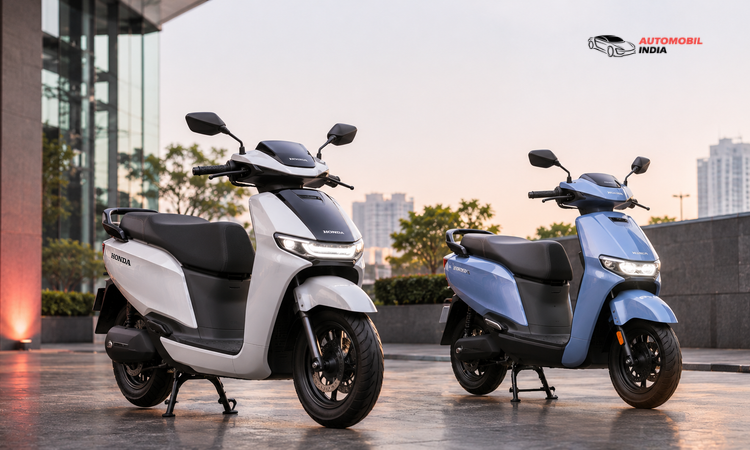
For years, Honda’s Activa name has been closely associated with dependable, everyday scooter mobility in India. Its scale and familiarity made an electric Activa one of the most anticipated developments in the country’s two-wheeler market. Honda Motorcycle and Scooter India (HMSI) finally took that step on 27 November 2024, unveiling two electric scooters: the Activa e: and the QC1.
Rather than launching two versions of the same product, Honda chose two distinct approaches to electric mobility. The Activa e: was designed around removable, swappable batteries and a more performance-oriented package. The QC1 took a simpler route, using a fixed battery that owners could charge at home. The pair represented Honda’s first electric two-wheelers developed for the Indian market and the beginning of a wider electrification strategy.
Their journey has also demonstrated that a trusted badge and established engineering are only part of the EV equation. Battery access, charging convenience, price, usable storage and a dependable service ecosystem can matter just as much as the scooter itself.
Two Scooters, Two Different EV Philosophies
The most important distinction between the Activa e: and QC1 is how their batteries are handled. The Activa e: uses Honda Mobile Power Pack e: batteries that can be exchanged at compatible Honda Power Pack Exchanger stations. The QC1 has a permanently installed battery and is supplied with an off-board home charger.
This split allowed Honda to address two different types of urban rider. The Activa e: targets customers who want quicker battery replenishment without waiting for a conventional charge, provided a swapping station is conveniently located. The QC1 is aimed at riders who prefer charging at home and want a relatively straightforward, lower-cost electric scooter.
The choice is not simply between two battery sizes. It is a choice between two ownership routines: access to a battery-swapping network or access to a safe home charging point.
Honda Activa e: – The Swappable-Battery Approach
The Activa e: carries the familiar Activa identity into an electric format, with a modernised body design, LED lighting, a flat floorboard and 12-inch alloy wheels. Honda offered it in standard and RoadSync Duo variants, with the latter receiving a larger connected instrument display and additional connected functions.
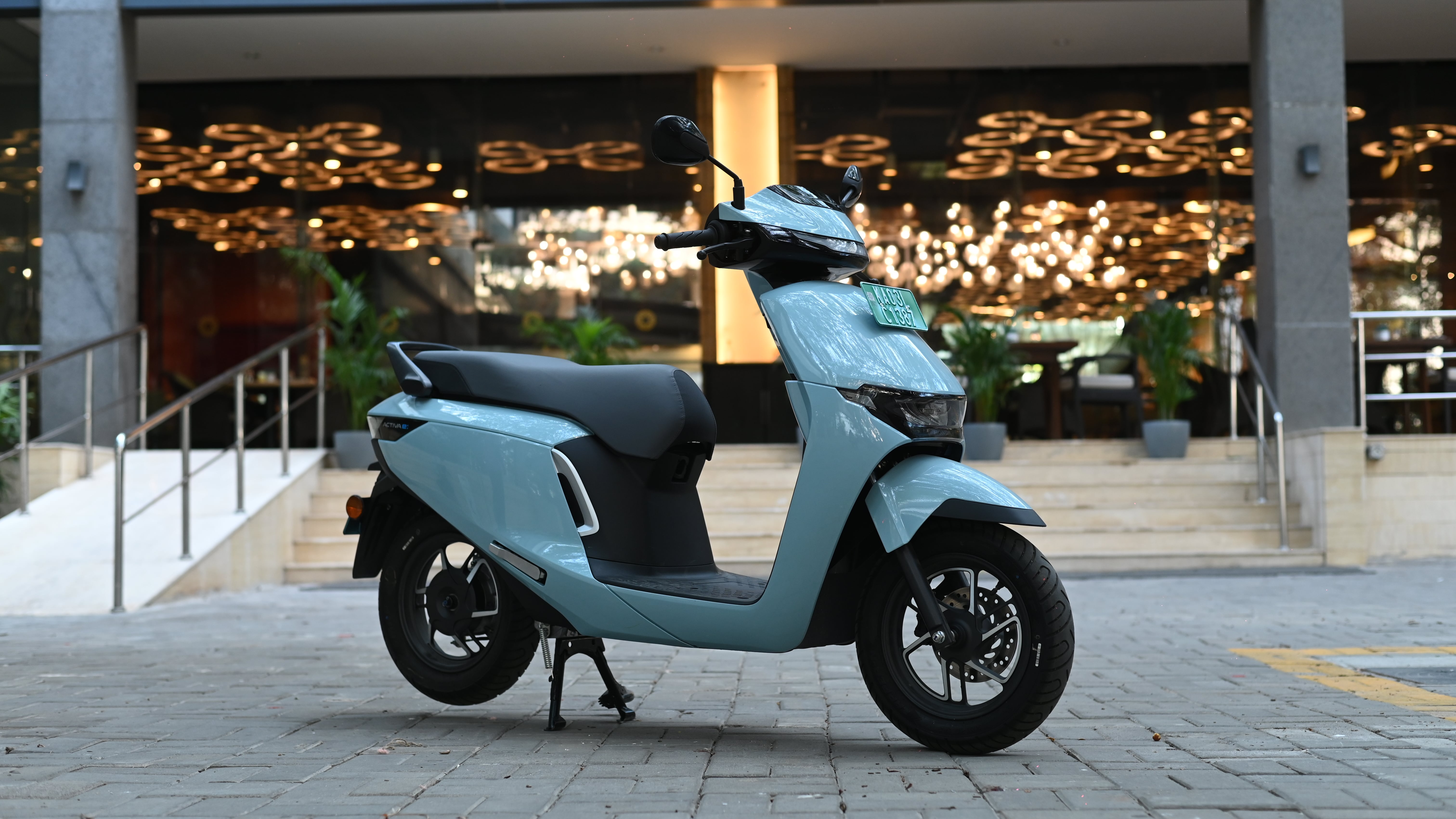
Its powertrain uses a permanent-magnet synchronous motor with a peak output of 6 kW and maximum torque of 22 Nm. Honda claims a 0–60 km/h time of 7.3 seconds and a top speed of 80 km/h. The scooter has three riding modes—Econ, Standard and Sport—allowing riders to choose between efficiency and stronger response.
The battery arrangement is its defining feature. Two 1.5 kWh Honda Mobile Power Pack e: units provide a combined capacity of 3 kWh. Honda’s claimed IDC range is 102 km on a full set of charged batteries. Instead of plugging the scooter in at home, users exchange depleted packs at a compatible battery-swapping station.
The benefit is reduced waiting time during a battery exchange. The trade-off is dependence on a functioning and conveniently located swapping network. The battery packs also occupy the space that a conventional scooter might otherwise use for under-seat storage, making everyday luggage practicality an important consideration.
The RoadSync Duo variant adds a 7-inch TFT display, navigation, smartphone connectivity, call and music controls, live tracking and other connected functions. The standard variant has a simpler display and fewer connected features. Both versions include smart-key functions and reverse assistance, according to Honda’s published specifications.
Honda QC1 – A Simpler Home-Charging Electric Scooter
The QC1 was introduced as the more accessible and straightforward member of Honda’s first EV pair. It uses a fixed 1.5 kWh lithium-ion battery and an in-wheel electric motor with a peak output of 1.8 kW. Honda quotes a top speed of 50 km/h and an IDC range of 80 km.
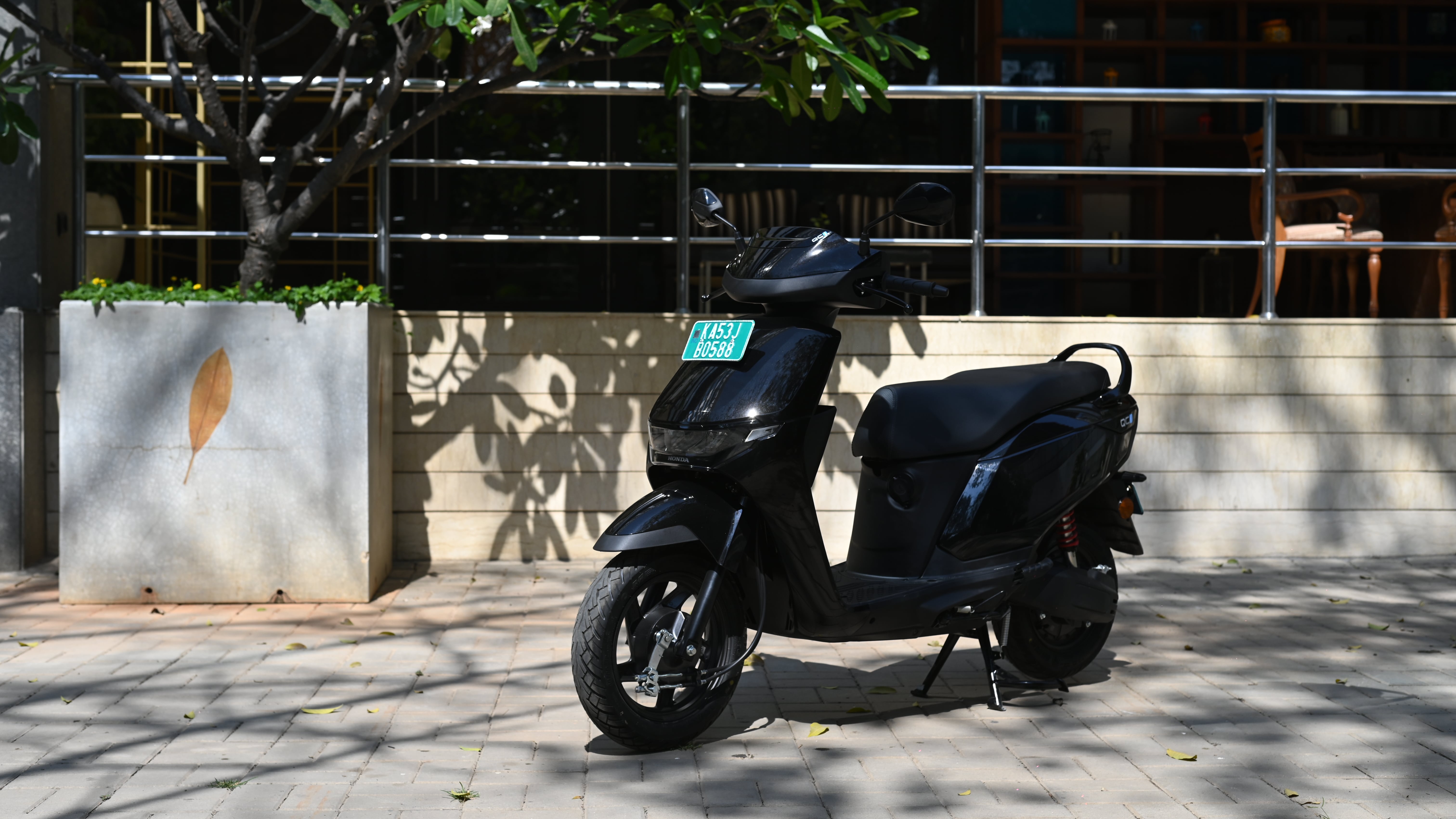
Unlike the Activa e:, the QC1 can be charged at home using its supplied 330-watt off-board charger. Honda’s published figures state a charging time of four hours and 30 minutes from zero to 80 percent, and approximately six hours and 50 minutes for a full charge. It has Standard and Econ riding modes.
The QC1’s equipment is focused on daily utility. It gets a 5-inch LCD instrument display, LED lighting, a USB Type-C charging outlet and 26 litres of under-seat storage. That storage space is a practical advantage over the Activa e:, particularly for riders who carry a helmet, rainwear or small shopping bags.
Its 50 km/h top speed and modest motor output position it primarily as a low-speed urban commuter. It is better suited to short neighbourhood journeys than riders who regularly need faster roads or longer inter-city commutes.
Activa e: vs QC1 – Key Specifications
|
Specification |
Honda Activa e: |
Honda QC1 |
|
Battery configuration |
2 × 1.5 kWh swappable packs |
1.5 kWh fixed battery |
|
Claimed IDC range |
102 km |
80 km |
|
Peak motor power |
6 kW |
1.8 kW |
|
Maximum torque |
22 Nm |
77 Nm (wheel torque, as quoted by Honda) |
|
Top speed |
80 km/h |
50 km/h |
|
Charging / energy access |
Battery exchange at Honda stations |
330 W home charger |
|
Claimed charge time |
Battery swapping |
0–80%: 4 h 30 min; full: 6 h 50 min |
|
Under-seat storage |
Very limited / batteries occupy space |
26 litres |
|
Riding modes |
Econ, Standard, Sport |
Standard, Econ |
|
Display |
5-inch TFT; 7-inch TFT on RoadSync Duo |
5-inch LCD |
Note: Specifications are manufacturer-claimed figures and can vary by variant or model-year update. IDC range is a certified test-cycle figure, not a guarantee of real-world riding distance.
Pricing and Ownership: The Cost Is More Than the Sticker Price
At launch, Honda positioned the QC1 as the more affordable option, while the Activa e: carried a higher entry price and a different battery access model. Honda’s current EV product pages list indicative starting prices of ₹90,708 for the QC1 and ₹1,20,133 for the Activa e:. Prices, city applicability, variant availability and taxes should be reconfirmed with an authorised dealer before purchase.
The Activa e: also requires buyers to understand the battery-as-a-service and swapping arrangement applicable to their purchase. The cost of using the scooter is not determined by the vehicle price alone; battery access plans, subscription charges and station availability can affect the total ownership calculation. This is a key difference from a scooter whose battery is owned by the customer and charged at home.
Honda’s EV Care information lists a complimentary care package that includes three periodic maintenance services, first-year roadside assistance and a vehicle warranty. It also lists a Honda Care Plus package priced at ₹9,900, with a five-year warranty, five-year AMC and five-year roadside assistance. The manufacturer’s current EV Care page should be checked for the latest terms, because its warranty wording and the original launch announcement are not identical.
For readers comparing the economics of electric mobility, our guide to EV charging in India explains the broader charging ecosystem and the difference between home, public AC and DC charging. While the Activa e: uses battery swapping rather than a conventional home charging routine, the same ownership principle applies: access to energy is part of the product.
The Infrastructure Challenge Behind the Activa e:
Battery swapping can be convenient, but only when stations are available where riders live, work and travel. The Activa e: was initially tied to a limited rollout in cities such as Bengaluru, Delhi and Mumbai. That restricted its addressable customer base compared with an electric scooter that can be charged from a domestic power connection.
The QC1 had a simpler infrastructure proposition because it came with a home charger. This helped it reach more cities and made ownership less dependent on a new network being built. Industry reporting on the models’ first year indicated that QC1 deliveries were significantly higher than Activa e: deliveries, with charging convenience and wider availability cited as likely reasons.
The early market response also exposed a broader challenge for established manufacturers entering the EV space. Customers may trust a familiar brand, but they still compare range, performance, storage, price and convenience against products from companies that have been selling electric scooters for several years.
The growth of the segment is real, but buyers remain selective. Our coverage of the BCG report on Indian two-wheeler buyers’ growing openness to EVs looks at changing consumer interest, while our feature on India’s electric scooter boom examines how electric scooter adoption is spreading beyond the largest cities.
What the First-Year Numbers Revealed
Honda’s first year in the electric two-wheeler market was more complicated than the brand’s established position in petrol scooters might have suggested. Autocar India’s February 2026 report, based on industry and registration data, said Honda had produced 11,168 Activa e: and QC1 units between February 2025 and January 2026, dispatched 5,445 units to dealers and delivered 3,723 units to customers. The report also noted that production had remained at zero from August 2025 through January 2026, as dealer inventory accumulated.
These figures should be read as a snapshot of the models’ early rollout, not as proof that Honda was abandoning electric mobility. In July 2026, Honda’s leadership said the company was recalibrating its EV strategy around customer expectations, including concerns about battery life and resale value. Honda also expanded its electric portfolio with the QC3, a more locally developed family scooter.
The QC3 is relevant to the Activa e: and QC1 story because it shows how Honda responded to some of the practical gaps exposed by its first products. It uses a fixed 3 kWh battery, has a claimed IDC range of 145 km, and offers 32 litres of under-seat storage. Honda launched it in September 2026 at ₹1.35 lakh ex-showroom Delhi, with an initial rollout in five cities. The QC3 is a separate model, but its arrival makes clear that Honda’s electric journey is continuing and evolving.
Warranty and After-Sales Support
For an EV buyer, long-term support matters as much as range. Battery health, electronic components, software and the availability of trained technicians can influence confidence in the product. Honda initially announced a three-year or 50,000 km warranty for the Activa e: and QC1, whichever came first, along with three free services and first-year roadside assistance.
Honda’s current EV Care page now describes a standard vehicle warranty of three years or 30,000 km, whichever comes earlier, and outlines the optional Care Plus package. Since published warranty information can change by model, production batch and package, prospective buyers should request the exact warranty booklet applicable to the scooter’s VIN and purchase date.
The company also highlighted EV-specific insulated tools and technician safety procedures when it announced the two scooters. This is an important part of the transition: an electric scooter requires different service knowledge from a conventional petrol model, and the quality and reach of that service network influence real-world ownership.
Who Should Consider Each Scooter?
The Activa e: makes the most sense for riders who live in an area with dependable Honda battery-swapping access, value quicker battery replenishment and want the stronger performance package. The RoadSync Duo variant is the more feature-rich choice for customers who value navigation and connected functions. However, buyers should calculate recurring battery access costs and check the location and operating hours of nearby exchange stations before committing.
The QC1 is more appropriate for short-distance city users who can charge at home and do not need a high top speed. Its fixed battery and under-seat storage make it easier to understand as a daily commuter, while its modest performance and 80 km claimed range place clear limits on its use case.
Neither scooter should be selected on claimed range alone. Consider your average daily distance, passenger use, road speeds, parking arrangement, charging access, service location and the cost of any battery subscription. A test ride and a written ownership-cost estimate are essential.
The Verdict: A Significant First Step, Not the Final Answer
The Honda Activa e: and QC1 marked an important milestone for one of India’s most recognisable two-wheeler manufacturers. Their arrival brought Honda’s engineering and brand familiarity into the electric scooter space, while offering two distinct solutions to the battery question.
The Activa e: demonstrated the potential of a battery-swapping ecosystem, but its usefulness depended on station coverage and the economics of battery access. The QC1 offered a more familiar home-charging routine and practical storage, but its performance and range were deliberately modest. Their early sales experience showed that Indian EV buyers expect a complete ownership proposition—not simply an electric motor and a trusted badge.
Honda’s subsequent QC3 launch suggests that the company is adapting its approach with more range, storage and localisation. The Activa e: and QC1 should therefore be seen as the opening chapter of Honda’s electric journey in India: ambitious in concept, instructive in execution and important for what comes next.