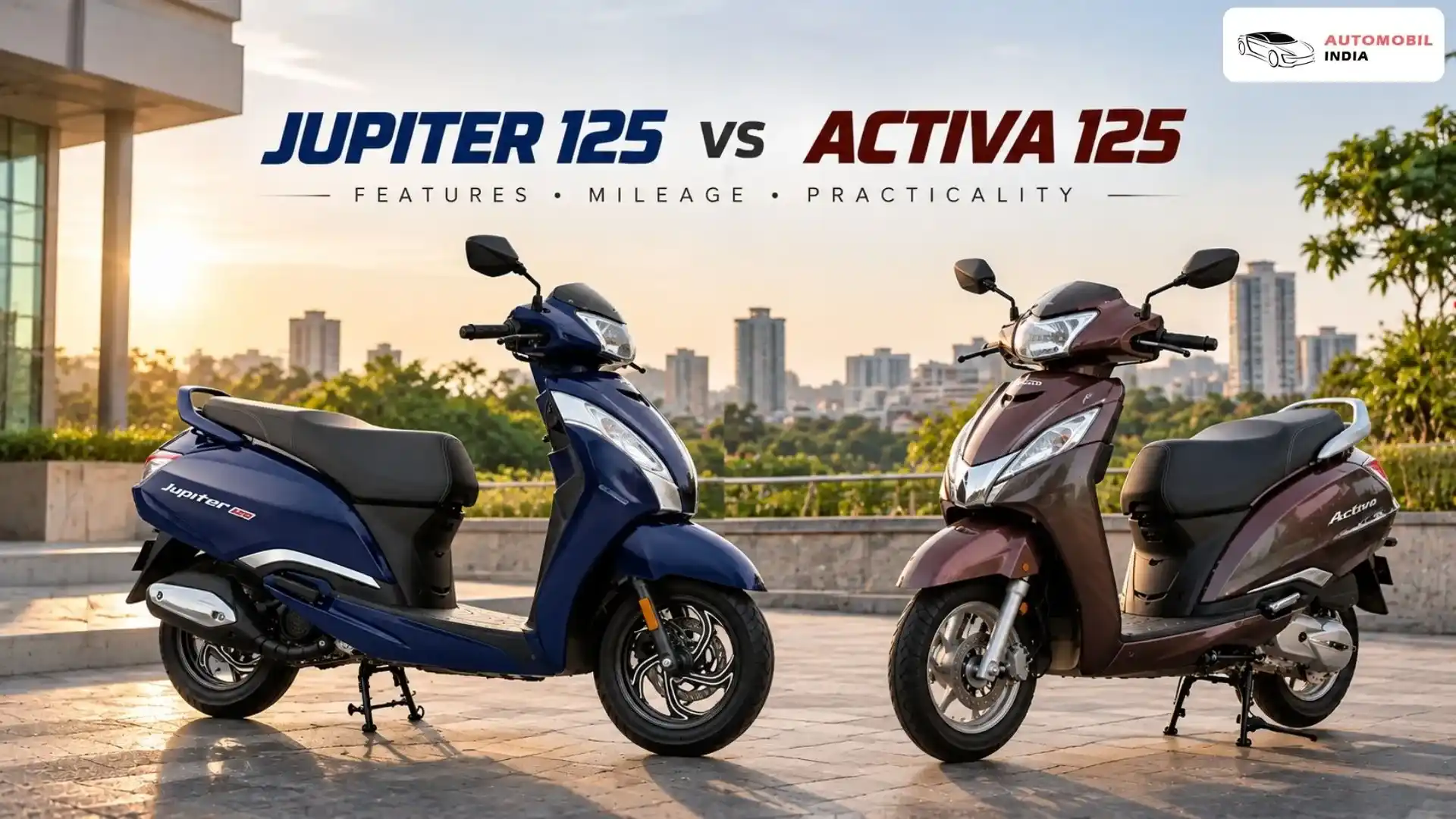
Choosing between the TVS Jupiter 125 and Honda Activa 125 comes down to more than engine capacity. Both are 125cc automatic scooters designed for everyday Indian commuting, but they take different approaches to practicality, comfort, storage, features and convenience.
The Jupiter 125 uses a 124.8cc engine and is rated at 50 kmpl under ARAI testing, while the Activa 125 uses a 123.92cc engine and is rated at around 47 kmpl by current industry references. The Jupiter also stands out with its 33-litre under-seat storage, external fuel filling and 12-inch wheels at both ends. The Activa 125 counters with features such as a TFT display, Honda RoadSync connectivity, H-Smart technology and a 5.3-litre fuel tank.
So, Jupiter 125 vs Activa 125 is essentially a choice between a more practicality-focused package and a feature-rich scooter built around Honda’s established Activa formula.
TVS Jupiter 125 vs Honda Activa 125: Quick Comparison
Specifications and equipment can vary by variant. Prices and equipment should be checked with the respective manufacturer before purchase.
Parameter
TVS Jupiter 125
Honda Activa 125
Engine
124.8cc, single-cylinder
123.92cc, single-cylinder
Transmission
Automatic CVT
Automatic CVT
Max power
Around 8.0 bhp
8.3 bhp
Max torque
10.5 Nm
10.5 Nm
Claimed/official mileage
50 kmpl ARAI
Around 47 kmpl
Fuel tank
5.1 litres
5.3 litres
Front brake
Disc on applicable variants
Disc
Rear brake
Drum
Drum
Front wheel
12-inch
12-inch
Rear wheel
12-inch
10-inch
Under-seat storage
Up to 33 litres
Smaller than Jupiter
Connectivity
SmartXonnect on higher variants
Honda RoadSync on applicable variant
Start-stop
Yes
Yes
Key highlight
Storage and practicality
Smart features and familiar Activa package
TVS Jupiter 125 vs Honda Activa 125 Price
The TVS Jupiter 125 starts at ₹81,700 ex-showroom on TVS India’s current model page, while its higher variants add features such as a front disc brake and SmartXonnect connectivity. TVS currently lists the Jupiter 125 in multiple variants, including Drum Alloy, Disc, DT SXC and SmartXonnect.
For the Honda Activa 125, recent pricing references put the range at roughly ₹90,000-plus ex-showroom, depending on variant and location. Current versions include DLX and H-Smart equipment levels, with Honda also offering an anniversary edition in the present model range.
Price Comparison
Scooter
Approx. ex-showroom positioning
TVS Jupiter 125
From ₹81,700*
Honda Activa 125
Around ₹90,000-plus*
*Prices can vary by location, variant, taxation and manufacturer updates. The final on-road price will be higher after registration, insurance and applicable charges.
For a buyer working with a strict budget, the Jupiter 125’s lower starting price can make it easier to enter the 125cc scooter segment. However, the actual comparison should be made between similarly equipped variants rather than only the cheapest versions.
Engine and Performance
The Jupiter 125 gets a 124.8cc single-cylinder petrol engine producing around 8.0 bhp and 10.5 Nm, paired with a CVT automatic transmission. Its torque output is useful for typical urban riding, where frequent stops, starts and overtaking are more important than outright top speed.
The Activa 125 uses a 123.92cc single-cylinder engine producing 8.3 bhp and 10.5 Nm. It also uses a CVT automatic transmission. The small difference in displacement means both scooters occupy essentially the same performance category rather than representing radically different mechanical packages.
What Does That Mean in Daily Use?
For city commuting, neither scooter needs to be driven aggressively to keep pace with traffic. Their automatic transmissions make them particularly convenient in stop-and-go conditions.
The Activa 125 has a slight advantage on peak power on paper, while the Jupiter’s 10.5 Nm torque output is comparable. In normal urban use, riding position, CVT calibration, rider weight, traffic and road conditions will have a greater effect on the perceived performance than the small numerical difference in engine output.
Jupiter 125 vs Activa 125 Mileage
Mileage is an important consideration for Indian scooter buyers, particularly for people covering 20-50 km every day.
The Jupiter 125 has an ARAI-certified mileage of 50 kmpl, while current references put the Activa 125 at approximately 47 kmpl. Real-world mileage will vary considerably depending on traffic, riding style, tyre pressure, load, maintenance and road conditions.
Mileage Comparison
Mileage measure
Jupiter 125
Activa 125
ARAI/officially cited figure
50 kmpl
Around 47 kmpl
Real-world expectation
Depends on usage
Depends on usage
Transmission
CVT
CVT
Fuel tank
5.1L
5.3L
The Jupiter has the higher certified figure, but the difference should not be treated as a guaranteed real-world advantage. A scooter ridden aggressively through congested traffic can return significantly less than its certified figure.
For example, if two scooters are ridden under different conditions, the scooter with the higher laboratory mileage figure may not necessarily deliver better fuel economy in every owner’s hands.
Practicality: Jupiter 125 Has a Clear Focus
Practicality is one of the strongest areas of the Jupiter 125.
TVS gives the scooter up to 33 litres of under-seat storage, designed to accommodate two helmets, along with an external front fuel-filling arrangement and a front utility/glove box on applicable variants. TVS also lists a 790mm seat and 380mm leg-space measurement among the Jupiter 125’s practical attributes.
This matters in India because scooters frequently serve multiple roles: commuting to work, grocery runs, carrying bags and short family trips.
The Activa 125 also focuses heavily on convenience, offering an open glove box, a 15W USB Type-C charging port and other utility features.
Which Is More Practical?
The Jupiter 125’s larger under-seat storage gives it a particularly useful advantage for riders who regularly carry bags or helmets.
The Activa 125 remains practical for everyday commuting, but buyers who prioritise maximum storage should pay close attention to the Jupiter’s packaging.
Features: Jupiter 125 vs Activa 125
Both scooters have moved well beyond the basic commuter-scooter formula.
TVS Jupiter 125 Features
Depending on the variant, the Jupiter 125 can offer:
SmartXonnect connected digital display
Voice-assisted navigation
Call and notification alerts
Distance-to-empty information
Average and instantaneous fuel-efficiency information
iGO Assist
External fuel filling
Front mobile charging
Large under-seat storage
LED lighting
Adjustable rear suspension
Front disc brake on higher variants
Side-stand indicator and related safety functions
TVS says its SmartXonnect system offers more than 60 connected features on the relevant variant.
Honda Activa 125 Features
The current Activa 125 includes equipment such as:
TFT display
Honda RoadSync connectivity
H-Smart technology
LED headlamp
LED position lamp
Open glove box
15W USB Type-C charging
Start-stop functionality
Front disc brake
Combined Braking System
Tubeless tyres
Honda’s current product page specifically highlights the TFT display, RoadSync connectivity, Smart Key technology and USB-C charging.
Which Has the Better Feature Package?
That depends on what you value.
The Jupiter 125’s feature list is particularly focused on storage, convenience and connected information, while the Activa 125 puts greater emphasis on Honda’s connected technology, Smart Key functionality and a familiar premium scooter experience.
Rather than judging features by their quantity, buyers should consider which ones they will actually use.
Comparing the Jupiter 125 and Activa 125 for your budget?
Browse cars and scooters side by side and see how price, mileage and features stack up before your test ride.
The Jupiter 125 uses a telescopic front suspension and a three-step adjustable rear suspension. Its longer seat and emphasis on ergonomics are designed around everyday comfort.
The Activa 125 also gets telescopic front suspension and a three-step adjustable rear setup. Both scooters therefore offer useful suspension adjustability rather than relying solely on a fixed rear suspension setting.
The difference becomes more noticeable in real-world use depending on the rider’s weight, passenger load and road conditions.
For buyers regularly carrying a pillion, the ability to adjust rear suspension can be useful when roads become rough or the scooter is loaded.
Wheels and Brakes
The Jupiter 125 uses 12-inch wheels at both ends, while the Activa 125 combines a 12-inch front wheel with a smaller 10-inch rear wheel.
Both scooters can be equipped with a front disc brake and rear drum arrangement depending on the version.
The Jupiter’s same-size 12-inch wheel setup can be useful from a stability and ride-quality perspective, particularly over typical broken urban roads. However, wheel size alone does not determine ride quality; suspension tuning, tyre construction, chassis geometry and tyre pressure also matter.
Dimensions and Everyday Ergonomics
The Jupiter’s approximately 765mm seat height gives it a relatively upright, spacious riding position, while the Activa’s lower seat height can make it easier for shorter riders to get their feet down.
This is one specification where a showroom test ride matters more than a comparison table.
A rider around average Indian height may find both manageable, but riders with shorter inseams should specifically test the Activa and Jupiter back-to-back.
Specification
TVS Jupiter 125
Honda Activa 125
Length
1,852 mm
1,850 mm
Front wheel
12-inch
12-inch
Rear wheel
12-inch
10-inch
Seat height
Around 765 mm
Around 712 mm
Fuel tank
5.1L
5.3L
Under-seat storage
Up to 33L
Lower than Jupiter
Technology and Connectivity
Connectivity is no longer limited to premium motorcycles.
The Jupiter 125’s SmartXonnect system can provide navigation assistance, call alerts, social-media notifications, vehicle information and fuel-economy data.
The Activa 125 uses Honda RoadSync, which connects the scooter with a smartphone through Bluetooth and works with its TFT display.
For a rider who simply wants basic scooter information, these systems may not be essential. For commuters who regularly use navigation or want notifications without repeatedly checking their phone, they can be genuinely useful.
Safety and Braking
Neither scooter should be evaluated only by the presence of a disc brake.
The Jupiter 125 uses TVS’s Synchronized Braking Technology (SBT), while the Activa 125 uses Honda’s Combined Braking System (CBS). Both systems are designed to distribute braking forces to improve stability during braking.
The scooters also offer features such as tubeless tyres and side-stand-related safety equipment, depending on the variant.
For Indian urban riding, correct tyre pressure, good tread depth, properly functioning brakes and responsible riding remain just as important as the hardware fitted to the scooter.
Working out the full cost of ownership?
Get an insurance quote alongside the on-road price for each scooter, so you can compare the complete cost before you decide.
For most buyers, ownership cost will depend on four major factors:
Fuel consumption
Service requirements
Tyre and brake wear
Insurance and consumables
The Jupiter’s 50 kmpl certified figure gives it a small paper advantage over the Activa 125’s roughly 47 kmpl figure. However, the difference in fuel cost will depend on annual running.
For example, at 1,000 km per month, a 3 kmpl difference does not automatically translate into a dramatic annual saving. Actual fuel expenditure depends on the petrol price in your city and the mileage you achieve in everyday traffic.
Service availability is another important consideration. Both TVS and Honda have extensive Indian dealer networks, but buyers should check the quality and accessibility of their nearest authorised workshop before purchasing.
Jupiter 125 vs Activa 125: Which One Should You Consider?
There is no universal answer because the two scooters target slightly different priorities.
Choose the TVS Jupiter 125 If You Prioritise:
Larger under-seat storage
Practical family-oriented design
12-inch wheels at both ends
Higher certified mileage figure
External fuel filling
Connected features on higher variants
Adjustable rear suspension
A lower starting price within the current range
Consider the Honda Activa 125 If You Prioritise:
Honda’s established Activa platform
TFT display and RoadSync connectivity
H-Smart technology
Lower seat height
5.3-litre fuel tank
Familiar Activa styling and controls
A straightforward daily commuting package
Jupiter 125 vs Activa 125: Variant Strategy
One of the most important buying tips is not to compare the cheapest Jupiter with the most expensive Activa, or vice versa.
The Jupiter 125’s equipment changes substantially between variants. Its higher versions add features such as SmartXonnect, navigation and front disc braking.
The Activa 125 similarly adds equipment as you move up its variant range, with H-Smart offering additional convenience technology.
The sensible approach is to identify the features you actually need and then compare similarly equipped versions.
Planning to buy a 125cc scooter?
Compare the latest prices, variants, specifications and features before booking your test ride.
Which has better mileage, Jupiter 125 or Activa 125?
The TVS Jupiter 125 has a higher certified mileage figure of 50 kmpl, compared with around 47 kmpl for the Honda Activa 125. Actual mileage will depend on traffic, riding style, load and maintenance.
Which is more powerful, Jupiter 125 or Activa 125?
The Activa 125 produces 8.3 bhp, while the Jupiter 125 produces around 8.0 bhp. Both produce around 10.5 Nm of peak torque.
Which scooter has more storage space?
The TVS Jupiter 125 has up to 33 litres of under-seat storage, giving it a significant practicality advantage for carrying helmets and everyday items.
Does Jupiter 125 have a disc brake?
Yes. Higher variants of the Jupiter 125 are offered with a front disc brake, while the base configuration uses a drum setup.
Does Honda Activa 125 have a TFT display?
Yes. The current Activa 125 is equipped with a 10.67cm TFT display, with Honda RoadSync connectivity on the applicable version.
Which has the bigger fuel tank?
The Honda Activa 125 has a 5.3-litre fuel tank, compared with 5.1 litres for the Jupiter 125.
Which is better for family use?
Both can work well for family commuting. The Jupiter 125 has an advantage for buyers who frequently carry luggage because of its larger storage capacity, while the Activa 125 offers useful convenience and connectivity features.
Which has bigger wheels?
The Jupiter 125 has 12-inch wheels at both ends. The Activa 125 uses a 12-inch front wheel and a 10-inch rear wheel.
Is the Jupiter 125 cheaper than the Activa 125?
The Jupiter 125 has a lower starting price on current manufacturer-listed pricing, while the Activa 125 sits higher depending on variant. Actual on-road prices vary by city and version.
Which scooter should I buy for daily city commuting?
Both are suitable for daily city use. The Jupiter 125 may appeal more to riders who prioritise storage, practicality and mileage, while the Activa 125 may suit buyers who prefer Honda’s technology package, Smart Key system and lower seat height.
Final Verdict: Jupiter 125 vs Activa 125
The TVS Jupiter 125 vs Honda Activa 125 comparison does not produce a single answer for every buyer.
The Jupiter 125 places a stronger emphasis on storage, everyday practicality, wheel size and fuel efficiency, while the Activa 125 combines Honda’s established scooter platform with TFT connectivity, RoadSync and H-Smart convenience features.
For a buyer carrying luggage regularly or using the scooter as a family workhorse, the Jupiter’s storage-focused packaging is particularly relevant. For someone who prefers the Activa’s lower seat, Honda’s connected technology and Smart Key system, the Activa 125 offers a different set of advantages.
The best choice is therefore the one whose equipment, ergonomics and running requirements match your actual daily use rather than simply the scooter with the longer feature list.
Prices, specifications, features, mileage figures and equipment may vary by variant, location and manufacturer updates. Mileage figures are based on certified or reported test conditions and may differ in real-world riding. Please verify the latest details and on-road price with the respective manufacturer or authorised dealer before making a purchase.
Ashish Ahire is an automobile content writer with an interest in the automotive industry, new vehicle launches, automotive technology, and the latest developments in the mobility sector. Through his articles, he aims to present automobile news and updates in a clear, informative, and reader-friendly manner.