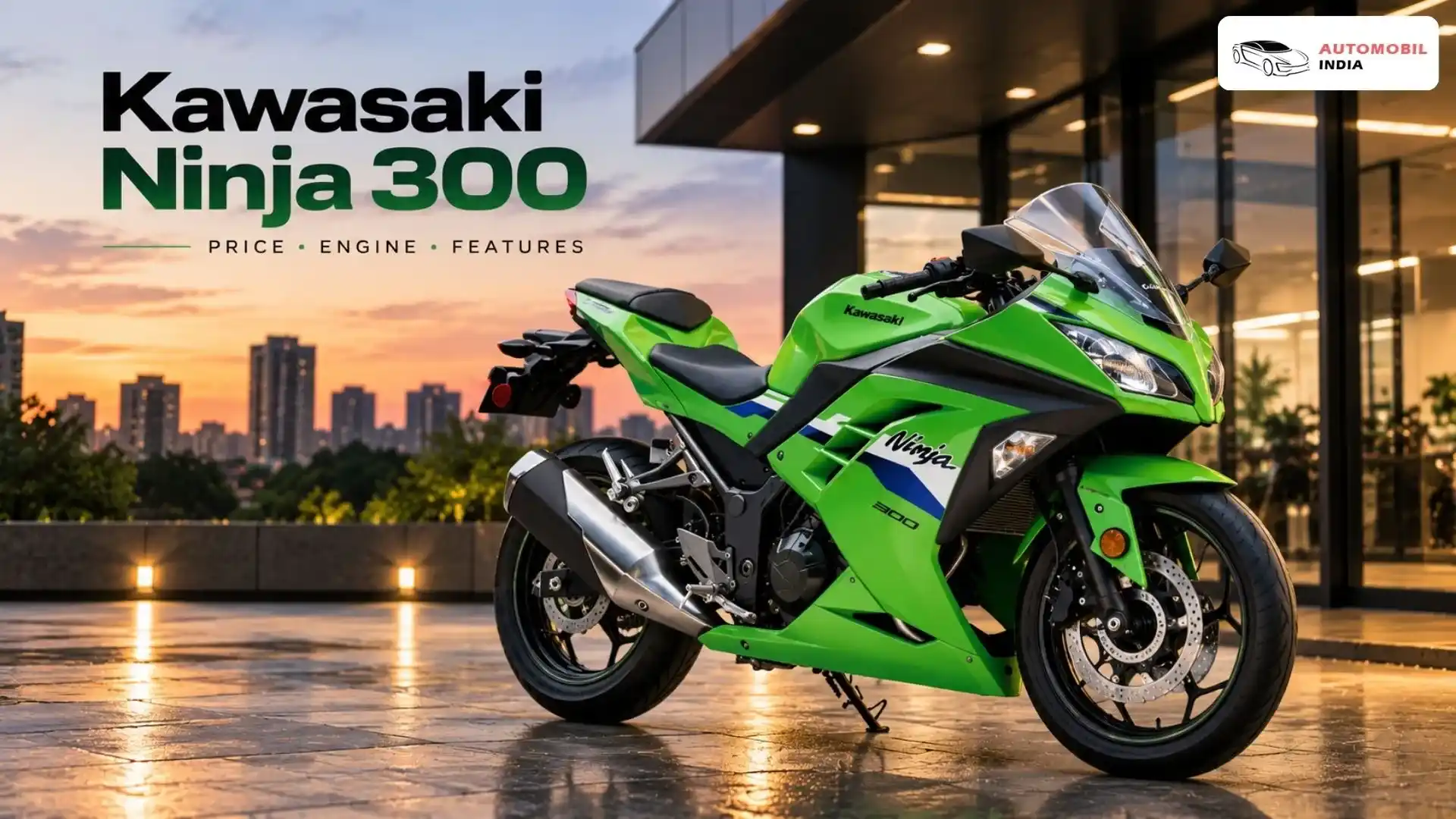
If you are looking for an entry-level fully faired motorcycle with a twin-cylinder engine, the Kawasaki Ninja 300 remains one of the established options in India. For the 2027 model year, Kawasaki has retained the same 296cc parallel-twin engine and core mechanical package, while the ex-showroom price has increased to ₹3.34 lakh. The motorcycle is currently offered in a single Lime Green colour and one variant.
The Ninja 300’s appeal is less about having the newest electronics and more about its compact twin-cylinder engine, familiar Ninja styling, six-speed gearbox and relatively approachable ergonomics. It is worth considering for riders who want a sports bike that can work for both city riding and longer highway trips.
Kawasaki Ninja 300 Price in India
The Kawasaki Ninja 300 price for the 2027 model year is ₹3.34 lakh ex-showroom, Delhi. Kawasaki has retained a single variant. On-road pricing varies substantially by state because of RTO charges and insurance.
For example, the estimated on-road price in Pune is around ₹3.97 lakh, while Pimpri-Chinchwad listings show approximately ₹3.87 lakh, although the final amount can vary with insurance and registration choices.
Price detail
Kawasaki Ninja 300
Ex-showroom price
₹3.34 lakh
Variants
1
Colour
Lime Green
Transmission
6-speed manual
Engine
296cc, parallel-twin
ABS
Dual-channel
Fuel tank
17 litres
Note: Ex-showroom pricing is not the final amount you pay. Registration, insurance and other applicable charges can significantly change the on-road price.
Kawasaki Ninja 300 Variants and Colours
The current Ninja 300 range is straightforward: there is one variant and one colour for the 2027 model year — Lime Green. The latest model does not bring a mechanical or feature upgrade over the previous model year.
This makes the buying process relatively simple because there is no need to choose between multiple engine or equipment variants.
Kawasaki Ninja 300 Engine and Performance
The Ninja 300 is powered by a 296cc, liquid-cooled, parallel-twin petrol engine. It produces approximately 39hp at 11,000rpm and 26.1Nm at 10,000rpm, paired with a six-speed gearbox and an assist-and-slipper clutch.
What does the twin-cylinder engine mean in everyday riding?
The parallel-twin layout is an important part of the Ninja 300’s character. Compared with many single-cylinder motorcycles in the same broad price territory, the engine is designed around smoother power delivery and stronger high-rpm performance.
The six-speed gearbox also gives the motorcycle enough flexibility for highway riding, while the slipper-assist clutch can make clutch operation and aggressive downshifts more manageable.
For a buyer moving up from a 150-200cc motorcycle, the Ninja 300 therefore represents a meaningful step up in engine capacity without moving directly into a much larger 500-650cc motorcycle.
Kawasaki Ninja 300 Specifications
Specification
Kawasaki Ninja 300
Engine
296cc parallel-twin
Cooling
Liquid-cooled
Maximum power
39hp @ 11,000rpm
Maximum torque
26.1Nm @ 10,000rpm
Gearbox
6-speed
Clutch
Assist and slipper
Fuel tank
17 litres
Front suspension
37mm telescopic fork
Rear suspension
Uni-Trak monoshock
Front brake
Disc
Rear brake
Disc
ABS
Dual-channel
Front tyre
110/70 R17
Rear tyre
140/70 R17
Wheel size
17-inch
Seat height
780mm
Ground clearance
140mm
Kerb weight
179kg
The specifications above show that the Ninja 300 is built around a conventional steel chassis, telescopic front fork, rear monoshock and 17-inch alloy wheels.
Is the Ninja 300 easy to handle?
The 780mm seat height is relatively approachable for a fully faired motorcycle, although the 179kg kerb weight is something shorter or less experienced riders should consider during parking and slow-speed manoeuvres.
Its relatively compact dimensions also make it less intimidating than some larger-capacity supersport-style motorcycles.
Thinking about the on-road cost?
Registration and insurance can add significantly to the ex-showroom price. Review your insurance needs before booking.
The Ninja 300 follows a fairly simple equipment philosophy.
Key features include:
Full fairing with Ninja styling
Twin projector-style headlamp setup
LED lighting elements
Semi-digital instrument cluster
Analogue tachometer
Dual-channel ABS
Assist-and-slipper clutch
17-inch alloy wheels
Disc brakes at both ends
Liquid-cooled parallel-twin engine
The current motorcycle does not offer some of the electronic features found on newer competitors, such as ride modes, traction control, smartphone connectivity or a TFT instrument cluster.
That distinction is important when comparing the Ninja 300 with newer motorcycles: its appeal is primarily mechanical rather than technology-led.
Kawasaki Ninja 300 Mileage
Mileage depends heavily on riding style, traffic, throttle use and maintenance.
Autocar India’s testing recorded approximately 27.48kmpl in city conditions and 29.31kmpl on the highway, while its user-reported figure is around 25.59kmpl.
Riding condition
Reported figure
City, tested
27.48kmpl
Highway, tested
29.31kmpl
User-reported
25.59kmpl
With a 17-litre fuel tank, the Ninja 300 has the capacity for long stretches between fuel stops. Actual range will depend on how and where the motorcycle is ridden.
Can the Ninja 300 be used as a daily bike?
Yes, but the answer depends on what you expect from a daily motorcycle.
The manageable seat height, relatively compact dimensions and smooth twin-cylinder configuration can make it usable for commuting. However, the full fairing, riding posture and 179kg kerb weight mean it is not as effortless in congested urban traffic as a typical commuter motorcycle.
For someone whose daily commute includes open roads or expressways and who also wants to tour on weekends, the package makes more sense.
Kawasaki Ninja 300 for Highway Riding
The Ninja 300’s combination of a 296cc twin-cylinder engine, six-speed transmission and full fairing gives it a clear highway-oriented character.
The 17-litre tank is also useful for touring because it reduces the need for frequent fuel stops. The riding position is sporty but not as extreme as larger supersport motorcycles, making it more suitable for riders who want a balance between performance and everyday usability.
However, buyers should remember that the Ninja 300 is still a compact sports motorcycle. It is not designed to provide the upright comfort or luggage practicality of an adventure or touring motorcycle.
Kawasaki Ninja 300 Safety
The most significant standard safety equipment is dual-channel ABS, with disc brakes at both ends.
ABS can help reduce the likelihood of wheel lock during hard braking, particularly when road grip changes because of rain, dust or emergency braking situations.
The motorcycle does not currently have traction control or a suite of electronic rider aids.
This does not mean the motorcycle lacks basic safety equipment; rather, its safety package is more conventional than that of some newer performance motorcycles.
Kawasaki Ninja 300 Design and Comfort
The Ninja 300 retains the characteristic fully faired Kawasaki sports-bike appearance, including its sharp fairing and compact tail section.
The design has remained familiar for several years, which can be seen as part of its identity. However, buyers specifically looking for the latest-generation digital cockpit or aggressively updated styling may find newer motorcycles more modern.
The 780mm seat height is one of the more practical aspects of the package.
Ready to explore your options?
Explore more bikes, compare specifications and find the right motorcycle for your budget. Get in touch if you’d like help.
Kawasaki Ninja 300 Ownership: What Should You Know?
Buying a performance motorcycle involves more than comparing engine displacement and showroom price.
Service and maintenance
Routine maintenance includes engine oil, filters, chain maintenance, brake inspection, tyres and other consumables. Costs can vary depending on usage, service interval, parts and the dealership.
Kawasaki’s specialised motorcycle network is another factor worth checking before purchase, particularly if you live outside a major city. Availability of authorised service support and parts should be confirmed for your location.
Tyres and consumables
The Ninja 300 uses relatively wide 17-inch tyres — 110/70 at the front and 140/70 at the rear.
Tyre replacement costs can therefore be considerably higher than those of a typical 150cc commuter motorcycle.
Insurance
Insurance costs also matter because the Ninja 300 is a higher-value performance motorcycle. Buyers should compare comprehensive insurance premiums and coverage rather than looking only at the ex-showroom price.
Kawasaki Ninja 300: Pros and Cons
Pros
296cc parallel-twin engine
Six-speed gearbox
Full-faired sports-bike design
Approachable 780mm seat height
Dual-channel ABS
17-litre fuel tank
Useful combination of city and highway capability
Cons
Limited electronic equipment compared with newer rivals
No traction control or riding modes
Instrument cluster is relatively conventional
Maintenance and consumable costs can be higher than smaller motorcycles
Only one variant and one colour for MY2027
Kawasaki Ninja 300 vs Rivals
The Ninja 300 sits in an interesting part of India’s performance-bike market. Depending on budget, buyers may also consider motorcycles such as the TVS Apache RR 310, KTM RC 390 and BMW G 310 RR.
The Ninja 300’s biggest mechanical differentiator is its parallel-twin engine. The alternatives use different engine configurations and offer different combinations of performance, electronics, equipment and pricing.
For example, the Ninja 300 uses a 296cc twin-cylinder engine and dual-channel ABS, while its current rivals can offer newer electronics and equipment. Autocar India lists the TVS Apache RR 310 and KTM RC 390 among its direct entry-level supersport alternatives.
Rather than choosing purely on engine capacity, buyers should compare:
Engine character
Riding position
Electronic equipment
Service availability
Spare-part costs
Insurance
Highway usage
City usability
Long-term ownership expectations
Who Should Buy the Kawasaki Ninja 300?
The Ninja 300 can make sense for:
First-time sports-bike buyers: The relatively accessible seat height and manageable dimensions can make it a reasonable step into the fully faired segment.
Highway-focused riders: The twin-cylinder engine, six-speed gearbox and 17-litre tank suit riders who regularly undertake longer rides.
Riders who prefer mechanical simplicity: Buyers who are less concerned about having the newest electronics may appreciate the conventional approach.
Ninja fans: The motorcycle offers Kawasaki’s familiar Ninja styling without moving to the company’s more expensive middleweight models.
Who Should Consider Something Else?
A different motorcycle may make more sense if your priority is:
Maximum electronic equipment
A TFT display and smartphone connectivity
Lower purchase price
More aggressive performance
Adventure-bike practicality
Extensive service availability in smaller cities
The right choice depends on the combination of performance, equipment and ownership requirements rather than displacement alone.
Is the Kawasaki Ninja 300 Worth Considering in India?
The current Kawasaki Ninja 300 is an interesting example of a motorcycle that has remained mechanically familiar while the surrounding market has evolved.
Its 296cc parallel-twin engine, six-speed gearbox, full fairing, dual-channel ABS and 17-litre tank continue to give it a distinct character. At the same time, its conventional instrumentation and lack of modern electronic rider aids mean buyers should understand what they are getting before purchasing.
At ₹3.34 lakh ex-showroom for MY2027, the key question is therefore not simply whether the Ninja 300 has enough performance. It is whether its twin-cylinder engine, styling and established mechanical package match your priorities better than newer motorcycles with more equipment.
Comparing the Ninja 300 with other performance bikes?
Talk to the Automobil India team about your requirements before choosing your next motorcycle.
The 2027 Kawasaki Ninja 300 is priced at ₹3.34 lakh ex-showroom in Delhi. On-road prices vary by city because of registration and insurance costs.
How many variants of the Ninja 300 are available?
The current Ninja 300 is offered in one variant in India.
What engine does the Kawasaki Ninja 300 use?
It uses a 296cc liquid-cooled parallel-twin petrol engine producing around 39hp and 26.1Nm.
What mileage does the Kawasaki Ninja 300 deliver?
Autocar India’s tests recorded 27.48kmpl in the city and 29.31kmpl on the highway. User-reported mileage is around 25.59kmpl. Actual results vary with riding conditions.
Does the Ninja 300 have ABS?
Yes. The motorcycle is equipped with dual-channel ABS.
Does the Ninja 300 have traction control?
No. The current Ninja 300 does not offer traction control.
Does the Kawasaki Ninja 300 have a slipper clutch?
Yes. It uses an assist-and-slipper clutch with its six-speed transmission.
What is the Ninja 300’s seat height?
The seat height is 780mm.
Is the Ninja 300 suitable for long rides?
Its twin-cylinder engine, six-speed gearbox, full fairing and 17-litre fuel tank make it suitable for highway and touring use. However, comfort is subjective, so a proper test ride is advisable before purchase.
What are the main alternatives to the Ninja 300?
The TVS Apache RR 310, KTM RC 390 and BMW G 310 RR are among the motorcycles buyers may cross-shop in this segment, although their engines, equipment and pricing differ.
Prices, specifications, features, mileage and availability can change based on manufacturer updates, location, model year and other factors. Please verify the latest details with an authorised Kawasaki dealer before making a purchase.
Have a question about the Ninja 300?
Talk to the Automobil India team about your requirements.
Ashish Ahire is an automobile content writer with an interest in the automotive industry, new vehicle launches, automotive technology, and the latest developments in the mobility sector. Through his articles, he aims to present automobile news and updates in a clear, informative, and reader-friendly manner.