India’s passenger-vehicle market continues to operate at a high volume, with SUVs, compact cars, CNG vehicles, hybrids and EVs all shaping the market. The latest available data shows that August 2026 was a particularly strong month for retail sales, while September 2026 saw manufacturers increase dispatches ahead of the festive season.
For readers tracking India car sales, it is important to distinguish between two different numbers: retail registrations, which represent vehicles registered with customers, and wholesale/dispatch sales, which represent vehicles shipped by manufacturers to dealers.
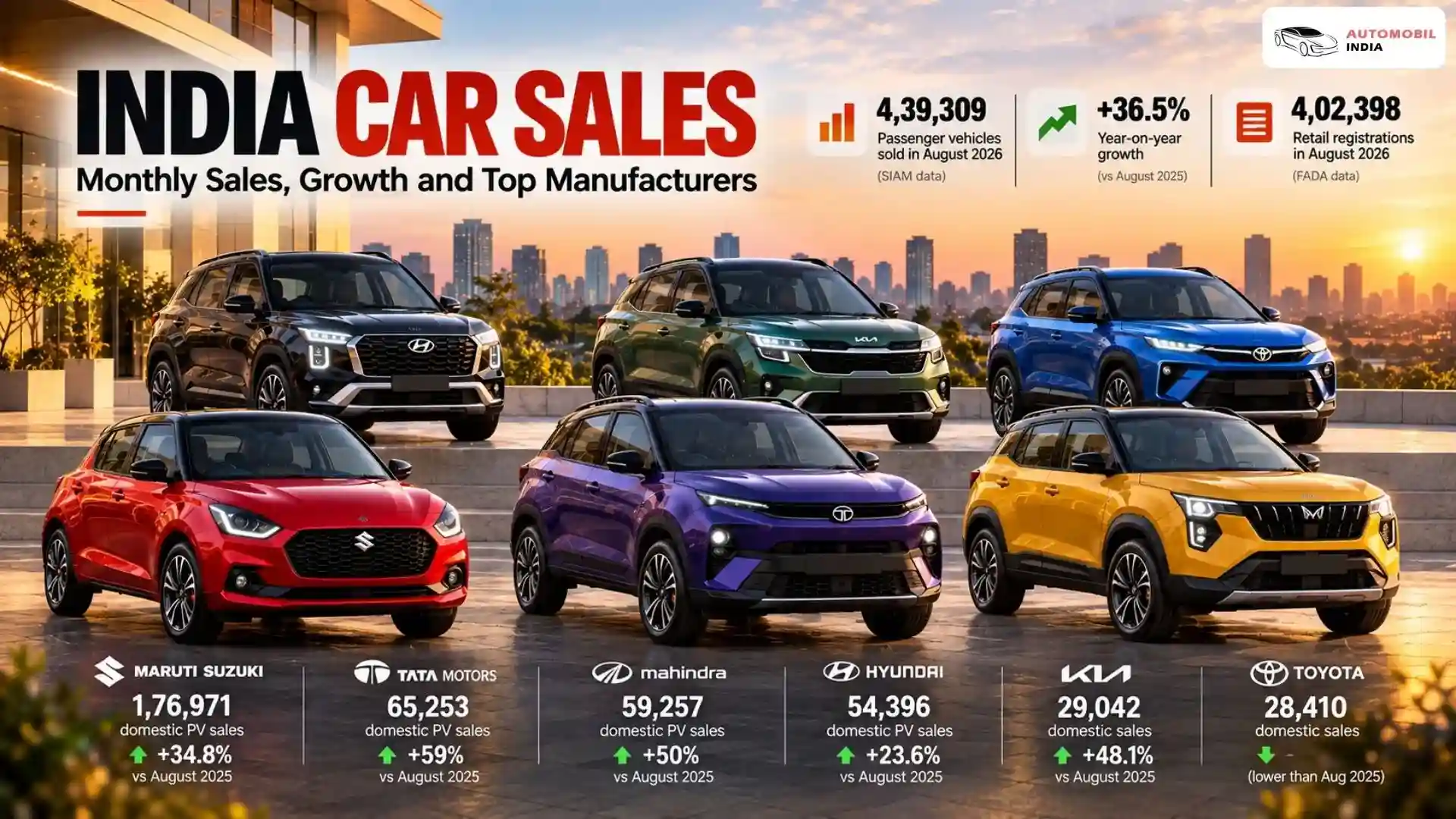
The latest complete FADA retail data for August 2026 recorded 4,02,398 passenger-vehicle registrations, up 16.14% year on year and the first time monthly August retail sales crossed four lakh units.
September data released on October 1 shows manufacturers increasing vehicle dispatches as dealers prepared inventory for the festive season. Reuters also reported that automakers posted higher September sales as dealers stocked up ahead of the festive period.
India Car Sales: Latest Market Update
The Indian passenger-vehicle market entered the festive season with strong momentum.
In August 2026, retail passenger-vehicle registrations reached 4,02,398 units, compared with 3,46,468 units in August 2025. That represented 16.14% year-on-year growth.
The wholesale market was even stronger. SIAM reported 4,39,309 passenger vehicles sold domestically in August 2026, a 36.5% increase over August 2025. SIAM also noted that the previous year’s lower base contributed to the unusually high growth rate.
September 2026: Why the Numbers Need Context
September is different because manufacturer dispatches can rise ahead of the festive season without immediately translating into equivalent customer registrations.
Manufacturers increased dealer inventory during September, anticipating higher demand around Navratri, Dussehra and the wider festive period. Reuters reported that automakers were also using financing offers, discounts and new-model launches to support demand.
Therefore, September wholesale figures should not automatically be interpreted as September customer purchases.
Top Car Manufacturers in India
Based on the latest completed August 2026 retail data, the leading passenger-vehicle manufacturers were:
Rank
Manufacturer
August 2026 Retail Sales
YoY Growth
Market Share
1
Maruti Suzuki
1,65,200
+22.83%
41.05%
2
Tata Motors
57,841
+40.49%
14.37%
3
Mahindra
50,245
+6.41%
12.49%
4
Hyundai
46,987
+4.84%
11.68%
5
Toyota
24,856
-9.94%
6.18%
6
Kia
23,371
+17.60%
5.81%
7
Skoda Volkswagen Group
7,469
-17.64%
1.86%
8
MG
5,784
-13.01%
1.44%
9
Honda
4,968
+12.37%
1.23%
10
Renault
3,275
+25.10%
0.81%
The figures are based on FADA retail registrations reported for August 2026.
Maruti Suzuki
Maruti Suzuki remained India’s largest passenger-vehicle manufacturer by a considerable margin, with 1,65,200 retail registrations in August.
Its 41.05% retail market share was almost three times that of the second-ranked Tata Motors. The company’s broad portfolio across hatchbacks, compact SUVs, MPVs and CNG models continues to give it substantial coverage across different price segments.
Tata Motors
Tata Motors recorded 57,841 retail registrations in August, up 40.49% year on year.
Its 14.37% retail share put it ahead of Mahindra. Tata’s portfolio also has a significant electrified component, making its sales performance useful for tracking the changing fuel mix in the Indian market.
Mahindra
Mahindra & Mahindra registered 50,245 passenger vehicles in August, up 6.41% year on year.
SUVs remain central to Mahindra’s passenger-vehicle business. The company subsequently reported domestic SUV dispatches of 64,092 units in September 2026, up 14% year on year.
Hyundai
Hyundai Motor India recorded 46,987 retail registrations in August, an increase of 4.84% over August 2025.
For September, Hyundai reported 57,166 domestic sales and total sales of 77,916 units including exports, representing its highest-ever monthly total according to the company.
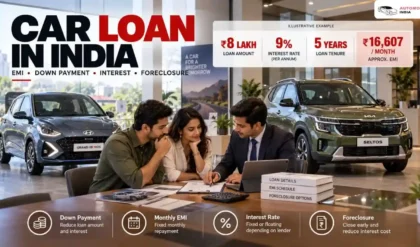
Thinking about financing your next car?
Compare loan amounts, down payments and tenures that fit your budget before you buy.
Several factors are influencing the market rather than a single trend.
1. SUV Demand
SUVs and SUV-styled vehicles remain a major part of the Indian passenger-vehicle market.
Manufacturers have responded by expanding their portfolios across compact SUVs, mid-size SUVs, three-row SUVs and electric SUVs. This has also changed the traditional definition of India’s car market, where hatchbacks once accounted for a much larger proportion of sales.
2. Festive-Season Buying
September and October are particularly important months for the Indian automotive industry.
Manufacturers typically increase dealer inventory before major festivals so that customers have greater availability of popular variants and colours. Reuters reported that this stocking contributed to higher September manufacturer sales.
For buyers, this can also mean greater availability of promotional finance schemes, exchange benefits and model-specific discounts.
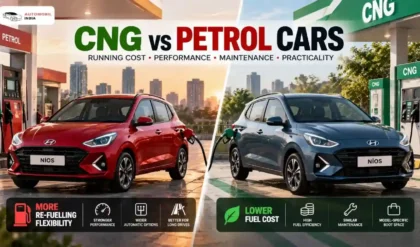
3. CNG, Hybrid and EV Adoption
The fuel mix is also changing.
FADA’s August 2026 retail data showed petrol/ethanol vehicles accounting for 40.85% of passenger-vehicle sales. CNG/LPG accounted for 25.28%, hybrids 9.04% and EVs 7.63%. Together, CNG/LPG, hybrids and EVs represented almost 42% of passenger-vehicle retail sales.
This does not mean petrol and diesel vehicles are disappearing. Instead, Indian buyers increasingly have several powertrain options within the same vehicle segment.
India Car Sales: Wholesale vs Retail Sales
This distinction is particularly important when comparing monthly numbers.
Metric
What it means
Main use
Wholesale sales
Vehicles dispatched by manufacturers to dealers
Measures manufacturer shipments
Retail sales
Vehicles registered with customers
Better indicator of actual registrations
Market share
Manufacturer’s share of the relevant market
Measures competitive position
YoY growth
Change versus same month last year
Shows annual growth
MoM growth
Change versus previous month
Shows short-term movement
A manufacturer can report strong wholesale growth while retail registrations remain weaker because dealers may be building inventory.
Conversely, strong retail sales can temporarily reduce dealer inventory and subsequently affect future wholesale dispatches.
For this reason, India car sales figures should always be read alongside their methodology and time period.
August 2026: Top-Selling Cars
The model-level rankings provide another view of the market.
The Tata Punch led the August 2026 retail/dispatch ranking reported by Autocar India with 21,320 units, followed by the Maruti Suzuki Wagon R and Maruti Suzuki Swift.
Rank
Model
August 2026 Sales
1
Tata Punch
21,320
2
Maruti Suzuki Wagon R
20,180
3
Maruti Suzuki Swift
19,832
4
Maruti Suzuki Fronx
18,730
5
Maruti Suzuki Ertiga
18,516
6
Tata Nexon
18,431
7
Maruti Suzuki Dzire
18,418
8
Hyundai Creta
16,288
9
Maruti Suzuki Baleno
15,746
10
Mahindra Scorpio
15,576
The top 10 models together accounted for 1,83,037 units in August 2026, compared with 1,37,334 units in August 2025.
Shopping for one of these models?
Browse available cars and compare your shortlisted models before making a decision.
Sales rankings are useful, but they should not be treated as a direct measure of whether a particular car is suitable for every buyer.
High sales can indicate strong market acceptance, wide availability and a large customer base. However, factors such as safety equipment, engine choice, comfort, fuel economy, pricing, service coverage and intended usage remain important when selecting a car.
For example, a buyer who primarily drives in a congested city may value a compact CNG or hybrid vehicle differently from someone who regularly travels on highways with a family.
Sales data is therefore best used as market context rather than a substitute for a vehicle comparison.
India Car Sales Outlook for the Festive Season
The immediate market environment remains closely connected to festive demand.
September manufacturer sales benefited from dealer stocking ahead of the festive period, while August retail passenger-vehicle registrations had already crossed the four-lakh mark.
Manufacturers are also entering the period with new products, updated models and additional electrified options.
However, monthly growth rates should be interpreted carefully. August 2026’s strong year-on-year growth partly reflected a relatively weak base in August 2025, when some buyers delayed purchases amid expectations around GST changes.
This means a high percentage growth figure does not necessarily mean the same rate of growth will continue every month.
India Car Sales: What to Watch Next
The key indicators to follow in the coming months include:
Festive-season retail registrations
SUV demand across compact, midsize and three-row segments
CNG and hybrid adoption
EV registrations and new EV launches
Dealer inventory levels
Monthly price increases and discounts
New model launches and major facelifts
Rural demand and financing conditions
Fuel-price movements
Changes in the overall passenger-vehicle mix
For buyers, October and November sales data may provide a clearer picture of actual festive-season customer demand than September dispatch figures alone.
Planning to buy during the festive season?
Compare loan options and current offers before you book your next car.
The latest completed FADA retail data available at the time of this update is for August 2026, when passenger-vehicle registrations reached 4,02,398 units, up 16.14% year on year.
Which car manufacturer sells the most cars in India?
Maruti Suzuki was the largest passenger-vehicle manufacturer by August 2026 retail sales, recording 1,65,200 registrations and a 41.05% market share.
Which car was India’s best-selling model in August 2026?
The Tata Punch recorded 21,320 units in August 2026 and topped the model-level sales ranking reported by Autocar India.
Are India car sales figures retail or wholesale?
Both types are published. Retail figures refer to vehicles registered with customers, while wholesale figures generally refer to vehicles dispatched by manufacturers to dealers. They should not be directly treated as identical measures.
Why were India car sales strong in August 2026?
Passenger-vehicle retail sales benefited from improving demand and festive-season preparation, while the wholesale market also benefited from a lower year-ago base and dealer stocking. SIAM reported 36.5% wholesale growth in August, while FADA reported 16.14% retail growth.
Are SUVs still driving India car sales?
SUVs remain a major driver of the passenger-vehicle market, with manufacturers continuing to expand their compact, midsize, three-row and electric SUV portfolios. Mahindra’s September 2026 domestic SUV dispatches, for example, rose 14% year on year to 64,092 units.
Are EV sales increasing in India?
Yes, EVs are taking a larger share of passenger-vehicle sales, although petrol, diesel, CNG and hybrid vehicles continue to account for most of the market. FADA’s August data showed EVs at 7.63% of passenger-vehicle retail sales.
Which factors should buyers consider beyond car sales rankings?
Buyers should consider the vehicle’s price, safety equipment, crash-test performance where available, engine and transmission, fuel economy, features, space, comfort, service network, running costs and suitability for their driving pattern.
Why can manufacturer sales be different from registration numbers?
Manufacturer sales generally reflect vehicles dispatched to dealers, while registration data records vehicles registered by customers. Inventory movement between manufacturers, dealers and customers means the two figures can differ significantly in an individual month.
Sales figures can vary depending on whether they represent manufacturer dispatches, wholesale sales or customer registrations. Figures and market conditions can also be revised as additional data becomes available. Always check the latest manufacturer, FADA or SIAM data before making purchase or business decisions.
Have a question about buying during the festive season?
Talk to the Automobil India team about your requirements.
Ashish Ahire is an automobile content writer with an interest in the automotive industry, new vehicle launches, automotive technology, and the latest developments in the mobility sector. Through his articles, he aims to present automobile news and updates in a clear, informative, and reader-friendly manner.