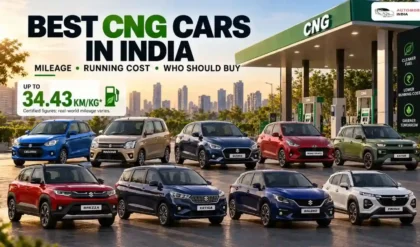

The best cars for city driving in India need to do more than simply have a small footprint. A good urban car should be easy to manoeuvre through crowded roads, simple to park, comfortable in stop-and-go traffic and economical enough for frequent daily use.
For many buyers, an automatic transmission can make a bigger difference to everyday comfort than a long list of premium features. Fuel choice also matters: a petrol car may suit moderate urban running, while CNG can make sense for drivers covering high daily kilometres and with convenient access to CNG stations.
Among the current options, the Hyundai Grand i10 Nios, Maruti Suzuki Celerio, Hyundai Exter, Hyundai i20, Maruti Suzuki Baleno, Tata Tiago and Maruti Suzuki WagonR cover different city-driving requirements.
There is no single best city car for everyone. A first-time buyer looking for an affordable automatic has different requirements from a daily commuter covering 60–80km or a family that wants a compact car with more cabin and luggage space.
What Makes a Car Good for City Driving?
City driving places very different demands on a vehicle compared with highway driving.
The most useful characteristics include:
- Compact exterior dimensions
- Good visibility
- Light and predictable steering
- Small turning radius
- Easy-to-use automatic transmission
- Strong low-speed drivability
- Good fuel efficiency
- Comfortable suspension
- Effective air-conditioning
- Easy parking
- Useful safety equipment
- Affordable routine maintenance
- Sufficient boot space for everyday requirements
A smaller car is not automatically better, however.
An extremely compact hatchback may be easy to park but can compromise rear-seat space and luggage capacity. Conversely, a larger SUV may offer more comfort but become inconvenient in narrow streets and crowded parking areas.
The ideal choice is therefore a balance between size, practicality, efficiency and comfort.
Best City Cars in India: Quick Comparison
| Car | Body style | City-friendly powertrain options | Why consider it? | Best suited to |
|---|---|---|---|---|
| Maruti Suzuki Celerio | Hatchback | Petrol / CNG, AMT | Compact dimensions and strong claimed efficiency | Mileage-focused urban users |
| Hyundai Grand i10 Nios | Hatchback | Petrol / CNG, AMT | Compact footprint, features and comfort | Daily family commuting |
| Hyundai Exter | Compact SUV | Petrol / CNG, AMT | Higher seating position and city-friendly size | Buyers wanting SUV styling |
| Maruti Suzuki WagonR | Tall hatchback | Petrol / CNG, AMT | Excellent urban practicality and cabin space | Family-focused city users |
| Tata Tiago | Hatchback | Petrol / CNG, AMT | Multiple powertrain choices and compact footprint | Value-conscious buyers |
| Maruti Suzuki Baleno | Premium hatchback | Petrol, AMT/automatic depending on variant | More space and practicality than smaller hatchbacks | Small families |
| Hyundai i20 | Premium hatchback | Petrol, manual/IVT depending on variant | Premium cabin and comfortable urban use | Buyers wanting more features |
1. Maruti Suzuki Celerio: For Buyers Who Prioritise Mileage and Compact Dimensions
The Maruti Suzuki Celerio is one of the most straightforward choices for buyers who spend most of their time in urban traffic.
Its relatively compact dimensions make it easy to manoeuvre through narrow streets and crowded parking areas. The car is also available with a CNG powertrain for buyers who want to reduce running costs.
Maruti Suzuki currently lists the Celerio with petrol and S-CNG options, while automatic variants use the company’s AGS automated manual transmission. The manufacturer quotes a certified fuel-efficiency figure of 26.00km/l for the petrol automatic variants listed on its website.
Why the Celerio makes sense in cities
The biggest advantages are:
- Compact footprint
- Easy manoeuvrability
- Automatic transmission availability
- Petrol and CNG choices
- Strong certified efficiency figure
- Relatively straightforward ownership proposition
The Celerio’s small dimensions are especially useful in cities where parking space is limited.
What about the AMT?
The Celerio’s AGS is an automated manual transmission, rather than a conventional torque-converter automatic or CVT.
That distinction matters.
An AMT removes the need to operate the clutch manually, making it considerably easier than a manual in traffic. However, gear changes can feel different from those of a smoother conventional automatic.
For buyers whose main priority is affordable automatic convenience, it remains worth considering.
Best suited to: Buyers prioritising compact dimensions, efficiency and affordable automatic driving.
2. Hyundai Grand i10 Nios: A Well-Rounded Urban Hatchback
The Hyundai Grand i10 Nios is designed around the needs of everyday urban users.
It measures 3,815mm in length, making it considerably easier to place on crowded city roads than larger sedans and SUVs. Hyundai offers a 1.2-litre petrol engine, petrol AMT variants and a CNG option.
The current petrol engine produces 83PS, while the CNG version produces 69PS.
Why consider the Grand i10 Nios?
The Grand i10 Nios combines its compact footprint with a relatively broad equipment package.
Depending on the variant, buyers can get:
- 8-inch touchscreen infotainment
- Wireless connectivity on selected variants
- Rear AC vents
- Cruise control
- Automatic climate control
- Rear camera
- TPMS
- Six airbags
- ESC on applicable variants
- Hill-start assist on applicable variants
Hyundai currently offers petrol AMT variants across multiple trims.
The company also introduced the VIBE edition, which adds features including a factory-fitted dashcam, black-and-red interior treatment and other equipment.
Why it works particularly well in traffic
The Grand i10 Nios is small enough for crowded urban roads but doesn’t feel as stripped-down as some entry-level hatchbacks.
That makes it particularly relevant to buyers who want a daily commuter that can also handle family duties.
Best suited to: Buyers wanting a compact hatchback with a comfortable cabin, automatic option and useful features.
3. Hyundai Exter: For Buyers Who Want a Compact SUV
The Hyundai Exter is aimed at buyers who want the appearance and seating position of an SUV without moving into a larger vehicle.
The current Exter measures 3,830mm long, 1,723mm wide and 1,643mm tall. Its 185mm ground clearance also gives it a more SUV-like stance.
Hyundai offers a 1.2-litre petrol engine producing 83PS and 113.8Nm, with manual and Smart Auto AMT options. A factory-fitted CNG option is also available.
Why the Exter makes sense for city driving
The Exter offers a useful combination of:
- Compact overall length
- Higher seating position
- 185mm ground clearance
- AMT option
- Petrol and CNG powertrains
- Six airbags as standard
- ESC and hill-start assist
- TPMS
- Rear parking camera
- Modern infotainment and connectivity
Hyundai’s latest Exter also offers a factory-fitted dual-camera dashcam on selected equipment levels.
What about parking?
The Exter’s relatively short length is an advantage in urban environments.
It isn’t as tiny as a Celerio, but it gives buyers more SUV-like cabin packaging while remaining considerably easier to place than a midsize SUV.
Best suited to: Buyers who want compact dimensions but prefer an SUV-style driving position.
4. Maruti Suzuki WagonR: Practicality for Everyday City Use
The Maruti Suzuki WagonR has remained relevant in the Indian urban market largely because of its practical packaging.
Its tall-body design prioritises cabin space relative to its footprint, making it useful for buyers who regularly carry family members.
The WagonR is also available with petrol and CNG powertrains, along with an AGS automatic option on applicable variants.
Why consider the WagonR?
Its strengths are primarily practical:
- Tall cabin
- Easy ingress and egress
- Good visibility
- Compact footprint
- CNG availability
- Automatic option
- Practical rear-seat access
This makes it particularly useful for families that want a city car rather than a car designed primarily around driving enjoyment.
Who should consider it?
The WagonR is particularly relevant to buyers who regularly use the car for:
- Office commuting
- School runs
- Shopping
- Family errands
- Short urban trips
It is less about premium styling and more about making daily urban transportation easy.
Best suited to: Families prioritising cabin practicality and ease of use.
5. Tata Tiago: A Compact Hatchback With Multiple Powertrain Choices
The Tata Tiago remains another important option in the city-car segment.
Its compact hatchback body makes it easier to manoeuvre and park than larger cars, while the availability of petrol, CNG and automatic configurations gives buyers several ways to configure the car around their usage.
Why consider the Tiago?
The Tiago can appeal to buyers who want:
- Compact dimensions
- Petrol and CNG choices
- Automatic convenience
- A practical hatchback body
- A feature-rich cabin depending on variant
- A relatively affordable entry point
The CNG version can be particularly relevant for high-mileage urban users who have reliable access to CNG refuelling.
CNG or petrol?
For someone covering a large number of kilometres every month, CNG can potentially reduce running costs.
However, the decision should include:
- Local CNG availability
- Purchase-price difference
- Expected annual kilometres
- Boot requirements
- Refuelling convenience
Don’t choose CNG simply because the fuel is cheaper per kilometre; calculate the payback period based on your actual monthly running.
Best suited to: Buyers looking for a compact, practical car with multiple fuel and transmission choices.
6. Maruti Suzuki Baleno: For More Space Without Moving to an SUV
The Maruti Suzuki Baleno occupies a useful middle ground between small hatchbacks and larger SUVs.
It offers more cabin and luggage practicality than entry-level urban hatchbacks while retaining a relatively manageable footprint.
For buyers who drive primarily in the city but regularly carry passengers, this additional space can matter.
Why consider the Baleno?
The Baleno makes sense if you want:
- A premium hatchback
- More cabin space than a small hatchback
- Useful boot capacity
- Easy urban manoeuvrability
- Petrol efficiency
- Automatic convenience depending on variant
It is particularly suitable for a buyer who finds the Celerio or Grand i10 Nios too small but does not want the size and running costs of an SUV.
Best suited to: Small families wanting a premium hatchback rather than an entry-level city car.
7. Hyundai i20: For a More Premium City Car Experience
The Hyundai i20 is another option for buyers who spend most of their time in urban environments but want a more premium hatchback.
Hyundai currently lists the i20 with a 1.2-litre Kappa petrol engine, with five-speed manual and IVT automatic options depending on variant.
Why consider the i20?
Compared with smaller city hatchbacks, the i20 focuses more heavily on:
- Cabin presentation
- Technology
- Comfort
- Premium features
- Automatic convenience
The IVT automatic is particularly relevant to buyers who spend substantial time in traffic and prefer a smoother automatic experience than an AMT.
Who should choose it?
The i20 makes sense when your priorities are closer to:
“I want a compact city car, but I don’t want an entry-level experience.”
That makes it a different proposition from the Celerio or WagonR.
Best suited to: Buyers wanting a more premium hatchback for daily urban driving.
Best City Cars in India by Requirement
Rather than ranking these cars from first to last, it is more useful to match them to specific needs.
| Requirement | Cars to consider | Why |
|---|---|---|
| Maximum urban efficiency | Maruti Suzuki Celerio | Compact size and strong certified efficiency |
| Affordable automatic | Celerio, Grand i10 Nios, Exter | AMT options |
| Smooth automatic city driving | Hyundai i20 | IVT availability |
| Compact SUV | Hyundai Exter | SUV seating position with compact dimensions |
| Family practicality | WagonR, Grand i10 Nios, Baleno | Cabin usability and easy access |
| CNG city commuting | Celerio, Grand i10 Nios, Exter, Tiago | Factory CNG options |
| Premium hatchback | Baleno, i20 | More equipment and cabin space |
| Small footprint | Celerio, Grand i10 Nios | Easier urban manoeuvrability |
| Higher seating position | Hyundai Exter | SUV-style packaging |
| Feature-rich compact car | Grand i10 Nios, Exter, i20 | Broad convenience and technology packages |
AMT vs CVT vs Torque Converter: Which Automatic Is Better for the City?
This is one of the most important decisions for urban buyers.
Not all automatic transmissions behave the same way.
AMT
AMT stands for Automated Manual Transmission.
It uses a conventional manual gearbox but automates clutch operation and gear changes.
Advantages
- Usually more affordable
- Easy to drive in traffic
- Can offer good fuel efficiency
- Available in several affordable hatchbacks
Limitations
Gear changes can be more noticeable, especially during harder acceleration.
Good for: Buyers who want affordable automatic convenience.
CVT / IVT
A CVT does not use conventional fixed gears in the same way as a manual or traditional automatic.
It is generally designed around smooth power delivery.
Advantages
- Smooth in stop-start traffic
- Easy to operate
- Comfortable for daily commuting
Limitations
Engine response under hard acceleration can feel different from a conventional automatic.
Good for: Buyers prioritising smooth urban driving.
Torque-Converter Automatic
A conventional torque-converter automatic uses a fluid coupling between the engine and transmission.
It can offer smooth take-off and predictable behaviour in traffic.
Good for: Buyers who want a more traditional automatic driving experience.
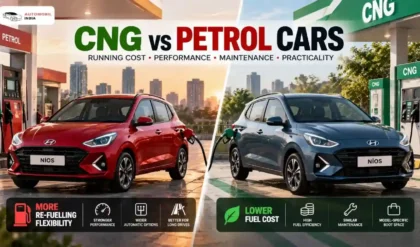
Petrol vs CNG for City Driving
The petrol-versus-CNG decision should be based on your monthly running.
Petrol makes more sense when:
- Your annual running is relatively low
- You value convenience
- CNG stations are not easily accessible
- You make occasional long-distance trips
- You don’t want to spend extra on a CNG variant
CNG makes more sense when:
- You drive many kilometres every month
- CNG stations are easily accessible
- Most of your driving is within areas with reliable CNG availability
- Running cost is a major priority
One important consideration is luggage space.
Modern dual-cylinder CNG systems have reduced the packaging penalty in some cars. Hyundai’s Exter, for example, uses its dual-cylinder CNG layout with an underbody spare wheel and retains 225 litres of boot space.
That is an important practical improvement over older CNG packaging solutions.
What Mileage Should You Expect From a City Car?
This is where buyers should be careful with online mileage claims.
Manufacturer-certified fuel-efficiency figures are produced under standardised testing conditions. Real-world city mileage will usually vary according to traffic and driving conditions.
Your actual consumption can be affected by:
- Traffic congestion
- Average speed
- Idling
- Air-conditioning use
- Tyre pressure
- Passenger load
- Road gradient
- Driving style
- Trip length
A car that returns excellent mileage on an open road may deliver considerably different consumption during short trips through heavy traffic.
Therefore, when comparing city mileage cars, use the official certified number as a reference rather than a guaranteed daily figure.
How Important Is Car Size in Indian Cities?
Vehicle dimensions matter more than many first-time buyers realise.
A difference of even a few hundred millimetres can affect:
- Parallel parking
- Basement parking
- U-turns
- Narrow lanes
- Traffic filtering
- Garage access
This is why a 3.8-metre hatchback can feel dramatically easier to live with than a 4.3-metre SUV in a congested neighbourhood.
However, don’t automatically buy the smallest vehicle.
If four adults regularly travel together, the additional rear-seat width and luggage capacity of a Baleno, i20 or compact SUV can make everyday life significantly easier.
Safety Features to Look for in a City Car
City driving may involve lower speeds than highway driving, but that does not make safety less important.
Look for:
- Multiple airbags
- Electronic Stability Control
- ABS with EBD
- Hill-start assist
- TPMS
- Rear parking sensors
- Rear camera
- ISOFIX mounts
- Strong structural safety performance where independently tested
Hyundai’s current Grand i10 Nios, for example, lists six airbags across the range, while ESC, vehicle stability management and hill-start assist are available according to variant.
The current Hyundai Exter lists six airbags as standard, along with ESC, hill-start assist, VSM and TPMS.
Don’t buy based only on the number of airbags
Six airbags are useful, but they are only one part of vehicle safety.
Also consider:
- Crash-test performance
- ESC availability
- Braking systems
- Tyres
- Child-seat compatibility
- Visibility
- Driver assistance technology where available
Safety should be considered as a complete system rather than a single specification.
Is an SUV Necessary for City Driving?
No.
The popularity of compact SUVs has made higher seating positions increasingly common, but a hatchback can be more convenient in a dense city.
A hatchback can offer:
- Smaller turning footprint
- Easier parking
- Lower running costs
- Easier entry into narrow spaces
- Better visibility in some urban conditions
A compact SUV can offer:
- Higher seating position
- Easier ingress and egress
- More ground clearance
- SUV-like styling
- Better suitability for rough urban roads
If most of your driving happens on well-paved roads in a crowded city, a hatchback may be sufficient.
If your daily route includes broken roads, steep ramps or frequent flooding-prone stretches, the additional ground clearance of a compact SUV may be useful.
How to Choose the Right City Car for Your Daily Commute
Before buying, answer these questions.
How many kilometres do you drive every day?
Someone travelling 10km per day has very different requirements from someone covering 70km.
High daily running makes fuel efficiency and automatic-transmission comfort more important.
How many people usually travel with you?
If you’re usually alone or with one passenger, a small hatchback can be ideal.
If four or five people regularly travel together, consider the rear-seat width and boot capacity before buying.
Do you have easy access to CNG?
If not, buying a CNG car may create unnecessary inconvenience.
Do you need an automatic?
If you regularly spend an hour or more in traffic, an automatic can significantly reduce the physical effort of driving.
Do you have a dedicated parking space?
Measure it.
Don’t assume every compact SUV will fit comfortably in your parking space.
Do you travel outside the city?
If the car will also be used for regular highway trips, don’t choose purely on city dimensions. Engine performance, stability, ride comfort and boot space become more important.
Best City Cars in India: Which One Should You Consider?
The right answer depends on your priorities.
For maximum focus on compactness and efficiency: the Maruti Suzuki Celerio is worth considering.
For a well-rounded small family hatchback: the Hyundai Grand i10 Nios offers a combination of compact dimensions, equipment and petrol/CNG choices.
For buyers who want an SUV-style city car: the Hyundai Exter combines compact dimensions with a higher seating position and petrol, AMT and CNG options.
For maximum practical cabin packaging: the Maruti Suzuki WagonR remains relevant.
For buyers wanting a compact car with multiple powertrain choices: the Tata Tiago is worth considering.
For buyers who want more space and a premium hatchback feel: the Maruti Suzuki Baleno and Hyundai i20 make more sense.
The important point is that the “best city car” changes according to the user.
A commuter who drives 60km through Mumbai traffic may value an automatic and low running cost. A family in Pune may care more about rear-seat space and parking. A buyer in a smaller city may prioritise CNG availability and service reach.
Your driving pattern should determine the car — not the badge or body style alone.
Frequently Asked Questions
Which is the best car for city driving in India?
There is no single best city car for every buyer. Maruti Suzuki Celerio, Hyundai Grand i10 Nios, Hyundai Exter, Maruti Suzuki WagonR, Tata Tiago, Maruti Suzuki Baleno and Hyundai i20 cater to different requirements around size, efficiency, automatic transmissions, space and features.
Which is the best automatic car for city driving?
The right automatic depends on budget and transmission preference. Affordable hatchbacks such as the Celerio and Grand i10 Nios use AMTs, while cars such as the Hyundai i20 offer an IVT on applicable variants. The smoothness, purchase price and driving character of each transmission should be considered before buying.
Is CNG better than petrol for city driving?
CNG can make financial sense for buyers with high monthly running and easy access to CNG stations. Petrol can be more convenient for buyers with lower annual running or those who frequently travel to areas with limited CNG availability.
Which small car is easiest to drive in traffic?
Compact hatchbacks such as the Maruti Suzuki Celerio and Hyundai Grand i10 Nios are designed around urban usability. Their relatively small footprints make them easier to manoeuvre and park than larger cars.
Are automatic cars worth buying for city driving?
For drivers who regularly deal with heavy stop-start traffic, an automatic can reduce the physical effort of repeatedly operating a clutch and changing gears. The additional purchase cost should be weighed against the convenience it provides.
Is an AMT good for city driving?
An AMT can be a practical choice for city driving because it provides clutch-free operation at a relatively accessible price. However, its gear changes can feel more noticeable than those of a CVT or conventional automatic.
Which city car is good for a small family?
A small family should consider the Hyundai Grand i10 Nios, Maruti Suzuki Baleno, Hyundai i20, Tata Tiago or Hyundai Exter depending on budget, space and powertrain requirements. The right choice depends on how frequently all family members travel together.
Is a compact SUV better than a hatchback for city driving?
Not necessarily. A hatchback can be easier to park and manoeuvre, while a compact SUV can offer higher ground clearance and a more upright seating position. The better choice depends on the roads, parking conditions and passenger requirements.
What should I check during a city-car test drive?
Pay attention to steering weight, turning radius, clutch or automatic response, low-speed ride quality, visibility, parking-camera quality, air-conditioning performance, rear-seat space and the ease of getting in and out.
What is more important for city driving: mileage or engine power?
For most urban commuters, efficiency and low-speed drivability are likely to matter more than outright power. However, if the same car is regularly used on highways or with a full passenger load, additional power and torque become more valuable.
Conclusion
The best cars for city driving in India are not necessarily the smallest cars or the ones with the highest claimed mileage.
A genuinely suitable urban car should make everyday driving easier.
For some buyers, that means a compact hatchback such as the Maruti Suzuki Celerio. For others, the Hyundai Grand i10 Nios offers a better balance between compact dimensions, comfort and features.
Buyers who prefer an SUV-style driving position can consider the Hyundai Exter, while the WagonR focuses heavily on cabin practicality. The Tata Tiago provides another compact alternative with petrol and CNG choices.
If your budget allows a larger premium hatchback, the Maruti Suzuki Baleno and Hyundai i20 offer more space and equipment without moving to an SUV.
Ultimately, the best city car is the one that fits your daily distance, traffic conditions, parking situation, passenger requirements, fuel availability and budget.
Before booking, test-drive the exact variant you intend to buy. A specification sheet can tell you the dimensions and mileage figure, but only a real drive through the type of roads you use every day will tell you whether the car actually suits your lifestyle.