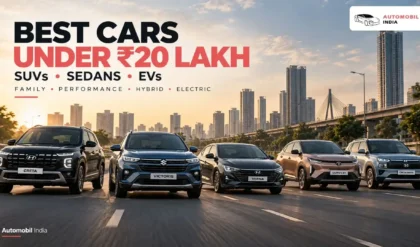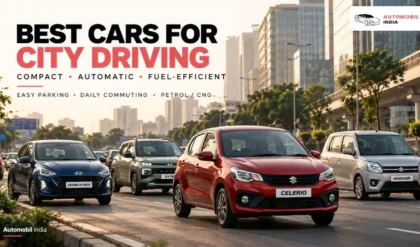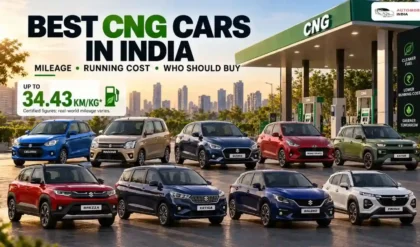

If you are looking for the best cars under ₹8 lakh in India, the market in 2026 offers far more than basic entry-level hatchbacks. Buyers can choose between compact hatchbacks, CNG cars, automatic city cars, compact SUVs and even a flexible seven-seater.
The right choice depends on what matters most to you. A small hatchback can make sense for congested city roads and low running costs, while a compact SUV can offer more ground clearance and a higher seating position. If fuel economy is the priority, factory-fitted CNG options can reduce running costs, while automatic variants can make daily traffic considerably easier.
Here are some of the most relevant cars to consider below the ₹8 lakh ex-showroom mark:
| Car | Starting ex-showroom price* | Powertrain options | Automatic available? | Best suited for |
|---|---|---|---|---|
| Maruti Suzuki Alto K10 | ₹3.70 lakh approx. | Petrol, CNG | Yes, AGS | Low-cost city use |
| Maruti Suzuki Celerio | ₹4.69 lakh approx. | Petrol, CNG | Yes, AGS | Mileage-focused buyers |
| Tata Tiago | ₹4.69 lakh approx. | Petrol, CNG | Yes, AMT | Balanced hatchback use |
| Renault Kwid | ₹4.53 lakh approx. | Petrol | Yes, AMT | Budget urban driving |
| Maruti Suzuki WagonR | ₹4.99 lakh approx. | Petrol, CNG | Yes, AGS | Space and practicality |
| Hyundai Grand i10 Nios | ₹5.60 lakh approx. | Petrol, CNG | Yes, AMT | Comfort and features |
| Hyundai Exter | ₹5.81 lakh approx. | Petrol, CNG | Yes, AMT | SUV-style city driving |
| Renault Triber | ₹5.81 lakh approx. | Petrol | No automatic | Family space and flexibility |
| Renault Kiger | ₹5.81 lakh approx. | Petrol | Yes, CVT on selected variants | SUV practicality |
| Nissan Magnite | ₹5.68 lakh approx. | Petrol, turbo-petrol | Yes, CVT on selected variants | SUV features and space |
Which are the best cars under ₹8 lakh in India?
There is no single car that will suit every buyer at this price. A better approach is to match the car to your usage.
- For maximum fuel efficiency: Maruti Suzuki Celerio
- For the lowest purchase price: Maruti Suzuki Alto K10 or Renault Kwid
- For a feature-rich hatchback: Hyundai Grand i10 Nios
- For SUV-style driving: Hyundai Exter
- For a spacious hatchback: Maruti Suzuki WagonR
- For a balanced hatchback with CNG and automatic options: Tata Tiago
- For family flexibility: Renault Triber
- For compact-SUV space: Renault Kiger or Nissan Magnite
- For a sedan: Maruti Suzuki Dzire
- For buyers wanting an SUV at the upper end of the budget: Maruti Suzuki Brezza
The important point is that starting price does not tell the whole story. Some cars enter the ₹8 lakh budget only in their lower variants, while others offer useful mid-level variants within the same amount.
1. Maruti Suzuki Alto K10
The Maruti Suzuki Alto K10 remains one of the most accessible ways to buy a new petrol car in India. Its current Arena range starts at about ₹3.70 lakh, while selected AGS automatic variants remain comfortably below ₹8 lakh.
The Alto K10 uses a 998cc three-cylinder K-Series petrol engine producing around 66.6 PS and 89 Nm. It is available with a 5-speed manual and AGS automated manual transmission. Maruti claims fuel efficiency of 24.39 km/l for the manual and 24.90 km/l for AGS petrol variants. CNG versions are also available.
Why consider the Alto K10?
Its biggest advantage is its compact footprint. At around 3.53 metres long, it is easy to place on narrow roads and in tight parking spaces.
The AGS option is particularly relevant for buyers who spend a lot of time in stop-and-go traffic.
However, buyers planning frequent highway trips with four or five adults should consider a larger car before making a decision.
Best for: First-time buyers, small families, city commuting and buyers prioritising purchase price.
2. Maruti Suzuki Celerio
The Celerio is one of the strongest choices for buyers who put fuel economy near the top of their priority list.
Maruti currently lists the Celerio from about ₹4.69 lakh, with petrol and S-CNG versions and AGS automatic options. The manufacturer quotes 26.00 km/l for selected petrol variants, while the CNG version is rated at approximately 34.43 km/kg.
The Celerio uses a 998cc three-cylinder petrol engine producing around 68.5 PS and 91.1 Nm. It measures 3,695 mm in length and has a 292-litre boot.
Why consider the Celerio?
The combination of a compact body, good claimed efficiency, CNG availability and automatic transmission makes the Celerio particularly relevant for urban commuters.
Its 292-litre boot is also useful for everyday shopping and moderate luggage.
Best for: Mileage-conscious city drivers, CNG users and buyers who want an affordable automatic.
3. Tata Tiago
The 2026 Tata Tiago received a substantial update, making it one of the more interesting options in the budget hatchback segment.
The updated Tiago was launched in May 2026 with an introductory starting price of ₹4.69 lakh. The range includes petrol and CNG versions, with manual and AMT transmission options.
The 1.2-litre three-cylinder petrol engine produces about 85 bhp and 113 Nm, while the CNG version produces approximately 74 bhp and 96 Nm.
The updated Tiago also adds features such as a larger touchscreen, digital instrument cluster, wireless smartphone connectivity and additional convenience equipment depending on variant.
Why consider the Tiago?
The Tiago makes sense for buyers who want a hatchback that sits between basic budget transportation and more feature-oriented premium hatchbacks.
The CNG option can be useful for high-mileage users, while the AMT provides an easier driving experience in urban traffic.
Best for: Buyers seeking a balanced mix of price, features, CNG availability and everyday practicality.
4. Renault Kwid
The Renault Kwid continues to occupy the entry-level end of the market. Renault currently lists it from approximately ₹4.53 lakh, with higher variants remaining within the ₹8 lakh budget.
The Kwid uses a 1.0-litre petrol engine and is offered with manual and AMT transmission options. Renault quotes 184 mm of ground clearance and 279 litres of boot space.
The manufacturer also lists features such as a touchscreen system, reverse parking camera on selected variants and hill-start assist.
Why consider the Kwid?
Its compact dimensions and relatively high ground clearance make it suitable for urban environments where narrow lanes, speed breakers and uneven roads are common.
The main reason to consider the Kwid is value rather than outright performance.
Best for: Budget-conscious urban buyers who want SUV-inspired styling and a compact footprint.
5. Maruti Suzuki WagonR
The WagonR remains a practical choice for buyers who need more usable cabin space without moving into a larger vehicle.
The current WagonR range starts at around ₹4.99 lakh. It is available with 1.0-litre and 1.2-litre petrol engines, S-CNG technology and AGS automatic transmission on selected petrol variants.
Maruti quotes up to 25.19 km/l for the 1.0-litre petrol AGS configuration and 33.47 km/kg for the 1.0-litre CNG version. The 1.2-litre petrol engine is rated at 24.43 km/l in the specified AGS configuration.
Why consider the WagonR?
The tall-boy design creates a more upright cabin than many conventional hatchbacks. That can make it easier to get in and out of the car and can be useful for families who value cabin practicality.
It is also one of the more versatile choices for buyers who want petrol, CNG and automatic options.
Best for: Families, practical city use, CNG buyers and buyers who value cabin space.
6. Hyundai Grand i10 Nios
The Hyundai Grand i10 Nios starts at around ₹5.60 lakh and is available with petrol and CNG powertrains. Petrol variants can be paired with either a manual or AMT, while CNG is offered with a manual transmission.
The 1.2-litre Kappa petrol engine produces 83 PS, while the CNG version produces 69 PS. The hatchback measures 3,815 mm long and 1,680 mm wide.
The Nios also focuses heavily on convenience and cabin equipment, with features such as rear AC vents, touchscreen infotainment, smartphone connectivity and cruise control depending on variant. Hyundai lists six airbags as standard on the current model.
Why consider the Grand i10 Nios?
Compared with the smallest cars in this list, the Grand i10 Nios offers a more substantial cabin and a more premium-feeling package.
It is particularly worth considering if the car will be used for both city commuting and occasional highway travel.
Best for: Small families, urban commuters and buyers who want comfort and features without moving to a larger SUV.
7. Hyundai Exter
The Hyundai Exter brings SUV-inspired styling and a relatively upright driving position into the sub-₹8 lakh space.
The current Exter starts at around ₹5.81 lakh. It uses a 1.2-litre petrol engine producing 83 PS and 113.8 Nm, with manual and Smart Auto AMT options. A factory-fitted CNG version is also available.
The Exter measures 3,830 mm long, 1,723 mm wide and 1,643 mm high, with 185 mm of ground clearance. Hyundai quotes 391 litres of boot space for petrol versions and 225 litres for the dual-cylinder CNG version.
Safety equipment includes six airbags, ESC, hill-start assist, vehicle stability management and TPMS, with equipment varying by variant.
Why consider the Exter?
The Exter is useful for buyers who want a compact footprint but prefer the seating position and visual character of an SUV.
The dual-cylinder CNG layout is also significant because Hyundai has designed it to retain usable luggage space compared with some conventional CNG packaging solutions.
Best for: City users wanting SUV styling, higher ground clearance, CNG and automatic convenience.
8. Renault Triber
The Renault Triber is the outlier in this list because its biggest advantage is not fuel economy or compactness — it is space flexibility.
The Triber starts at approximately ₹5.81 lakh and offers seating for five to seven people. Renault’s current range includes four versions, with the Techno variant starting at about ₹7.44 lakh.
The second row can slide and recline, while the third row can be removed. Renault says the vehicle offers more than 100 seating and cargo configurations and up to 1,065 litres of cargo capacity with the rear seats folded.
Why consider the Triber?
If you occasionally need seven seats but do not want to spend SUV money, the Triber is one of the few new-car options that makes the requirement possible within this budget.
The compromise is that it uses a small 1.0-litre petrol engine and is not positioned as a performance-oriented vehicle.
Best for: Large families, flexible seating requirements and buyers who prioritise space.
9. Renault Kiger
The Renault Kiger provides another route into the compact-SUV segment under ₹8 lakh.
The current Kiger starts at approximately ₹5.81 lakh. Renault offers 72 PS and 100 PS turbo-petrol engine options, while selected variants are available with a CVT automatic.
The Kiger offers 205 mm of ground clearance and a 405-litre boot. Renault also quotes 222 mm of second-row knee room.
Safety equipment includes six airbags, ESP, TPMS and hill-start assist, although equipment varies by variant.
Why consider the Kiger?
It is particularly relevant for buyers who want more boot space and SUV proportions without crossing into a higher price segment.
The CVT option is another reason to consider it if automatic driving comfort is more important than simply choosing the cheapest automatic available.
Best for: SUV buyers, families needing boot space and buyers wanting a CVT option.
10. Nissan Magnite
The Nissan Magnite is another compact SUV that brings a relatively large footprint into the sub-₹8 lakh space.
Nissan’s current website lists the Magnite from approximately ₹5.68 lakh. Selected variants up to the N-Connecta are priced below ₹8 lakh, while higher variants move beyond the budget.
The Magnite measures 3,994 mm long, 1,758 mm wide and 1,572 mm high. It has a 2,500 mm wheelbase, 205 mm ground clearance and 336 litres of boot space.
The range includes naturally aspirated and turbo-petrol engines, with a CVT available on selected turbo variants. Nissan also lists six airbags as standard.
Why consider the Magnite?
The Magnite makes sense for buyers who want the visual presence and dimensions of a compact SUV while keeping the entry price relatively low.
It also provides a path to a turbo-petrol/CVT combination, although those variants need to be checked carefully against the ₹8 lakh budget.
Best for: Buyers wanting an SUV-style car with good boot space, features and an available CVT.
Other Cars That Technically Fit the ₹8 Lakh Budget
The ₹8 lakh limit does not end with the models above. Several other cars enter this price bracket in their lower variants.
Maruti Suzuki Swift
The Swift starts at approximately ₹5.84 lakh, although its higher variants and automatic versions move beyond the ₹8 lakh mark.
It is worth considering if you want a mainstream hatchback with a familiar footprint and a balance between city use and occasional highway driving.
Maruti Suzuki Dzire
The Dzire starts at around ₹6.31 lakh. The LXi manual and VXi manual are within the ₹8 lakh ex-showroom budget, while higher automatic variants move beyond it.
Its sedan body gives it a separate boot, making it useful for buyers who regularly carry luggage.
Maruti Suzuki Brezza
The current Brezza enters the budget at approximately ₹7.40 lakh according to Maruti Suzuki’s current Arena range, although the budget covers only lower variants.
This makes it relevant for buyers specifically looking for an SUV rather than a hatchback, but the variant-to-feature trade-off becomes important at this price.
Maruti Suzuki S-Presso
The S-Presso starts at about ₹3.50 lakh and offers petrol, S-CNG and AGS options. Even its higher petrol variants remain within the ₹8 lakh ceiling.
It is best viewed as a compact urban car rather than a family car for frequent highway use.
Best Cars Under ₹8 Lakh by Requirement
Instead of asking which car is universally “best”, it is more useful to identify which models match different needs.
| Requirement | Cars worth considering | Why |
|---|---|---|
| Lowest purchase price | Alto K10, S-Presso, Kwid | Lower entry prices |
| Maximum claimed petrol efficiency | Celerio | Up to 26.00 km/l on specified petrol variants |
| CNG commuting | Celerio, WagonR, Grand i10 Nios, Tiago, Exter | Factory-fitted CNG options |
| Automatic city driving | Alto K10, Celerio, Tiago, Grand i10 Nios, Exter | AGS/AMT options at relatively accessible prices |
| Comfortable family hatchback | Grand i10 Nios, Tiago, WagonR | More usable cabin than the smallest cars |
| SUV-style driving | Exter, Kiger, Magnite | Higher seating position and SUV proportions |
| Large boot | Kiger, Magnite, Dzire | Useful luggage capacity |
| Seven seats | Triber | Flexible 5-7 seat configuration |
| Sedan requirement | Dzire | Separate boot and sedan body |
| SUV near ₹8 lakh | Brezza, Exter, Kiger, Magnite | SUV options at or around the budget |
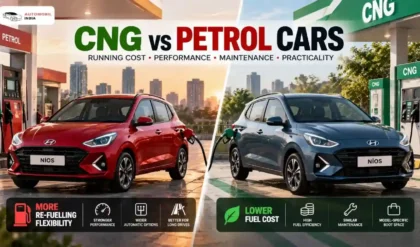
Petrol vs CNG: Which Makes More Sense Under ₹8 Lakh?
CNG can make sense if your annual running is high and you have convenient access to CNG stations.
Models such as the Celerio, WagonR, Grand i10 Nios, Tiago and Exter offer factory-fitted CNG options.
However, CNG should not be selected purely because its claimed fuel-economy number looks higher.
Consider:
- Your monthly kilometres
- CNG availability near your home and workplace
- How much luggage you normally carry
- Whether you frequently travel outside major cities
- The price difference between petrol and CNG variants
- The actual on-road price difference
For a low-mileage owner, the additional upfront cost of a CNG version may take longer to recover.
Manual vs Automatic: What Should You Buy?
For a car that will spend most of its life in city traffic, an automatic can be worth considering even within this budget.
AMT/AGS
Cars such as the Alto K10, Celerio, WagonR, Tiago, Grand i10 Nios and Exter offer automated-manual transmission options in their respective ranges.
AMTs are generally attractive because they allow automatic gear changes without the price premium associated with some other automatic technologies.
The trade-off is that gear changes can be more noticeable during acceleration compared with a CVT or torque-converter automatic.
CVT
The Renault Kiger and Nissan Magnite offer CVT options on selected variants.
A CVT can be particularly comfortable in congested traffic because it delivers smooth, continuous acceleration.
Manual
A manual remains the straightforward choice if:
- Your driving is mostly on open roads
- You want maximum control
- Your annual running is relatively low
- You want to keep the purchase price down
What About Safety in Cars Under ₹8 Lakh?
Safety should not be reduced to the number of airbags alone.
When comparing cars, check:
- Airbag count
- ABS with EBD
- Electronic Stability Control
- Hill-start assist
- TPMS
- Rear parking sensors
- Reverse camera
- ISOFIX child-seat mounts
- Seat-belt reminders
- Vehicle crash-test results where available
- Whether the safety equipment is standard or limited to higher variants
There can be a significant difference between the base and mid variants of the same car.
For example, the current Grand i10 Nios, Exter, Celerio, Kiger and Magnite all advertise substantial safety equipment, but the exact feature mix varies by variant.
Therefore, do not select a car based solely on the model’s maximum feature list. Check the exact variant you can afford.
Hatchback or SUV Under ₹8 Lakh?
This is one of the biggest decisions buyers face.
Choose a hatchback if:
- Most driving happens in crowded cities
- Parking space is limited
- You want a smaller turning footprint
- Fuel economy is important
- You want more equipment for the money
- Your typical usage is one to four occupants
Consider an SUV if:
- You prefer a higher seating position
- You frequently encounter rough roads or large speed breakers
- Ground clearance matters
- You want more visual road presence
- You occasionally travel with family and luggage
The Exter, Kiger and Magnite demonstrate why compact SUVs have become relevant even in this price range.
However, an SUV is not automatically more practical for every urban buyer. A smaller hatchback can be easier to park and manoeuvre in tight city environments.
What Should You Check Before Buying a Car Under ₹8 Lakh?
Do not make the decision based only on the advertised starting price.
1. Check the exact variant
A car starting at ₹5 lakh may require a ₹7 lakh-plus variant to get the features you actually want.
2. Calculate the on-road price
Your ₹8 lakh budget may mean:
- ₹8 lakh ex-showroom
- ₹8 lakh on-road
- ₹8 lakh including insurance and accessories
These are very different budgets.
Registration, road tax, insurance and other charges vary by state and city.
3. Test the rear seat
If the car will regularly carry three adults in the second row, sit there before buying.
4. Check the boot
Do not rely solely on litre figures. Put your actual luggage inside the boot.
5. Test the automatic in traffic
An AMT can feel different from a conventional automatic. Drive it in the kind of traffic you normally encounter.
6. Check CNG practicality
If you choose CNG, check the boot arrangement and your local CNG station availability.
7. Compare insurance and service support
The purchase price is only the beginning of ownership. Check insurance premiums, service intervals, warranty coverage and dealer accessibility.
Are Cars Under ₹8 Lakh Good for Highway Driving?
Yes, but the right model depends on how frequently you travel.
Small 1.0-litre hatchbacks can comfortably handle normal highway use, but they are not all equally suited to carrying five adults and luggage over long distances.
If highway use is frequent, consider a larger 1.2-litre hatchback or compact SUV such as the Grand i10 Nios, Tiago, Exter, Kiger or Magnite.
For predominantly urban driving, the Alto K10, Celerio, Kwid and WagonR can be more appropriate because their compact dimensions make everyday manoeuvring easier.
Which Car Under ₹8 Lakh Should You Consider?
There is no universal answer because the ideal car depends on your usage.
If purchase price and compact dimensions are the priority, the Alto K10, S-Presso and Kwid deserve consideration.
If fuel efficiency is the main concern, the Celerio is one of the strongest options based on its manufacturer-claimed figures.
If you want a more rounded hatchback, the Tata Tiago and Hyundai Grand i10 Nios offer a broader mix of space, features and powertrain choices.
If you prefer an SUV-style vehicle, the Hyundai Exter, Renault Kiger and Nissan Magnite are relevant choices, while the Maruti Suzuki Brezza provides an option at the upper end of the budget in its lower variants.
If you need maximum family flexibility, the Renault Triber stands apart because of its 5-to-7-seat configuration.
And if you specifically want a sedan, the Maruti Suzuki Dzire enters the budget with its lower variants.
The best way to narrow the list is therefore not to ask which car has the highest specification sheet, but which car fits your daily distance, family size, road conditions, fuel preference, parking situation and total ownership budget.
FAQs
1. Which is the cheapest car under ₹8 lakh in India?
The Maruti Suzuki S-Presso currently starts at around ₹3.50 lakh ex-showroom, followed by the Alto K10 at around ₹3.70 lakh. Renault Kwid is another entry-level option at around ₹4.53 lakh.
2. Which car under ₹8 lakh gives the best mileage?
The Maruti Suzuki Celerio has a manufacturer-claimed petrol efficiency figure of up to 26.00 km/l for specified variants. Its CNG version is rated at approximately 34.43 km/kg. Actual mileage will depend on traffic, driving style, load, tyre pressure and road conditions.
3. Which automatic cars are available under ₹8 lakh?
Depending on the exact variant and current pricing, automatic options include the Alto K10, Celerio, WagonR, Tiago, Grand i10 Nios and Exter. Selected Renault Kiger and Nissan Magnite variants also offer CVT automatic transmissions, although higher-spec versions can cross the ₹8 lakh limit.
4. Which CNG cars are available under ₹8 lakh?
Options include the Maruti Suzuki Alto K10, Celerio, WagonR, Hyundai Grand i10 Nios, Hyundai Exter and Tata Tiago, depending on the selected variant.
5. Which is the best family car under ₹8 lakh?
The answer depends on family size. The Grand i10 Nios, Tiago and WagonR are worth considering for smaller families, while the Renault Triber is particularly relevant if flexible five-to-seven-seat capacity is important.
6. Can I get an SUV under ₹8 lakh?
Yes. The Hyundai Exter, Renault Kiger and Nissan Magnite start below ₹6 lakh, while the Maruti Suzuki Brezza starts around ₹7.40 lakh according to current manufacturer listings. However, the higher variants of these SUVs can exceed ₹8 lakh.
7. Is an AMT automatic good for city driving?
An AMT can be convenient for city traffic because it removes the need for constant clutch operation. However, its gear changes can be more noticeable than those of a CVT or some conventional automatic transmissions. A test drive in actual traffic is recommended before buying.
8. Which car under ₹8 lakh has the most boot space?
Among the cars discussed here, the Renault Kiger offers 405 litres of boot space, while the Nissan Magnite offers 336 litres. The Hyundai Exter offers 391 litres in petrol versions.
9. Is CNG better than petrol for a daily-use car?
CNG can reduce running costs for drivers who cover significant distances and have convenient access to CNG stations. Petrol can be more convenient for lower-mileage users and those who frequently travel to locations without CNG availability.
10. What should I consider besides the ex-showroom price?
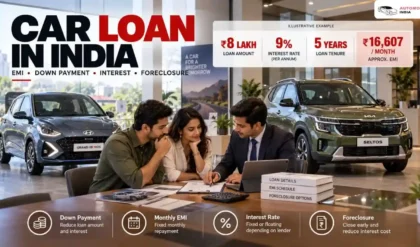
Look at the complete on-road price, insurance, financing cost, service support, warranty, fuel expenses, variant equipment and expected annual running. A car with a lower sticker price is not necessarily cheaper to own over several years.
Conclusion
The best cars under ₹8 lakh in India now cover a surprisingly wide range of requirements.
For pure urban affordability, the Alto K10, S-Presso and Kwid remain relevant. The Celerio and WagonR make stronger cases for efficiency and practicality, while the Tiago and Grand i10 Nios offer a more rounded hatchback experience.
Buyers wanting SUV styling can look at the Exter, Kiger and Magnite, while the Triber provides an unusual amount of seating flexibility for the money. The Dzire remains relevant if a sedan is preferred.
The most important step is to compare actual variants rather than starting prices. Once you factor in the features you need, your fuel choice, annual running and on-road budget, the shortlist usually becomes much smaller.