Best Electric Cars in India: Range, Charging, Price and Use-Case Guide
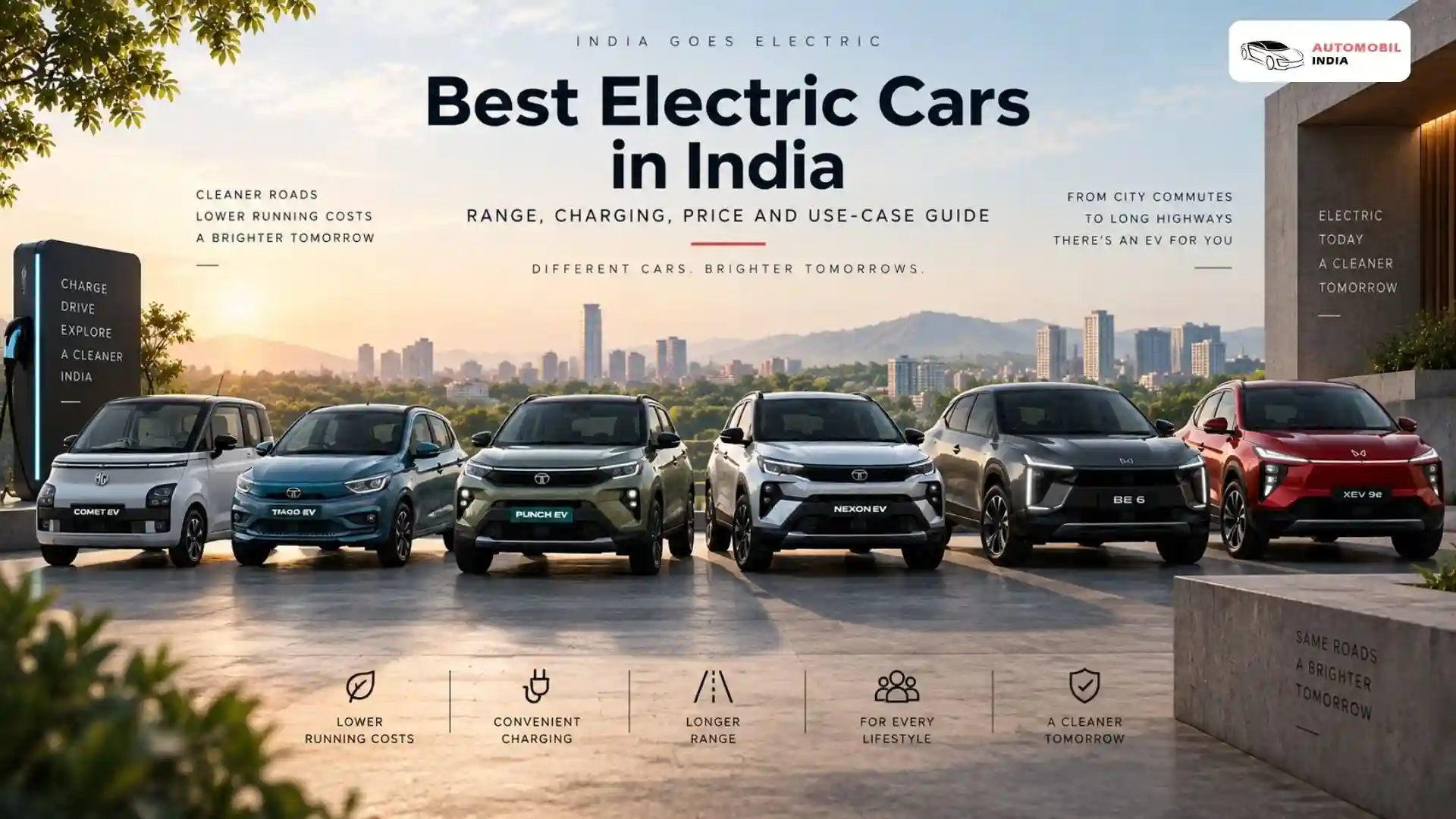
Electric cars in India have moved well beyond the early stage where buyers had only a handful of options. In 2026, the market stretches from small city EVs such as the Tata Tiago EV and MG Comet EV to long-range SUVs such as the Mahindra BE 6, Tata Harrier EV and Mahindra XEV 9e.
That makes choosing the best electric car in India more complicated than simply looking for the highest claimed range.
A city commuter may be better served by a compact EV with a smaller battery, lower purchase price and easy home charging. A family travelling regularly between cities may benefit more from a 45–79kWh battery, faster DC charging and a larger cabin.
This guide therefore looks at electric cars by price, range, charging, practicality, features and intended use, rather than declaring one model the universal winner.
Best Electric Cars in India: Quick List
| Electric car | Approx. ex-showroom price | Battery / range | Best suited for |
|---|---|---|---|
| Tata Tiago EV | ₹6.99–10.09 lakh | 19.2/24kWh; 226/285km | Affordable city EV |
| MG Comet EV | ₹7.79 lakh onwards* | 17.4kWh; 230km | Urban-only driving |
| Tata Punch EV | ₹9.79–12.99 lakh | 30/40kWh; 365–375/468km | City + occasional highway |
| Tata Nexon EV | ₹12.49–17.89 lakh | 30/45kWh; up to 489km | Family EV |
| Mahindra XUV 3XO EV | ₹13.89–14.96 lakh | 39.4kWh; 351km | Performance-oriented compact SUV |
| MG Windsor EV Pro | ₹17.89–18.99 lakh | 52.9kWh; 449km | Comfort and cabin space |
| Tata Curvv EV | ₹16.99–19.49 lakh | 55kWh; 502km | Long-range stylish SUV |
| Hyundai Creta Electric | ₹18.02–24.70 lakh | 42/51.4kWh; 420/510km | Premium family SUV |
| MG ZS EV | ₹17.99–20.75 lakh | 50.3kWh; 461km | Feature-rich family SUV |
| Mahindra BE 6 | ₹19.45–26.95 lakh | 59/70/79kWh | Performance and long range |
| Mahindra XEV 9e | ₹21.90–30.50 lakh | 59/79kWh; 542/656km | Premium long-range SUV |
| Tata Harrier EV | ₹21.79–29.29 lakh | 65/75kWh; up to 627km | Large family SUV / AWD |
The Tiago EV’s current 2026 range is ₹6.99–10.09 lakh with 226km and 285km versions. The Punch EV currently costs ₹9.79–12.99 lakh and offers 365–375km or 468km depending on battery. The Nexon EV starts at ₹12.49 lakh and goes to ₹17.89 lakh, with a maximum claimed range of 489km.
How to Choose the Best Electric Car in India
Before comparing individual models, it helps to understand the five numbers that matter most.
1. Battery capacity
A larger battery generally stores more energy, but it also adds weight and cost.
For example:
- 17–25kWh: mainly suitable for urban use
- 30–40kWh: practical for city driving with occasional longer trips
- 45–55kWh: more suitable for regular family use and highway travel
- 59–79kWh: aimed at long-distance and premium EV buyers
Battery capacity alone does not determine range. Motor efficiency, vehicle weight, aerodynamics and software also matter.
2. Certified range
The number advertised by manufacturers is a laboratory-certified figure.
It is useful for comparing vehicles but should not be treated as the distance you will always achieve on Indian roads.
3. Real-world range
Actual range changes with:
- Highway speed
- Traffic
- Air-conditioning
- Temperature
- Number of passengers
- Tyre pressure
- Driving style
- Terrain
For highway planning, a conservative usable-range estimate is more useful than the maximum certified number.
4. DC charging speed
A larger battery is useful only if you can recharge it conveniently.
A 20–80% DC charging time can be more relevant to road trips than a 0–100% AC charging time.
5. Home charging
If you can charge overnight at home, an EV becomes much easier to live with.
If you depend heavily on public chargers, charging-network coverage becomes a major part of the buying decision.
Best Electric Car in India Under ₹10 Lakh
Tata Tiago EV
The Tiago EV remains one of the most accessible ways to enter electric mobility in India.
The updated 2026 model starts at ₹6.99 lakh and is available with 19.2kWh and 24kWh battery packs. The claimed ranges are 226km and 285km respectively.
The 2026 update also brought considerably more equipment, including:
- 10.25-inch touchscreen
- Digital instrument display
- Wireless Android Auto and Apple CarPlay
- 360-degree camera
- Blind-view monitor
- Automatic climate control
- Rear AC vents
- Cruise control
- Rain-sensing wipers on higher variants
The 24kWh version also gets Tata’s lifetime battery warranty programme for the first owner, subject to applicable terms.
Who should consider it?
The Tiago EV makes the most sense for buyers whose driving is predominantly:
- City commuting
- Office travel
- School runs
- Shopping
- Short daily trips
If your daily driving is 30–60km and you have home charging, a 226km certified-range EV can be sufficient without paying for a much larger battery.
MG Comet EV
The MG Comet EV approaches the idea of an electric car differently.
It is extremely compact, measures just 2,974mm in length and seats four people. It uses a 17.4kWh battery and has a claimed range of 230km.
The biggest advantage is not range. It is size.
The Comet can be particularly useful in:
- Crowded city streets
- Tight parking areas
- Narrow residential lanes
- Short urban commutes
It can be charged using a relatively small 3.3kW AC setup, with MG quoting around 7 hours for a 0–100% charge.
Important limitation
The Comet is a four-seater.
It should therefore be considered a city mobility vehicle rather than a conventional family hatchback.
For a household that already has another car and needs a compact second vehicle, its packaging can make sense.
Best Electric Car Under ₹15 Lakh
Tata Punch EV
The Punch EV sits between the Tiago EV and larger electric SUVs.
The current model uses 30kWh and 40kWh batteries. Tata quotes 365–375km for the 30kWh version and 468km for the 40kWh version. Tata’s estimated C75 figures are approximately 260–275km and 335–355km respectively.
Current prices are ₹9.79–12.99 lakh ex-showroom.
The Punch EV also offers:
- 10.25-inch touchscreen
- 10.25-inch digital driver display
- 360-degree camera
- Blind-view monitor
- Ventilated front seats on higher variants
- Wireless charging
- Cruise control
- Connected-car features
- Six airbags
The 40kWh version can charge from 20–80% in around 26 minutes using a suitable DC fast charger, according to Tata.
Who should consider it?
The Punch EV is particularly relevant to buyers who want:
A compact SUV + good city usability + enough range for occasional highway trips.
Its 195mm ground clearance and relatively compact 3,880mm body are useful for Indian urban conditions.
Mahindra XUV 3XO EV
The XUV 3XO EV starts at ₹13.89 lakh and is available with a 39.4kWh battery.
Mahindra quotes a real-world range of up to 285km, while current industry specifications list a 351km certified range. The motor produces 150hp and 310Nm, and the claimed 0–100km/h time is 8.3 seconds.
It is also unusual in this price bracket because the higher variant gets:
- Level 2 ADAS
- Adaptive cruise control
- Autonomous emergency braking
- Lane-keep assistance
- 360-degree camera
- Blind-view monitor
- Harman Kardon audio
- Connected-car technology
Who should consider it?
The XUV 3XO EV is worth looking at if you want strong performance and advanced safety technology without moving into the ₹20 lakh-plus EV segment.
Best Electric Cars Under ₹20 Lakh
This is currently one of the most competitive EV price bands in India.
Tata Nexon EV
The Nexon EV remains a practical middle-ground option between compact EVs and premium electric SUVs.
It is available with 30kWh and 45kWh battery packs. The 45kWh version has a claimed range of 489km, while Tata’s current pricing starts at ₹12.49 lakh and extends to ₹17.89 lakh ex-showroom.
The 45kWh version produces up to 142hp and 215Nm and has a claimed 0–100km/h time of 8.9 seconds.
Higher variants offer equipment such as:
- 360-degree camera
- Blind-view monitor
- Ventilated seats
- Panoramic sunroof
- Connected-car technology
- Vehicle-to-load functionality
- ADAS on the top variant
Who should consider it?
The Nexon EV is suited to buyers who want a family-sized EV without moving into premium-SUV pricing.
The 45kWh version is particularly relevant for people who expect to use their EV for occasional inter-city travel.
MG Windsor EV Pro
The Windsor has become an interesting alternative because of its spacious cabin and BaaS ownership model.
The conventional battery-included Windsor range currently extends from around ₹14.70 lakh to ₹18.99 lakh depending on variant. Under BaaS, the entry price is lower because the battery is financed/rented separately.
The Windsor Pro uses a 52.9kWh battery and has a claimed 449km range.
Its strengths include:
- Very spacious cabin
- Aero Lounge seats with 135-degree recline
- 15.6-inch touchscreen
- 360-degree camera
- Ventilated front seats on higher variants
- Level 2 ADAS on Essence Pro
- V2L and V2V on higher Pro variants
Who should consider it?
The Windsor makes sense for buyers who place rear-seat comfort and cabin space ahead of outright SUV styling.
It is particularly interesting for family users.
Tata Curvv EV
The Curvv EV is aimed at buyers who want a more distinctive SUV design without stepping into the ₹25–30 lakh category.
The current Series X range starts at ₹16.99 lakh and extends to ₹19.49 lakh ex-showroom.
The current range uses a 55kWh battery, with the model’s certified range around 502km in the current specification. Tata’s original Curvv EV launch offered both 45kWh and 55kWh versions, with the 55kWh version originally certified at 585km. The current Series X line-up has since been simplified.
Higher variants offer:
- 12.3-inch touchscreen
- Ventilated seats
- Panoramic sunroof
- JBL audio
- Powered driver’s seat
- Level 2 ADAS
Who should consider it?
The Curvv EV is aimed at buyers who want:
Long range + SUV practicality + distinctive styling.
Its 500-litre boot is also useful for family road trips.
Hyundai Creta Electric
The Creta Electric brings Hyundai’s familiar SUV format into the EV market.
It is available with:
- 42kWh battery
- 51.4kWh long-range battery
The certified ranges are 420km and 510km respectively.
Hyundai currently lists the conventional Creta Electric price range at approximately ₹18.02–24.70 lakh ex-showroom.
It offers features such as:
- Dual 10.25-inch displays
- ADAS
- V2L
- Connected-car technology
- Regenerative braking
- 7.4kW AC charging
- CCS2 DC fast charging
Hyundai quotes approximately 39 minutes for a 10–80% DC charge under suitable conditions.
There is also a BaaS model starting at ₹10.99 lakh plus a battery usage charge beginning at ₹3.90/km. This is a different ownership structure from the normal battery-included purchase and should be evaluated using total financing and running costs rather than the headline price alone.
Who should consider it?
The Creta Electric is relevant for buyers wanting a premium family SUV with a familiar Hyundai ownership proposition and long-range battery option.
MG ZS EV
The ZS EV is another option around the ₹18–21 lakh price bracket.
It uses a 50.3kWh battery and has a certified range of 461km. Current prices range from approximately ₹17.99 lakh to ₹20.75 lakh depending on variant.
Its equipment includes:
- Panoramic sunroof
- 10.1-inch touchscreen
- 360-degree camera
- Blind-spot detection
- Rear cross-traffic alert
- Wireless charging
- Powered driver’s seat
- ADAS Level 2 on the Essence variant
Who should consider it?
The ZS EV remains relevant to buyers who want a feature-heavy, conventional electric SUV with a relatively straightforward 50.3kWh battery setup.
Best Electric Cars for Long Range
Mahindra BE 6
The BE 6 is one of the more performance-focused EVs in the Indian market.
It is available with 59kWh, 70kWh and 79kWh batteries, depending on variant. The current BE 6 SPORTEQ price structure starts around ₹19.45 lakh for the 59kWh version and reaches ₹26.95 lakh for the 79kWh versions.
Mahindra’s 79kWh battery has a certified range of 682km.
The platform can deliver up to 210kW of power, while Mahindra claims 0–100km/h in 6.7 seconds for the 79kWh version.
It also offers advanced technology such as:
- Level 2+ ADAS
- 360-degree surveillance system
- Adaptive cruise control
- Large digital displays
- Connected-car technology
- Fast DC charging
Who should consider it?
The BE 6 is particularly relevant to buyers who want performance and long range rather than a traditional family-SUV experience.
Mahindra XEV 9e
The XEV 9e uses the same INGLO architecture as the BE 6 but focuses more heavily on premium cabin experience and long-distance comfort.
The 59kWh version has a certified range of 542km, while the 79kWh version reaches 656km. Mahindra’s original pricing put the range at ₹21.90–30.50 lakh depending on battery and trim.
It also carries a five-star Bharat NCAP result with 32/32 for adult occupant protection and 45/49 for child occupant protection.
Who should consider it?
The XEV 9e makes sense for buyers looking for:
- Long highway range
- Premium interiors
- Large battery
- Strong performance
- Advanced driver assistance
- Premium SUV technology
Best Electric SUV for Large Families
Tata Harrier EV
The Harrier EV moves Tata into the larger premium-EV SUV segment.
It is offered with 65kWh and 75kWh battery packs.
Tata quotes:
- 538km for 65kWh RWD
- 627km for 75kWh RWD
- 622km for the 75kWh AWD version
The 75kWh AWD model produces 313hp and 504Nm.
Current ex-showroom pricing is approximately ₹21.79–29.29 lakh.
The Harrier EV is also significant because it offers all-wheel drive, something still relatively uncommon in India’s mainstream EV market.
Who should consider it?
The Harrier EV is particularly relevant to buyers who want:
A large family SUV + long range + premium equipment + AWD capability.
It is a different proposition from compact EVs such as the Punch and Nexon.
Electric Cars in India: Price vs Range
A common mistake is assuming that the car with the highest range automatically offers the best value.
Consider these examples:
| Model | Approx. price | Claimed range |
|---|---|---|
| Tiago EV | ₹6.99 lakh onwards | Up to 285km |
| Punch EV | ₹9.79 lakh onwards | Up to 468km |
| Nexon EV | ₹12.49 lakh onwards | Up to 489km |
| XUV 3XO EV | ₹13.89 lakh onwards | 351km |
| Curvv EV | ₹16.99 lakh onwards | Around 502km |
| Creta Electric | ₹18.02 lakh onwards | Up to 510km |
| BE 6 | ₹19.45 lakh onwards | Up to 682km |
| XEV 9e | ₹21.90 lakh onwards | Up to 656km |
The table demonstrates why range should be evaluated against price and intended use.
A person driving 30km every day does not necessarily benefit enough from a 79kWh battery to justify paying for it.
Someone travelling 400–500km between cities regularly may have a completely different requirement.
Best Electric Car for City Driving
For urban use, the most important factors are often:
- Compact dimensions
- Easy parking
- Home charging
- Affordable purchase price
- Adequate range
- Low energy consumption
This puts cars such as the Tiago EV, Comet EV and Punch EV in a different category from large premium EVs.
Typical city use
If you drive:
20–40km/day: a 17–25kWh EV can be sufficient.
40–70km/day: a 30–40kWh EV provides more comfortable range headroom.
70–100km/day: a 40–55kWh EV becomes more attractive.
These are practical guidelines, not fixed requirements. Your actual range will depend on driving conditions.
Best Electric Car for Highway Trips
For frequent highway driving, look beyond the range figure.
A good highway EV should ideally have:
- 400km+ certified range
- Strong real-world range
- DC fast charging
- Good highway stability
- Large battery
- Reliable charging-network access
- Comfortable seats
- Adequate boot space
This makes models such as the Nexon EV 45, Curvv EV, Creta Electric 51.4, BE 6, XEV 9e and Harrier EV more relevant for frequent inter-city travel.
EV Charging: AC vs DC Explained
AC charging
AC charging is generally what you use at home.
Typical wall-box outputs include:
- 3.3kW
- 7.2kW
- 7.4kW
- 11kW
The actual charging time depends on battery size and the car’s onboard charger.
For an owner who parks at home overnight, a 7.2kW or 7.4kW wall box can be sufficient for many EVs.
DC fast charging
DC chargers are primarily useful for highway travel.
Instead of the car converting AC into DC, the external charger supplies DC directly to the battery.
This allows significantly faster charging.
For example, Tata quotes around 26 minutes for a Punch EV 40kWh to go from 20–80% under suitable DC charging conditions.
Hyundai quotes around 39 minutes for the Creta Electric to charge from 10–80% using a suitable DC charger.
Mahindra says its BE 6 and XEV 9e can charge from 20–80% in under 20 minutes when connected to a 175kW fast charger.
But there is a catch
Your charging time is limited by the lowest-capacity component:
Car’s charging capability + charger output + battery temperature + state of charge + electrical conditions
Therefore, connecting a car that supports 60kW to a 30kW charger will not magically give you 60kW charging.
How Much Does It Cost to Charge an Electric Car?
The basic calculation is simple:
Charging cost = Electricity consumed × electricity tariff
Suppose an EV uses approximately 15kWh to travel 100km.
At an electricity tariff of ₹8/kWh:
15 × ₹8 = ₹120 per 100km
That works out to:
₹1.20 per km
This is an illustrative calculation, not a guaranteed running cost.
Actual energy consumption will change according to the vehicle, speed, weather, traffic and charging losses.
Why home charging matters
Public DC charging can cost considerably more per unit than residential electricity.
Therefore, an EV’s running-cost advantage is usually strongest when the owner can do a substantial amount of charging at home.
Real-World EV Range vs Claimed Range
This is perhaps the most important thing buyers should understand before purchasing an EV.
A car with a claimed 500km range does not necessarily deliver 500km in everyday highway driving.
For example, Tata’s current Punch EV 40kWh has a 468km certified range, while Tata’s C75 estimate is approximately 335–355km.
The difference is not evidence that the certified figure is meaningless. The two figures represent different testing approaches and conditions.
For trip planning
A better approach is to maintain a charging buffer.
If your expected usable range is around 350km, you should not plan a 350km trip assuming the battery will reach zero exactly at your destination.
Weather, traffic, detours and charger availability can all affect the trip.
What Battery Size Should You Choose?
20–25kWh
Suitable for:
- Short city commutes
- Second-car use
- Low annual running
- Owners with home charging
Examples include the Tiago EV and Comet EV.
30–40kWh
Suitable for:
- Regular city driving
- Occasional highway trips
- Buyers who want a balance between cost and range
Examples include the Punch EV and Nexon EV 30.
45–55kWh
Suitable for:
- Family use
- Longer daily driving
- More frequent inter-city trips
Examples include the Nexon EV 45, Curvv EV, Windsor Pro and Creta Electric.
59–79kWh
Suitable for:
- Frequent highway travel
- Premium SUV buyers
- Long-distance touring
- Buyers who want substantial range headroom
Examples include the BE 6, XEV 9e and Harrier EV.
Should You Buy an EV in India in 2026?
For the right usage pattern, an EV can be a practical daily car.
It makes the most sense when you have:
- Regular daily driving
- Home or workplace charging
- Access to public charging on important routes
- Predictable travel patterns
- A plan to keep the car for several years
It requires more consideration if:
- You live in a building without parking
- You cannot install a charger
- You frequently make long highway trips through areas with limited charging
- Your annual driving is extremely low
- You regularly need to travel long distances without planned stops
An EV should therefore be evaluated as an ownership system, not simply as a car.
Battery-as-a-Service: Is It Worth Considering?
BaaS has become an increasingly important part of India’s EV market.
The concept separates the vehicle purchase price from the battery cost.
For example, Hyundai’s Creta Electric BaaS programme starts at ₹10.99 lakh plus a battery charge beginning at ₹3.90/km.
MG’s Windsor BaaS pricing starts at ₹9.99 lakh plus a per-kilometre battery charge, while Mahindra also offers battery-financing structures on selected EVs.
The important point
Do not compare:
₹9.99 lakh BaaS
directly against:
₹15 lakh battery-included EV
and conclude that the first car is automatically cheaper.
You need to calculate:
- Initial down payment
- Battery EMI/rental
- Per-kilometre charge
- Electricity
- Financing interest
- Ownership period
- Battery warranty
- Resale implications
- Maximum/minimum usage conditions
BaaS can reduce the upfront barrier, but the total cost needs to be evaluated over your expected ownership period.
Which Electric Car Should You Consider?
Instead of a single ranking, this is a more useful use-case map:
| Your requirement | Cars worth shortlisting |
|---|---|
| Lowest-cost EV ownership | Tiago EV, Comet EV |
| Compact city EV | Comet EV, Tiago EV |
| City + occasional highway | Punch EV |
| Family EV under ₹15 lakh | Punch EV, Nexon EV, XUV 3XO EV |
| Performance under ₹15 lakh | XUV 3XO EV |
| Spacious family EV | Windsor EV, Nexon EV |
| Long-range mid-size EV | Curvv EV, Creta Electric |
| Feature-rich SUV | Creta Electric, ZS EV |
| Long-range performance | BE 6 |
| Premium long-range SUV | XEV 9e |
| Large family SUV | Harrier EV |
| Three-row electric SUV | XEV 9S |
The Mahindra XEV 9S is particularly notable for buyers who specifically need three rows. It offers 59kWh, 70kWh and 79kWh batteries, with certified ranges of 521km, 600km and 679km respectively.
Final Takeaway
There is no single best electric car in India for every buyer.
The market has become diverse enough that the correct choice depends heavily on how the car will be used.
For a low-cost urban EV, the Tiago EV and Comet EV address different versions of the same requirement: affordable city mobility.
The Punch EV adds more range and SUV practicality, while the Nexon EV moves towards a more spacious family EV.
The XUV 3XO EV brings stronger performance and ADAS into the compact-SUV EV segment. The Windsor EV focuses heavily on cabin space and comfort, while the Curvv EV, Creta Electric and ZS EV occupy the more premium family-EV space.
At the higher end, the BE 6, XEV 9e and Harrier EV demonstrate how far India’s EV market has moved, with large batteries, high performance, advanced driver assistance and certified ranges exceeding 600km in some configurations.
The most important question is therefore not:
“Which EV has the highest range?”
It is:
“Which EV gives me enough range, charging convenience, space and equipment for the way I actually drive?”
For most buyers, calculating daily kilometres + home charging availability + highway frequency + five-year ownership cost will narrow the shortlist much faster than comparing brochure range figures alone.
Frequently Asked Questions
Which is the best electric car in India?
There is no single best option for every buyer. The right EV depends on budget, daily driving distance, charging access, passenger requirements and highway usage. The Tiago EV and Comet suit urban-focused buyers, while the Punch EV, Nexon EV and larger SUVs address progressively longer-range and family-oriented requirements.
Which electric car has the longest range in India?
Among the mainstream passenger EVs covered here, the Mahindra BE 6 offers up to 682km of certified range with its 79kWh battery, while the XEV 9e offers up to 656km and the Harrier EV up to 627km depending on configuration.
Which is the cheapest electric car in India?
The exact answer depends on whether battery-rental/BaaS schemes are included. The Tata Tiago EV starts at ₹6.99 lakh with the battery included, while some BaaS programmes advertise lower upfront prices by separating the battery cost.
Which EV is best for city driving?
Compact models such as the MG Comet EV and Tata Tiago EV are particularly suited to urban use. The Tata Punch EV is more appropriate if you want additional range, higher ground clearance and a more conventional five-seat SUV format.
Which electric car is best for highway driving?
For regular highway travel, larger-battery EVs such as the Nexon EV 45, Curvv EV, Creta Electric 51.4, BE 6, XEV 9e and Harrier EV provide more range headroom than small city EVs.
How much real-world range should I expect from an EV?
There is no universal percentage that can be applied to every EV. Real-world range depends on speed, weather, traffic, air-conditioning, terrain, load and driving style. Manufacturer C75 estimates can be a useful additional reference where available, but they are still estimates rather than guarantees.
Is an electric car cheaper to run than a petrol car?
It can be, particularly when the EV is charged mainly at home. The actual saving depends on electricity and fuel prices, vehicle efficiency, annual kilometres and charging habits. Public DC charging can reduce the running-cost advantage compared with inexpensive home charging.
Is home charging necessary for an EV?
It is not technically necessary, but it makes EV ownership considerably easier for most private users. If you depend entirely on public chargers, you need to consider charger availability, charging time and the cost of public electricity.
How long does an EV battery last?
Battery life varies by chemistry, thermal management, charging behaviour, climate and usage. Buyers should examine the manufacturer’s battery warranty, degradation terms and transferability rather than relying on a generic battery-life number.
Should I buy a long-range EV if I mostly drive in the city?
Not necessarily. A larger battery adds cost and weight. If your daily driving is predictable and you can charge at home, a smaller-battery EV may meet your needs while reducing the initial purchase price.