Hybrid cars have become a more relevant choice for Indian buyers who want better fuel efficiency without moving completely to an electric vehicle. But there is an important distinction that is often missed in car listings: not every car marketed with “hybrid” technology is a strong hybrid.
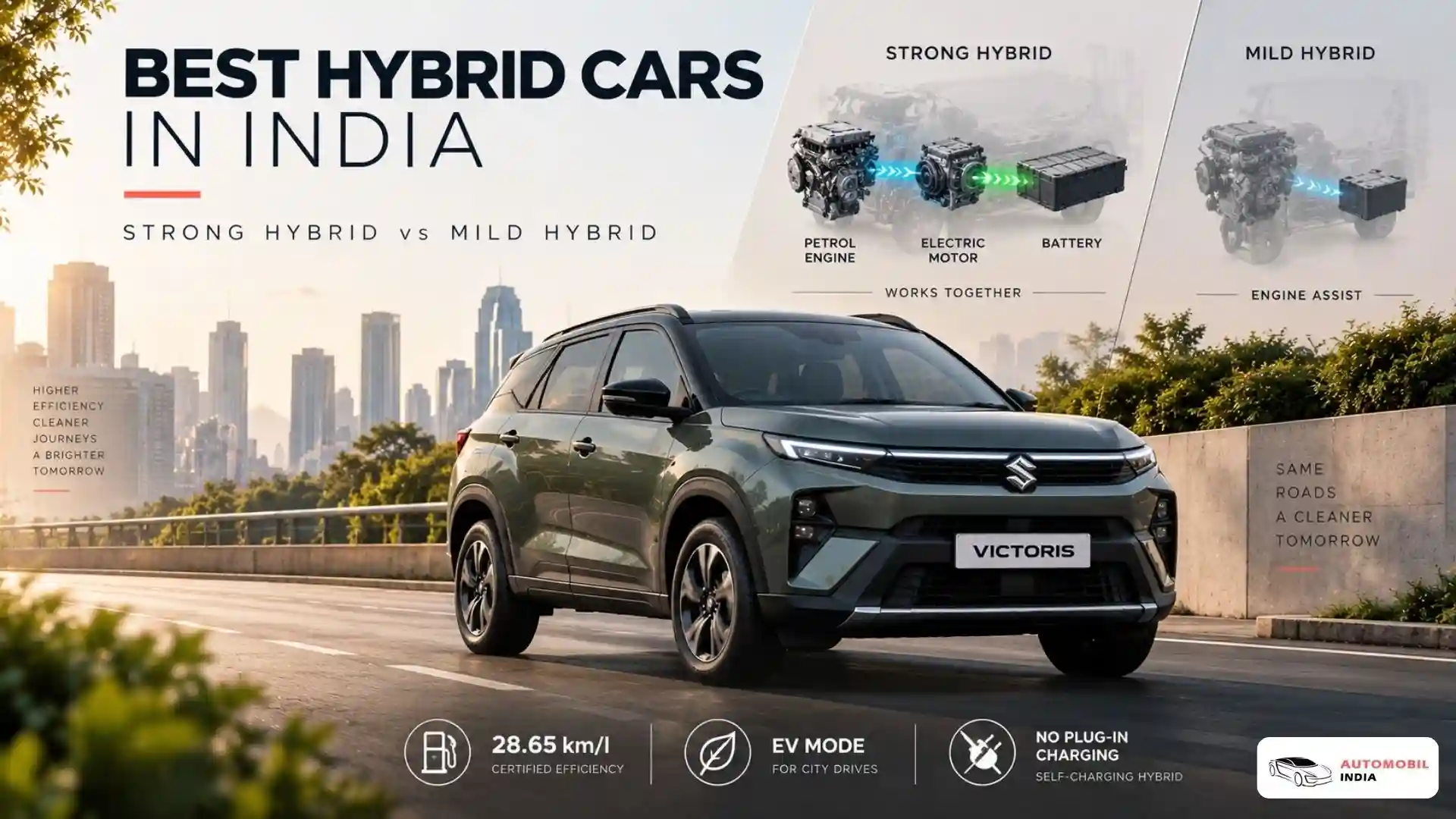
A strong hybrid has a proper traction motor and a larger battery, allowing the car to drive on electric power for short periods. A mild hybrid, by comparison, mainly uses a smaller motor-generator to assist the petrol engine and recover energy during deceleration — it generally cannot drive the vehicle independently on electric power.
For buyers looking at the best hybrid cars in India, the mainstream strong-hybrid choices currently include the Maruti Suzuki Victoris, Maruti Suzuki Grand Vitara, Toyota Urban Cruiser Hyryder, Honda City e:HEV, Toyota Innova HyCross and Maruti Suzuki Invicto. The Toyota Camry sits further upmarket.
The strongest reason to consider a strong hybrid in India is its ability to deliver high fuel efficiency in conditions where petrol cars typically consume more fuel — particularly urban traffic, low-speed running and repeated acceleration and braking.
Best Hybrid Cars in India: Quick Comparison
| Model | Hybrid type | Certified mileage* | Seating | Approx. hybrid variant price* | Best suited for |
|---|---|---|---|---|---|
| Maruti Suzuki Victoris | Strong hybrid | 28.65 km/l | 5 | ₹18.59–19.99 lakh | Urban/family SUV buyers |
| Maruti Suzuki Grand Vitara | Strong hybrid | 27.97 km/l | 5 | From about ₹16.99 lakh | Efficient family SUV |
| Toyota Urban Cruiser Hyryder | Strong hybrid | 27.97 km/l | 5 | From about ₹17.18 lakh | City-focused SUV buyers |
| Honda City e:HEV | Strong hybrid | 27.26 km/l | 5 | Premium sedan range | Sedan buyers |
| Toyota Innova HyCross | Strong hybrid | 23.24 km/l | 7/8 | From about ₹26.76 lakh | Large families |
| Maruti Suzuki Invicto | Strong hybrid | 23.24 km/l | 7/8 | From ₹24.97 lakh | Premium MPV buyers |
| Toyota Camry | Strong hybrid | 25.49 km/l | 5 | Around ₹48 lakh | Premium/luxury sedan buyers |
The table also shows why it is difficult to simply call one model the “best hybrid car”. A five-seat compact SUV, a three-row MPV and a premium sedan serve very different buyers.
Strong Hybrid vs Mild Hybrid: What Is the Difference?
This is the first thing you should understand before comparing hybrid cars.
What is a strong hybrid?
A strong hybrid, also called a full hybrid or HEV, combines:
- A petrol engine
- A traction electric motor
- A relatively larger high-voltage battery
- A control system that manages the engine and motor
- Regenerative braking
The electric motor can actually propel the vehicle under suitable conditions.
Maruti’s strong-hybrid system, for example, combines an internal-combustion engine with an electric motor and lithium-ion battery. The system can switch between electric, engine and combined operation, while regenerative braking helps recharge the battery.
This is particularly useful in city traffic.
The car can shut the petrol engine off while stationary and can use electric propulsion during suitable low-speed conditions. When more power is required, the petrol engine starts and the system automatically combines the two sources.
What is a mild hybrid?
A mild hybrid is fundamentally different.
It normally uses a smaller motor-generator and battery to:
- Assist the petrol engine during acceleration
- Recover energy during braking
- Enable smoother engine stop-start operation
- Reduce some fuel consumption
However, the motor is generally not designed to independently propel the car for meaningful distances.
Examples include Maruti’s Smart Hybrid systems and Toyota’s Neo Drive with Integrated Starter Generator (ISG).
The Toyota Urban Cruiser Hyryder, for example, is available with both a self-charging strong-hybrid system and a 1.5-litre petrol Neo Drive system. The strong hybrid uses an e-drive transmission, while Neo Drive uses the petrol engine with ISG and conventional manual/automatic transmissions.
Strong hybrid vs mild hybrid
This distinction matters because a car with “hybrid” branding may not provide the same fuel-saving benefits as a strong hybrid.
| Feature | Strong hybrid | Mild hybrid |
|---|---|---|
| Electric motor can drive car | Yes | Generally no |
| Larger high-voltage battery | Yes | No |
| EV-only operation | Yes, under suitable conditions | No meaningful EV driving |
| Regenerative braking | Yes | Yes |
| Petrol engine can switch off in traffic | Yes | Yes |
| Fuel-efficiency improvement | Usually substantial | Usually modest |
| External charging required | No | No |
| Typical Indian advantage | City efficiency | Lower-cost electrification |
1. Maruti Suzuki Victoris Strong Hybrid
The Maruti Suzuki Victoris is one of the newest mainstream strong-hybrid SUVs in India and has brought strong-hybrid technology into Maruti’s Arena portfolio.
Its 1.5-litre strong-hybrid system uses an e-CVT and delivers a certified 28.65 km/l, making fuel efficiency one of the central reasons to consider this version.
Key specifications
| Specification | Victoris Strong Hybrid |
|---|---|
| Engine | 1.5-litre petrol |
| Engine displacement | 1,490cc |
| Transmission | e-CVT |
| Petrol engine power | 92.45 PS |
| Motor power | 80 PS |
| Motor torque | 141 Nm |
| Certified mileage | 28.65 km/l |
| Seating | 5 |
| Drive | 2WD |
The Victoris is 4,360mm long with a 2,600mm wheelbase and offers a relatively conventional midsize-SUV footprint. Its strong-hybrid versions are available in VXi/ZXi-family grades, with the current official price list showing strong-hybrid variants from ₹18.59 lakh and reaching about ₹19.99 lakh depending on trim.
Why consider it?
The Victoris makes sense for buyers who want:
- A five-seat SUV
- High certified fuel efficiency
- Automatic transmission
- Strong-hybrid electric assistance
- Maruti’s broad service ecosystem
- Modern safety and technology features
Its equipment list can include a panoramic sunroof, ventilated seats, wireless charging, a 26.03cm digital cluster, 360-degree camera and, on specified petrol variants, Level 2 ADAS.
For someone buying primarily for fuel efficiency, however, it is important to compare the strong-hybrid price premium against the buyer’s annual kilometres rather than assuming that the highest mileage automatically makes the car cheaper to own.
2. Maruti Suzuki Grand Vitara Strong Hybrid
The Grand Vitara Strong Hybrid remains one of the established choices for buyers looking for a fuel-efficient midsize SUV.
It uses a 1.5-litre petrol engine with an electric motor and e-CVT. Maruti quotes 27.97 km/l for the strong-hybrid version.
The strong-hybrid range has expanded over time, with Maruti adding the Delta+ Strong Hybrid at ₹16.99 lakh and continuing with higher Zeta+ and Alpha+ variants.
What makes the Grand Vitara different?
Its biggest advantage is the combination of:
- SUV seating position
- Strong-hybrid efficiency
- e-CVT automatic
- Five-seat cabin
- Large Maruti/NEXA ownership ecosystem
The strong hybrid also supports EV driving under suitable conditions and uses regenerative braking to recover energy.
Who should consider it?
The Grand Vitara Strong Hybrid is particularly relevant for buyers who:
- Drive extensively in cities
- Want an SUV rather than a sedan
- Prefer automatic transmission
- Want high certified fuel efficiency
- Do not want to depend on external charging
It is also worth considering the regular petrol/Smart Hybrid versions before deciding. If annual driving is relatively low, the lower purchase price of a non-strong-hybrid variant may alter the ownership-cost calculation.
3. Toyota Urban Cruiser Hyryder Strong Hybrid
The Toyota Urban Cruiser Hyryder shares its fundamental hybrid architecture with the Grand Vitara and is one of the most established strong-hybrid SUVs in India’s mainstream market.
Toyota quotes 27.97 km/l for its self-charging strong-hybrid version. The system combines a 1.5-litre petrol engine with an electric motor and e-drive transmission.
Toyota says the strong-hybrid system can operate on electric power for suitable portions of a journey, including situations where the engine can remain switched off.
Current hybrid variants
The current range includes hybrid versions such as:
- S Hybrid
- G(O) Hybrid
- V Hybrid
- Special-edition variants depending on availability
Current pricing data places the S Hybrid at around ₹17.18 lakh, G(O) Hybrid around ₹19.24 lakh and V Hybrid around ₹19.99 lakh, with special editions priced differently.
Features
Depending on variant, the Hyryder offers equipment such as:
- Ventilated seats
- Panoramic sunroof
- 9-inch touchscreen
- Wireless Apple CarPlay and Android Auto
- Wireless charging
- 360-degree camera
- Rear AC vents
- Six airbags
Toyota also currently offers an 8-year/160,000km hybrid warranty on the Hyryder, alongside its vehicle warranty provisions.
Hyryder vs Grand Vitara
The two are closely related mechanically, so the decision can come down to:
- Dealer/service network in your area
- Variant equipment
- Purchase price
- Warranty/package differences
- Brand preference
- Local dealer experience
The hybrid powertrain itself is not the main differentiator.
4. Honda City e:HEV
For buyers who prefer a sedan, the Honda City e:HEV remains one of the most distinctive hybrid options in India.
The 2026 City e:HEV uses Honda’s two-motor strong-hybrid system and produces a claimed 126 PS combined output and 253 Nm of combined torque, with an official fuel-efficiency figure of 27.26 km/l.
Key specifications
| Specification | Honda City e:HEV |
|---|---|
| Engine | 1.5-litre Atkinson-cycle petrol |
| Hybrid system | Two-motor strong hybrid |
| Transmission | e-CVT |
| Combined power | 126 PS |
| Combined torque | 253 Nm |
| Certified mileage | 27.26 km/l |
| Seating | 5 |
| Fuel tank | 40 litres |
Honda’s system can automatically switch between EV Drive, Hybrid Drive and Engine Drive, depending on the driving situation.
The e:HEV is available in the ZX+ grade, rather than being offered across the complete City variant range.
Why consider the City e:HEV?
It suits buyers who want:
- A sedan rather than an SUV
- Excellent certified fuel efficiency
- Refined city driving
- Strong-hybrid technology
- A petrol-engine backup for highway travel
- Honda Sensing ADAS features
The main consideration is the higher purchase price compared with the regular City. Buyers should therefore calculate annual running and expected ownership period before paying the hybrid premium.
5. Toyota Innova HyCross Hybrid
If your requirement is a large family vehicle, the Toyota Innova HyCross changes the hybrid equation.
This is a three-row MPV rather than a compact or midsize SUV. It uses Toyota’s fifth-generation self-charging hybrid system with a 2.0-litre petrol engine.
Toyota offers the HyCross in 7- and 8-seat configurations depending on variant, while the top hybrid grades are 7-seaters.
The hybrid version has a certified fuel-efficiency figure of around 23.24 km/l.
Key specifications
| Specification | Innova HyCross Hybrid |
|---|---|
| Engine | 2.0-litre petrol |
| Battery | Ni-MH |
| Transmission | e-Drive |
| Seating | 7/8 depending on variant |
| Hybrid mileage | ~23.24 km/l |
| Drive | Front-wheel drive |
Toyota’s current specifications show a 2.0-litre hybrid system, EV mode and a 206Nm electric-motor torque figure.
Hybrid variants currently start at roughly ₹26.76 lakh ex-showroom for the VX 7-seater, with higher grades extending beyond ₹30 lakh.
Why its mileage matters
A three-row petrol MPV does not need to achieve the same mileage as a compact SUV to make the hybrid system useful.
The HyCross is much larger and heavier than the Victoris or Grand Vitara. Yet its strong-hybrid system is capable of returning a certified 23.24 km/l.
For large families that spend considerable time in urban traffic, this can make the hybrid system particularly relevant.
6. Maruti Suzuki Invicto
The Maruti Suzuki Invicto is the NEXA counterpart to the Innova HyCross and uses the same fundamental 2.0-litre strong-hybrid architecture.
It is offered as a premium three-row MPV with 7- and 8-seat configurations, depending on variant.
The current Invicto range is priced from around ₹24.97 lakh, with the top variant extending to roughly ₹28.70 lakh after the August 2026 revision.
Maruti’s current strong-hybrid technology page lists the Invicto’s hybrid mileage at 22.16 km/l, while older launch material quoted 23.24 km/l. The current figure should therefore be used when comparing the latest product information.
Key features
Depending on variant, the Invicto offers:
- 7/8-seat configurations
- Panoramic sunroof
- 360-degree camera
- Ventilated front seats
- Powered driver seat
- Rear AC
- Connected-car technology
- Six airbags
- e-CVT/strong-hybrid powertrain
It is particularly relevant for buyers who want a large family MPV through the NEXA network.
7. Toyota Camry Hybrid
The Toyota Camry sits in a different price and vehicle segment from the mainstream hybrid SUVs.
It is a premium sedan powered by a 2.5-litre petrol engine and Toyota’s fifth-generation hybrid system.
Toyota quotes:
- 2.5-litre Dynamic Force engine
- 221Nm engine torque
- 169kW/230PS combined system output
- 25.49 km/l certified efficiency
- e-CVT transmission
- Lithium-ion hybrid battery
The Camry also gets Toyota Safety Sense 3.0, including features such as adaptive cruise control, lane-tracing assistance and pre-collision technology, along with nine airbags and a 360-degree panoramic-view monitor on the current model.
With pricing around the ₹48 lakh mark, it should not be compared directly with the Grand Vitara or Hyryder simply on mileage.
Here, the hybrid system is part of a much more premium package involving performance, comfort, cabin quality and long-distance refinement.
Mild-Hybrid Cars in India: Are They Worth Considering?
Strong hybrids receive most of the attention when people search for the best hybrid cars in India, but mild-hybrid systems are still relevant.
Common examples include:
| Model | Hybrid system | What it offers |
|---|---|---|
| Maruti Grand Vitara | Smart Hybrid | Engine assistance and regenerative braking |
| Toyota Urban Cruiser Hyryder | Neo Drive/ISG | Engine assistance and stop-start efficiency |
| Maruti Victoris | Smart Hybrid petrol | Lower-cost electrification |
| Maruti Brezza | Smart Hybrid | Mild hybrid assistance |
| Maruti Fronx | Smart Hybrid on applicable powertrain | Engine assistance |
| Maruti Ertiga | Smart Hybrid | Efficiency-focused engine assistance |
| Maruti XL6 | Smart Hybrid | Efficiency-focused engine assistance |
The crucial point is that mild-hybrid mileage should not be compared directly with strong-hybrid mileage.
For example, the Hyryder’s Neo Drive petrol variants are rated at lower efficiency than the 27.97km/l strong-hybrid version. Toyota’s own specifications list 21.11km/l for the 2WD manual and 20.58km/l for the 2WD automatic Neo Drive, compared with 27.97km/l for the strong hybrid.
This is a useful real-world lesson: the word “hybrid” alone does not tell you how much electric propulsion the vehicle actually has.
Strong Hybrid vs Mild Hybrid: Which Should You Buy?
Rather than asking which technology is universally better, look at how you drive.
Choose a strong hybrid if you:
- Drive heavily in city traffic
- Cover a high annual distance
- Want an automatic
- Want to maximise fuel efficiency
- Frequently encounter stop-start traffic
- Do not want EV charging dependency
- Plan to keep the car for several years
The strong hybrid’s ability to use electric propulsion at suitable times is especially valuable in urban driving.
Consider a mild hybrid if you:
- Want a lower purchase price
- Prefer conventional petrol driving
- Do not drive very high annual kilometres
- Want some efficiency assistance without paying for a full hybrid system
- Want more transmission/powertrain choices
A mild hybrid should be viewed as an efficiency-assistance system, not as a substitute for a full strong hybrid.
Why Strong Hybrids Can Be Efficient in Indian Cities
Indian city traffic creates an unusual environment for petrol engines.
A conventional petrol car may spend significant time:
- Idling at signals
- Accelerating from low speed
- Braking repeatedly
- Crawling through congestion
- Operating inefficiently at low speeds
A strong hybrid can turn some of these situations into opportunities to use electric propulsion and recover energy through regenerative braking.
This is why strong-hybrid cars can produce particularly strong fuel-economy results in urban use.
However, this does not mean a strong hybrid will always be more efficient on every highway journey.
At sustained highway speeds, the petrol engine can operate efficiently, but there are fewer opportunities for regenerative braking and electric-only operation.
Are Hybrid Cars More Expensive to Maintain?
The answer needs more nuance than simply saying “hybrids are expensive to maintain”.
A strong hybrid has additional components such as:
- High-voltage battery
- Electric motor
- Power electronics
- Hybrid control systems
At the same time, some hybrid systems can reduce stress on certain components because the engine does not need to operate continuously and regenerative braking can reduce reliance on friction brakes.
Modern mainstream hybrid systems are designed for normal vehicle ownership rather than requiring special daily maintenance.
Battery warranty is also an important factor.
For example, Toyota currently advertises an 8-year/160,000km hybrid warranty for the Urban Cruiser Hyryder. Maruti’s Grand Vitara strong-hybrid launch information also specified an 8-year/160,000km battery warranty.
Do Hybrid Cars Need to Be Charged?
No, mainstream self-charging strong hybrids do not need to be plugged into an external charger.
This is one of their biggest differences from EVs and plug-in hybrids.
The battery is replenished through:
- Regenerative braking
- Energy generated by the engine/hybrid system
- The vehicle’s energy-management system
Maruti explicitly states that its strong-hybrid systems do not require external charging.
This gives a strong hybrid an important advantage for buyers who want some electric driving capability but do not have convenient home charging.
Hybrid vs Petrol vs EV: Which Powertrain Makes Sense?
There is no universally correct powertrain.
| Requirement | Petrol | Strong Hybrid | EV |
|---|---|---|---|
| Low purchase price | Often favourable | Higher | Varies |
| City fuel efficiency | Moderate | Very high potential | Very high energy efficiency |
| Highway convenience | High | High | Depends on charging network |
| External charging | No | No | Yes |
| Long-distance refuelling | Very convenient | Very convenient | Requires planning |
| Low-speed electric driving | No | Yes | Yes |
| Battery dependency | Small 12V battery | High-voltage hybrid battery | Large traction battery |
| Best suited to | Lower annual mileage/general use | High city usage + long ownership | Buyers comfortable with charging |
A person driving 5,000-7,000km a year may not recover a strong-hybrid price premium as quickly as someone driving 15,000-20,000km every year.
On the other hand, someone spending hours every day in congested traffic may value the hybrid system’s smoothness and efficiency even beyond the simple fuel-cost calculation.
How to Calculate Whether a Strong Hybrid Is Worth the Extra Money
Instead of assuming a hybrid will automatically save money, use a simple calculation.
Step 1: Estimate annual kilometres
For example:
- 15,000km per year
Step 2: Estimate real-world fuel economy
Do not automatically use the ARAI figure.
If a petrol car actually returns 13km/l and a strong hybrid returns 20km/l in your usage:
- Petrol consumption: 15,000 ÷ 13 = 1,154 litres
- Hybrid consumption: 15,000 ÷ 20 = 750 litres
- The difference is approximately 404 litres per year
Multiply that by your actual petrol price.
That gives you an approximate annual fuel saving.
Step 3: Compare the purchase-price difference
If the strong-hybrid variant costs significantly more than the equivalent petrol model, divide the additional purchase cost by the expected annual fuel saving.
This gives you a rough fuel-cost payback period.
What Is the Best Hybrid Car for Different Buyers?
Instead of giving every hybrid a single ranking, the more useful approach is to match the vehicle to the requirement.
For a fuel-efficient five-seat SUV
Consider the Maruti Suzuki Victoris, Grand Vitara Strong Hybrid or Toyota Urban Cruiser Hyryder Strong Hybrid.
The Victoris currently has the highest certified mileage among these at 28.65km/l, while the Grand Vitara and Hyryder are rated at 27.97km/l.
For a hybrid sedan
The Honda City e:HEV is the mainstream option to examine, particularly if you prefer sedan comfort and Honda’s two-motor hybrid system.
Its 27.26km/l certified figure is competitive with the strong-hybrid SUVs.
For a large family
The Toyota Innova HyCross Hybrid and Maruti Suzuki Invicto are the relevant three-row choices.
Their hybrid systems are especially interesting for families that spend significant time in city traffic but still need a petrol-powered vehicle for highway journeys.
For a premium sedan
The Toyota Camry Hybrid sits in a different category, combining a strong hybrid system with a significantly more premium vehicle package.
For buyers who want lower upfront cost
A mild-hybrid petrol model may make more financial sense if annual driving is limited and the buyer does not want to pay the premium for a strong-hybrid powertrain.
What to Check Before Buying a Hybrid Car
Before booking a hybrid, look beyond the mileage figure.
1. Compare equivalent variants
Do not compare the entry-level petrol version with the top-end hybrid version and conclude that the hybrid is expensive.
Compare equipment and powertrain as closely as possible.
2. Calculate your annual kilometres
A hybrid makes more financial sense when the car is driven regularly.
3. Consider your driving environment
Strong hybrids tend to make particularly good use of their technology in urban traffic.
4. Check battery warranty
Look at:
- Duration
- Kilometre limit
- Warranty conditions
- Transferability
- Coverage after the first owner
5. Check boot space
Hybrid battery packaging can affect luggage space depending on the vehicle.
6. Take a test drive in traffic
Do not evaluate a hybrid only on an empty road.
Try it in:
- Traffic
- Parking areas
- Slow-speed roads
- Stop-start conditions
This is where the character of the powertrain becomes much easier to understand.
Frequently Asked Questions