Premium hatchbacks continue to make sense for Indian buyers who want a car that is compact enough for crowded cities but offers more space, equipment and road presence than an entry-level hatchback.
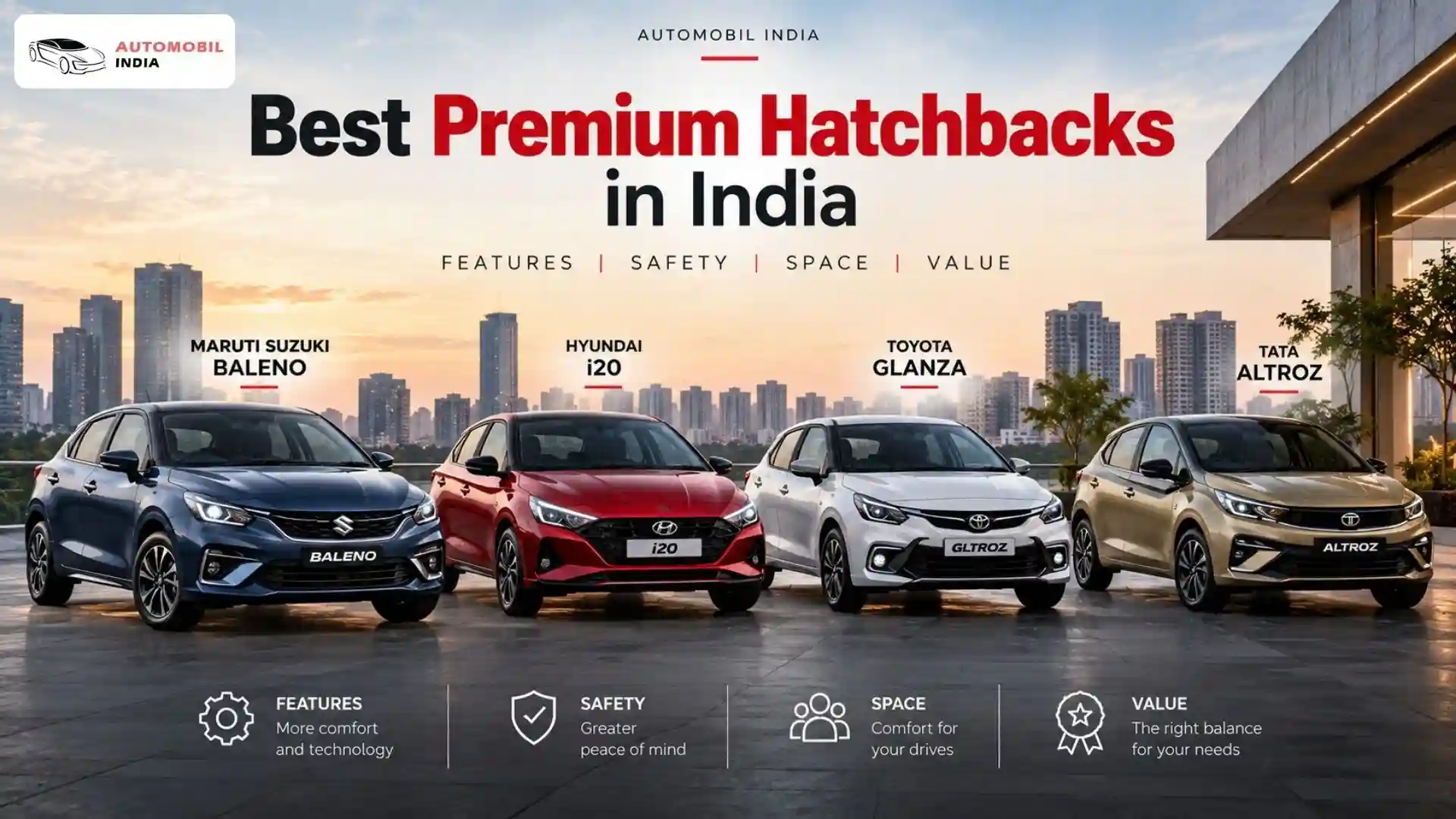
As of September 2026, the segment includes familiar names such as the Maruti Suzuki Baleno, Hyundai i20, Toyota Glanza and Tata Altroz. Their priorities are different: the Baleno has received a major technology and safety upgrade, the i20 focuses heavily on premium equipment and cabin experience, the Glanza combines hatchback practicality with petrol and CNG choices, while the Altroz remains an important option for buyers looking at Tata’s premium-hatchback proposition.
The right choice depends less on finding a universal “best” car and more on deciding what matters most to you: features, safety equipment, automatic convenience, fuel economy, rear-seat practicality, CNG availability or ownership priorities.
Best Premium Hatchbacks in India at a Glance
| Car | Key strengths | Powertrain highlights | Best suited for |
|---|---|---|---|
| Maruti Suzuki Baleno | Features, ADAS, efficiency, equipment | 1.2L petrol, MT/AGS; CNG MT | Buyers wanting technology and efficiency |
| Hyundai i20 | Premium cabin, features, automatic option | 1.2L petrol, MT/IVT | Buyers prioritising comfort and premium features |
| Toyota Glanza | Petrol/CNG flexibility, efficiency, features | 1.2L petrol, MT/AMT; CNG MT | City users and CNG-focused buyers |
| Tata Altroz | Premium-hatchback design, multiple powertrain choices | Petrol/CNG and other configurations depending on variant | Buyers wanting powertrain and styling flexibility |
Which Is the Best Premium Hatchback in India?
There is no single answer for every buyer.
The Maruti Suzuki Baleno is particularly relevant for buyers looking for a feature-rich hatchback with modern driver-assistance technology. Its latest version adds Level 2 ADAS, six airbags and features such as ventilated front seats and a 360-degree camera.
The Hyundai i20 remains focused on premium cabin equipment. It offers a 1.2-litre petrol engine with manual and IVT automatic transmission choices, while higher variants add features such as a large touchscreen, Bose audio system, wireless connectivity, sunroof and connected technology.
The Toyota Glanza is worth considering if fuel economy and CNG availability are important. Toyota lists both petrol and E-CNG configurations, with petrol variants offering manual and AMT options.
The Tata Altroz is another important choice for buyers who want a premium hatchback with a different design approach and a broad powertrain portfolio.
1. Maruti Suzuki Baleno
The Baleno has become one of the most technology-focused cars in this segment following its latest update.
Maruti Suzuki has introduced the new Baleno with a starting ex-showroom price of ₹6.09 lakh in Bengaluru. The company has also opened bookings for the updated model.
Baleno engine and mileage
The updated Baleno uses Maruti Suzuki’s 1.2-litre Advanced Z12E petrol engine.
It produces:
- 61 kW of maximum power
- 112.4 Nm of peak torque
- 5-speed manual transmission
- AGS automatic transmission
- S-CNG option with manual transmission
Maruti Suzuki claims certified fuel efficiency of 23.80 km/l for the manual and 24.77 km/l for the AGS. The CNG version is rated at 33.61 km/kg.
These are certified test-cycle figures and should not be interpreted as guaranteed real-world mileage.
Baleno features
The latest Baleno brings several features that were previously unusual in this price bracket.
Depending on variant, the car offers:
- Level 2 ADAS
- Advanced Emergency Braking
- Lane Keep Assist
- Lane Departure Warning
- Adaptive Cruise Control
- High Beam Assist
- Forward Collision Warning
- 6 airbags
- ESP
- TPMS
- 360-degree camera
- Head-Up Display
- Ventilated front seats
- 9-inch SmartPlay Pro+ infotainment system
- Wireless Apple CarPlay and Android Auto
- Suzuki Connect
- Premium Clarion audio system
The Level 2 ADAS package uses a combination of radar and camera hardware.
Who should consider the Baleno?
The Baleno makes particular sense for buyers who want a compact hatchback with a large technology package, especially those interested in ADAS and fuel-efficient powertrain choices.
The CNG version also gives it relevance for high-mileage urban users.
2. Hyundai i20
The Hyundai i20 continues to occupy the more premium end of the hatchback segment, with a strong emphasis on cabin equipment, styling and convenience features.
Hyundai currently lists the i20 from ₹5.99 lakh ex-showroom for the Era variant. The manufacturer notes that prices vary by variant and location.
i20 engine and transmission
The i20 uses a 1.2-litre Kappa petrol engine.
It is available with:
- 5-speed manual transmission
- IVT automatic transmission
Hyundai lists the engine as a four-cylinder 1,197cc naturally aspirated petrol unit.
For buyers spending significant time in city traffic, the IVT can make the i20 easier to drive because there is no need for repeated clutch operation.
i20 features
The higher variants bring a substantial equipment list, including:
- 6 airbags
- Highline TPMS
- Dashcam on applicable variants
- Wireless Apple CarPlay and Android Auto
- Bose premium 7-speaker audio system
- 10.25-inch HD touchscreen and navigation on applicable variants
- Wireless charger
- Smart electric sunroof
- Voice-enabled sunroof on applicable variants
- Cruise control
- Hyundai Bluelink
- Digital instrument cluster
Hyundai’s current feature matrix confirms that equipment varies considerably between variants, so buyers should compare the exact trim rather than assuming every i20 gets every feature.
i20 dimensions and practicality
The i20 measures:
- Length: 3,995 mm
- Width: 1,775 mm
- Height: 1,505 mm
- Fuel tank: 37 litres
It is a front-wheel-drive, five-door hatchback.
The dimensions give the i20 a relatively substantial footprint for a hatchback while keeping it manageable for urban driving.
Who should consider the i20?
The i20 suits buyers who put a high value on interior ambience, convenience features and automatic driving without moving into SUV territory.
3. Toyota Glanza
The Toyota Glanza shares its underlying architecture with the Baleno but has its own Toyota design, equipment packaging and ownership proposition.
Toyota currently lists the Glanza from ₹6.73 lakh ex-showroom on its India website.
Glanza engine and mileage
Toyota lists a 1.2-litre four-cylinder petrol engine producing:
- 66 kW
- 113 Nm
The petrol version is offered with manual and AMT transmission choices.
Toyota’s listed fuel-efficiency figures are:
- 22.35 km/l — manual
- 22.94 km/l — AMT
The Glanza is also available with an E-CNG powertrain.
Glanza dimensions
The Toyota Glanza measures:
- Length: 3,990 mm
- Width: 1,745 mm
- Height: 1,500 mm
- Wheelbase: 2,520 mm
- Fuel tank: 37 litres
- Seating: 5
It uses MacPherson struts at the front and a torsion beam at the rear.
Glanza features
Depending on variant, Toyota lists equipment such as:
- Head-Up Display
- 360-degree camera
- Connected-car technology
- Toyota i-Connect
- Cruise control
- Auto AC
- Rear AC vents
- Push-button start
- 60:40 split rear seats
- Rear USB charging
- TPMS
- Vehicle Stability Control
- Hill-hold control
- Front, side and curtain airbags
The exact feature availability varies by variant.
Glanza CNG
For buyers covering large monthly distances, the E-CNG version is one of the Glanza’s important differentiators.
Toyota lists certified fuel efficiency of 30.61 km/kg for the E-CNG version.
CNG can reduce fuel expenditure per kilometre, although buyers should also consider the availability of CNG stations along their regular routes and the implications for luggage space and refuelling convenience.
Who should consider the Glanza?
The Glanza is particularly relevant to buyers looking for petrol/CNG flexibility, efficient city transportation and a feature-rich hatchback.
4. Tata Altroz
The Tata Altroz occupies a slightly different space in the premium-hatchback conversation, with its styling, cabin design and broad powertrain portfolio being major considerations.
For buyers comparing the Altroz with the Baleno, i20 and Glanza, the important areas to examine include:
- Engine choice
- CNG availability
- Automatic transmission availability
- Rear-seat space
- Boot practicality
- Safety equipment
- Variant-wise features
- Service support in your area
The Altroz should therefore be evaluated on the exact variant rather than simply comparing the starting price.
Premium Hatchback Price Comparison
Ex-showroom pricing can change because manufacturers periodically revise prices, introduce new variants and alter equipment.
| Model | Current starting-price reference | Important note |
|---|---|---|
| Maruti Suzuki Baleno | ₹6.09 lakh* | New Baleno; Bengaluru introductory ex-showroom price |
| Hyundai i20 | ₹5.99 lakh* | Era variant; location-specific on-road price will be higher |
| Toyota Glanza | ₹6.73 lakh* | Toyota India listed starting price |
| Tata Altroz | Check current Tata price list | Price varies by powertrain and variant |
For an actual purchase comparison, use the on-road price in your city, because registration, insurance and other charges can substantially change the final amount.
Premium Hatchback Features Compared
| Feature | Baleno | i20 | Glanza | Altroz |
|---|---|---|---|---|
| 6 airbags | Yes | Yes | Yes* | Variant-dependent |
| Automatic option | AGS | IVT | AMT | Depends on powertrain/variant |
| CNG | Yes | No | Yes | Yes |
| ADAS | Level 2 on applicable variant | Not the main differentiator | No Level 2 ADAS listed | Not the main differentiator |
| 360-degree camera | Yes | Variant-dependent | Yes, applicable variant | Variant-dependent |
| Connected technology | Suzuki Connect | Bluelink | Toyota i-Connect | Variant-dependent |
| Sunroof | Variant-dependent | Yes | Variant-dependent | Variant-dependent |
| Rear AC vents | Variant-dependent | Yes, applicable variants | Yes | Variant-dependent |
Which Premium Hatchback Is Best for Features?
If features are your primary criterion, don’t simply compare the number of features.
Look at which variant provides the features you actually want.
For example, the latest Baleno’s Level 2 ADAS package is significant for buyers specifically interested in driver-assistance technology.
The i20, meanwhile, has a strong premium-equipment proposition with features such as a Bose audio system, large touchscreen, wireless charging and sunroof on higher variants.
The Glanza’s combination of connected technology, HUD, 360-degree camera and CNG availability gives it a different value proposition.
Which Premium Hatchback Is Best for Mileage?
The answer depends on the fuel type.
For petrol buyers, the latest Baleno’s claimed 24.77 km/l with AGS is higher than Toyota’s listed 22.94 km/l for the Glanza AMT under their respective certified test cycles.
For CNG buyers, Toyota lists 30.61 km/kg for the Glanza E-CNG, while Maruti Suzuki lists 33.61 km/kg for the new Baleno S-CNG.
These figures should be treated as certified test-cycle figures, not guaranteed fuel economy in Indian traffic.
Real-world consumption can vary considerably depending on:
- Traffic
- Driving style
- Air-conditioning use
- Vehicle load
- Road conditions
- Tyre pressure
- Average speed
Which Premium Hatchback Is Better for City Driving?
All four are fundamentally designed to work well in urban environments because of their compact footprints.
For buyers who frequently encounter heavy traffic, the automatic transmission choice becomes important.
- Baleno: AGS automatic
- i20: IVT
- Glanza: AMT
- Altroz: automatic availability depends on the specific powertrain and variant
The transmission characteristics are different.
An IVT generally provides smooth acceleration without conventional gear shifts, while an AMT/AGS uses automated manual gear changes and can feel different during low-speed shifts.
A test drive in your normal traffic conditions is therefore more useful than judging an automatic only from its specification sheet.
Which Premium Hatchback Is Better for Families?
For a family buyer, don’t judge practicality purely by exterior dimensions.
Check:
- Rear-seat knee room
- Shoulder room
- Seat cushioning
- Rear AC vents
- Door opening
- Ease of installing a child seat
- Boot capacity
- Rear-seat split
- Visibility
- Ride comfort
The i20 and Glanza have particularly practical hatchback dimensions, while the Baleno’s packaging also makes it relevant for family use.
The final choice should be based on the actual family members who will use the car. A test drive with the family can reveal differences that specifications cannot.
Safety: What Should You Check?
Six airbags are useful equipment, but they should not be treated as a complete measurement of vehicle safety.
When comparing premium hatchbacks, check:
- Airbag count
- Electronic stability control
- ABS and EBD
- Seat-belt reminders
- ISOFIX mounts
- TPMS
- Parking sensors/camera
- ADAS availability
- Official crash-test results where available
- Variant-specific safety equipment
The latest Baleno, for example, combines six airbags and ESP with its available Level 2 ADAS package.
The i20’s current equipment list also includes six airbags across the range, with additional safety and driver-convenience features varying by trim.
The important distinction is between active safety features, which can help avoid or mitigate a collision, and passive safety equipment, which is designed to protect occupants during a crash.
What About Automatic vs Manual?
Your transmission choice can significantly change the ownership experience.
Choose manual if:
- You enjoy controlling gear changes.
- You want a lower purchase price where applicable.
- You are comfortable using the clutch in traffic.
- You frequently drive on open roads and prefer direct control.
Consider an automatic if:
- Most of your driving is in traffic.
- You want to reduce clutch operation.
- Multiple family members drive the car.
- Ease of driving is a priority.
The i20’s IVT has a different operating character from the Baleno and Glanza’s AMT/AGS systems, so buyers should not treat all automatic hatchbacks as identical.
What Should You Check Before Buying a Premium Hatchback?
1. Compare the exact variants
A base model and top model can have very different equipment.
2. Check the on-road price
Ex-showroom price alone does not tell you what you will actually pay.
3. Test the rear seat
Take the people who will regularly use the rear seat.
4. Test the automatic in traffic
An automatic that feels good in an empty showroom road may feel different in bumper-to-bumper traffic.
5. Check boot practicality
If you travel frequently, physically test your luggage.
6. Check service availability
Service accessibility can matter more than a small difference in specification.
7. Check tyre size and replacement cost
Larger alloy wheels may look attractive but can increase tyre replacement costs.
8. Check the safety equipment of your exact variant
Do not assume a feature available on the top variant is available throughout the range.
Premium Hatchback vs Compact SUV
A premium hatchback is not automatically inferior to a compact SUV.
The two body styles simply prioritise different things.
A premium hatchback generally offers:
- Lower seating height
- Easier manoeuvrability
- Lower centre of gravity
- Usually lower purchase price
- Efficient use of urban road space
A compact SUV generally offers:
- Higher seating position
- More visual road presence
- Easier ingress and egress for some users
- Different ground-clearance and packaging characteristics
If most of your driving is in a city, don’t buy an SUV simply because it looks larger. Compare the actual requirements of your household.
Frequently Asked Questions
Which is the best premium hatchback in India?
There is no single choice that suits every buyer. The Baleno, i20, Glanza and Altroz have different strengths in features, powertrains, efficiency, technology and practicality.
Which premium hatchback has the best mileage?
Certified mileage depends on the fuel type and transmission. The latest Baleno is rated at up to 24.77 km/l with AGS, while Toyota lists the Glanza at up to 22.94 km/l with AMT.
Which premium hatchback has CNG?
The Maruti Suzuki Baleno and Toyota Glanza are available with CNG powertrains. The Tata Altroz also has a CNG option depending on the current model and variant lineup.
Does the Hyundai i20 have an automatic transmission?
Yes. The current i20 is available with Hyundai’s IVT automatic on selected variants.
Which premium hatchback has ADAS?
The latest Maruti Suzuki Baleno introduces Level 2 ADAS on applicable variants, including features such as adaptive cruise control, lane-keeping assistance and automatic emergency braking.
Which premium hatchback is good for city driving?
All of the major premium hatchbacks can work well in urban conditions. Buyers who spend a lot of time in traffic should pay particular attention to the automatic transmission’s behaviour, steering effort, visibility and ride comfort.
Are premium hatchbacks better than SUVs?
Not universally. Premium hatchbacks generally prioritise compact dimensions and efficient urban packaging, while SUVs offer a higher seating position and different proportions. The better body style depends on your requirements.
Is six-airbag equipment enough to call a car safe?
No. Airbag count is only one part of vehicle safety. Buyers should also consider crash-test results, structural performance, electronic stability control, seat-belt systems and other safety equipment.
What should I compare besides price?
Compare the exact variant’s safety equipment, engine, transmission, mileage claim, rear-seat space, boot practicality, comfort features, technology, service network and expected ownership costs.
Should I buy the top variant?
Not necessarily. A mid-spec variant can sometimes provide the features you actually need without paying for equipment you will rarely use. Compare variant-wise equipment before deciding.