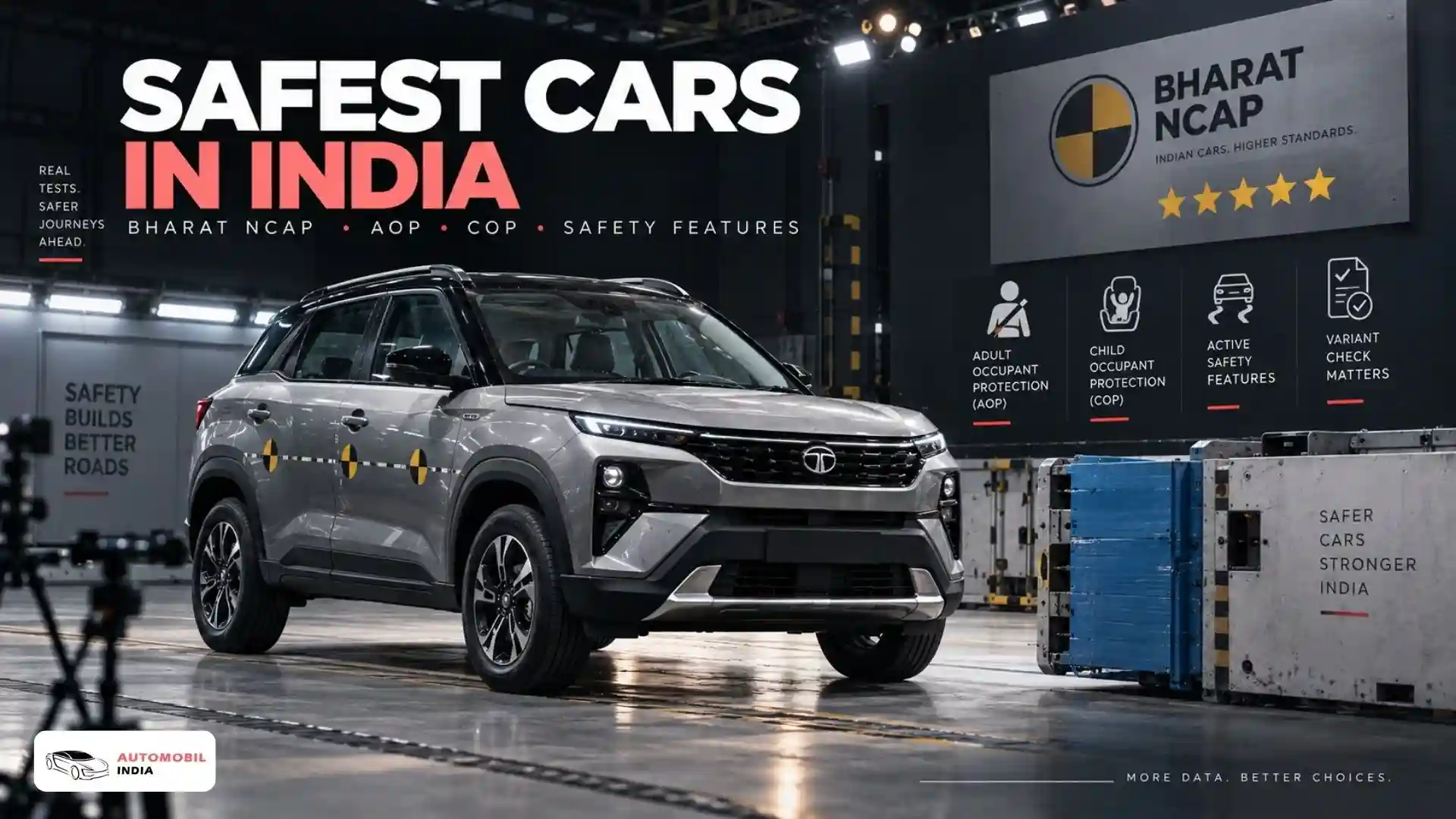
For Indian car buyers, safety has moved from being a secondary consideration to one of the most important factors in a new-car purchase. The arrival of Bharat NCAP (BNCAP) has also made it easier to compare crash protection using a standardised Indian testing programme.
But looking for the safest cars in India is more complicated than finding every model with five stars.
A five-star Bharat NCAP rating means the vehicle has met the programme’s requirements for a five-star result. However, two five-star cars can have different Adult Occupant Protection (AOP) and Child Occupant Protection (COP) scores, different standard safety equipment and very different levels of driver-assistance technology.
As of September 2026, the current Bharat NCAP database includes five-star-rated models such as the Mahindra XEV 9e, Mahindra BE 6, Kia Seltos, Maruti Suzuki Victoris, Hyundai Venue, Tata Sierra, Tata Punch EV, Maruti Suzuki Brezza, Nissan Tekton, Renault Duster, Tata Punch, Mahindra XUV 7XO, Skoda Kylaq and Tata Nexon, among others.
This guide explains the current Bharat NCAP results, what the scores mean, how different safety features work and what buyers should check before choosing a car.
Safest Cars in India: Current Bharat NCAP Snapshot
The following table focuses on current passenger vehicles with published Bharat NCAP results. The scores are from the official BNCAP database.
| Car | BNCAP Rating | Adult Protection | Child Protection | Test Year | Vehicle Type |
|---|---|---|---|---|---|
| Mahindra XEV 9e | 5 stars | 32/32 | 45/49 | 2025 | Electric SUV |
| Mahindra BE 6 | 5 stars | 31.97/32 | 45/49 | 2025 | Electric SUV |
| Kia Seltos | 5 stars | 31.70/32 | 45/49 | 2026 | SUV |
| Maruti Suzuki Victoris | 5 stars | 31.66/32 | 43/49 | 2025 | SUV |
| Maruti Suzuki e Vitara | 5 stars | 31.49/32 | 43/49 | 2025 | Electric SUV |
| Hyundai Venue | 5 stars | 31.15/32 | 44.46/49 | 2026 | Compact SUV |
| Tata Sierra | 5 stars | 31.14/32 | 44.73/49 | 2026 | SUV |
| Tata Punch EV 2026 | 5 stars | 31.09/32 | 45/49 | 2026 | Electric SUV |
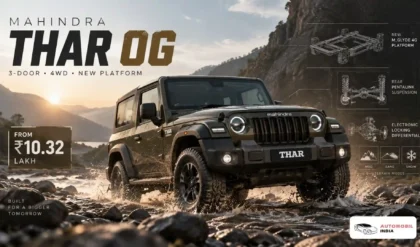
| Mahindra Thar Roxx | 5 stars | 31.09/32 | 45/49 | 2024 | SUV |
| Mahindra XUV 7XO | 5 stars | 30.76/32 | 44.97/49 | 2026 | 3-row SUV |
| Tata Punch | 5 stars | 30.58/32 | 45/49 | 2025 | Compact SUV |
| Nissan Tekton | 5 stars | 30.49/32 | 45/49 | 2026 | SUV |
| Renault Duster | 5 stars | 30.49/32 | 45/49 | 2026 | SUV |
| Maruti Suzuki Invicto | 5 stars | 30.43/32 | 45/49 | 2025 | MPV |
| Maruti Suzuki Brezza | 5 stars | 30.41/32 | 43/49 | 2026 | Compact SUV |
| Mahindra XUV400 EV | 5 stars | 30.38/32 | 43/49 | 2024 | Electric SUV |
| Skoda Kylaq | 5 stars | 30.88/32 | 45/49 | 2025 | Compact SUV |
| Tata Altroz | 5 stars | 29.65/32 | 44.90/49 | 2025 | Hatchback |
| Tata Nexon | 5 stars | 29.41/32 | 43.83/49 | 2024 | Compact SUV |
| Mahindra XUV 3XO | 5 stars | 29.36/32 | 43/49 | 2024 | Compact SUV |
What Does a 5-Star Bharat NCAP Rating Actually Mean?
Bharat NCAP is India’s official new-car safety assessment programme. It evaluates vehicles beyond the minimum regulatory requirements by testing their crash performance and assessing safety-assistance systems.
The programme assesses three broad areas:
Adult Occupant Protection
AOP measures protection offered to adult occupants during the prescribed crash tests.
It considers factors such as:
- Head protection
- Chest protection
- Neck protection
- Pelvis and leg protection
- Restraint performance
- Airbag performance
- Structural behaviour
Child Occupant Protection
COP evaluates protection for child occupants using child dummies and child-restraint-related assessments.
This is particularly relevant for families because a car can perform strongly for adults while having a different result for children.
Safety Assist Technologies
BNCAP also considers specified safety-assistance systems.
The programme identifies systems such as:
- Electronic Stability Control
- Pedestrian protection
- Side-head protection
- Seatbelt reminders
as part of its safety assessment.
Why a Five-Star Rating Does Not Tell the Whole Story
Imagine two cars both carrying a five-star rating.
That does not mean they have identical crash-test scores.
For example:
- Kia Seltos: 31.70/32 AOP, 45/49 COP
- Maruti Suzuki Victoris: 31.66/32 AOP, 43/49 COP
- Hyundai Venue: 31.15/32 AOP, 44.46/49 COP
- Tata Sierra: 31.14/32 AOP, 44.73/49 COP
- Tata Punch: 30.58/32 AOP, 45/49 COP
All are five-star-rated, but their individual scores are different.
That is why a useful safety comparison should show both the star rating and the underlying scores.
Cars With Particularly Strong Bharat NCAP Scores
Mahindra XEV 9e
The Mahindra XEV 9e recorded 32/32 for Adult Occupant Protection and 45/49 for Child Occupant Protection in Bharat NCAP.
The result places the XEV 9e in the highest five-star category, while its safety package also includes modern electronic driver-assistance technology.
The XEV 9e is a premium electric SUV rather than a budget family car. Its price starts around ₹21.90 lakh ex-showroom, with the current range extending to around ₹29.95 lakh depending on variant and battery configuration.
Mahindra offers Level 2 ADAS and a large technology package across the XEV 9e range.
What this means for buyers
The XEV 9e demonstrates why safety should not be reduced to airbags alone. It combines crash-test performance with electronic stability systems, restraint systems and active driver assistance.
Mahindra BE 6
The Mahindra BE 6 scored 31.97/32 in AOP and 45/49 in COP, earning a five-star Bharat NCAP rating.
The tested BE 6 variant was the Three B79, and the rating applies to the variants listed by Bharat NCAP.
The BE 6 starts at around ₹18.90 lakh ex-showroom for the Pack One configuration, although the price depends on battery pack and variant.
The BE 6 also offers a substantial electronic safety package, including ESC, side-head protection and seatbelt reminders as standard within the BNCAP-rated configuration.
Why it matters
For buyers considering a premium electric SUV, the BE 6 combines a high crash-protection score with an electric powertrain and advanced driver-assistance technology.
Kia Seltos
The latest Kia Seltos achieved 31.70/32 for Adult Occupant Protection and 45/49 for Child Occupant Protection, with a five-star Bharat NCAP rating.
The tested vehicle included the HTE(O) and GTX diesel automatic configurations, and the official BNCAP fact sheet specifies the variants to which the rating applies.
Safety equipment
The current Seltos has:
- Six airbags as standard
- ESC
- Vehicle Stability Management
- Hill-start assist
- ISOFIX
- Rear parking sensors
- All-wheel disc brakes
- Rear-view camera
- Tyre-pressure monitoring
Higher variants add:
- 360-degree camera
- Blind View Monitor
- ADAS
- Front collision warning
- Lane keeping assistance
- Blind-spot collision warning
- Rear cross-traffic collision avoidance
- Safe Exit Warning
Kia currently advertises Level 2 ADAS with 21 autonomous safety features on the new Seltos.
Price
The Seltos starts at approximately ₹10.99 lakh ex-showroom, while higher variants extend beyond ₹20 lakh.
Who should consider it?
The Seltos is relevant to buyers who want a family SUV with a five-star BNCAP result, multiple engine choices and advanced active-safety equipment on higher variants.
Maruti Suzuki Victoris
The Maruti Suzuki Victoris achieved 31.66/32 in AOP and 43/49 in COP, earning five stars under Bharat NCAP.
The rating covers a broad range of listed petrol, automatic, strong-hybrid and 4WD variants.
Safety features
Depending on variant, Victoris offers:
- Six airbags
- ESC
- TPMS
- 360-degree camera
- ADAS
- Electronic parking brake
- Connected safety functions
Maruti’s current variant information shows the Victoris starting at ₹10.499 lakh, with petrol, CNG and strong-hybrid versions available.
Higher automatic variants can be equipped with Level 2 ADAS, while the strong-hybrid range begins at around ₹16.43 lakh.
Why it matters
The Victoris is particularly relevant for families who want a five-star safety result without moving into a premium SUV price bracket.
Hyundai Venue
The latest Hyundai Venue achieved 31.15/32 in AOP and 44.46/49 in COP, earning a five-star Bharat NCAP rating.
Hyundai says the new Venue has more than 65 advanced safety features, including 33 standard safety features across all variants.
Standard safety
The current Venue offers:
- Six airbags
- ESC
- Hill-start assist
- Vehicle stability management
- Seatbelt-related safety systems
Higher variants add technologies such as:
- Surround View Monitor
- Blind View Monitor
- ADAS Level 2
- Forward Collision-Avoidance Assist
- Lane Keeping Assist
- Driver attention-related assistance
Hyundai’s current Venue price starts at ₹7.999 lakh ex-showroom.
Why the Venue is relevant
The Venue demonstrates how advanced safety technology is increasingly moving into the compact-SUV segment rather than remaining exclusive to expensive premium cars.
Tata Sierra
The Tata Sierra scored 31.14/32 for adults and 44.73/49 for children, earning five stars under Bharat NCAP.
The tested vehicles were the Accomplish+ and Adventure+ variants with the CRAIL manual configuration.
The Sierra combines its crash-test result with a substantial safety and driver-assistance package.
Depending on variant, equipment includes:
- Six airbags
- ESC
- 360-degree camera
- ADAS
- Blind View Monitor
- Electronic stability systems
- Parking assistance
- Multiple driver-alert functions
Family relevance
The Sierra is a larger SUV than the Punch or Venue, so its safety proposition is relevant to buyers who need greater cabin and luggage space.
However, buyers should still check the exact safety equipment on the variant they intend to purchase.
Tata Punch EV 2026
The updated Punch EV has a separate 2026 Bharat NCAP result.
It scored:
- 31.09/32 AOP
- 45/49 COP
- 5 stars
The tested variants were ADV 40 and EMP+S 40, while the BNCAP applicability list covers the specified 30kWh and 40kWh variants.
Safety equipment
The BNCAP data shows:
- Frontal airbags
- Side chest airbags
- Curtain airbags
- ESC
- Pedestrian protection
- Seatbelt reminders
- ISOFIX on the rear outboard seats
as part of the assessed equipment.
This makes the Punch EV particularly interesting for buyers looking for a relatively compact electric SUV with a current five-star Indian crash-test result.
Tata Punch
The petrol/CNG Punch has its own current Bharat NCAP result, separate from the Punch EV.
The 2025-tested Punch achieved:
- 30.58/32 AOP
- 45/49 COP
- 5 stars
The test vehicle was the Punch Pure+ CNG AMT and Accomplish CNG MT, with the rating subsequently extended to the listed variants.
The BNCAP database specifically notes that the rating applies only to the variants listed in its applicability table, so buyers should not assume that an unrelated future variant automatically inherits a result without checking the official applicability list.
Mahindra XUV 7XO
The latest Mahindra XUV 7XO achieved:
- 30.76/32 AOP
- 44.97/49 COP
- 5 stars
The current BNCAP result was published in September 2026 and covers listed petrol and diesel variants, including 6- and 7-seat configurations.
The XUV 7XO starts from around ₹13.66 lakh ex-showroom at launch and offers three-row seating. Mahindra also offers Level 2 ADAS and a substantial safety package.
Why it matters for families
A crash-test result is particularly relevant when the SUV is used as a family vehicle, but three-row buyers should also check how child seats fit and how accessible the third row is.
Safety does not stop at the crash test; correct seating and restraint use matter just as much.
Renault Duster and Nissan Tekton
The current Renault Duster scored:
- 30.49/32 AOP
- 45/49 COP
- 5 stars
The tested Duster variants included 1.3-litre manual and DCT versions, and the BNCAP applicability table covers the listed variants.
The Nissan Tekton has the same score:
- 30.49/32 AOP
- 45/49 COP
This is because BNCAP identifies the Tekton as a corporate twin of the Renault Duster, with the same vehicle structure and safety equipment, and states that its rating is based on the Duster assessment.
Why this is important
The Tekton result should not be interpreted as an entirely independent crash test of a separate body structure. Bharat NCAP explicitly explains the relationship between the two vehicles.
That is a good example of why reading the BNCAP fact sheet is more informative than simply reading the number of stars.
Maruti Suzuki Brezza
The 2026 Brezza has a five-star Bharat NCAP result with:
- 30.41/32 AOP
- 43/49 COP
The BNCAP listing identifies the rating as applying to selected variants.
The tested vehicle was the ZXI+ 1.5-litre automatic.
This distinction matters because BNCAP’s official page explicitly labels the result “Select Variants only.”
For buyers, the correct approach is therefore to check whether the variant being considered appears in the BNCAP applicability list.
Mahindra XUV 3XO and Tata Nexon
Both models have five-star Bharat NCAP ratings, but their published scores are different.
Mahindra XUV 3XO
- AOP: 29.36/32
- COP: 43/49
- Tested year: 2024
- Five stars
Tata Nexon
- AOP: 29.41/32
- COP: 43.83/49
- Tested year: 2024
- Five stars
Both are useful examples of why the star count alone is not enough for a detailed comparison.
A five-star result establishes the rating category, while the underlying scores and equipment provide additional context.
What About Skoda Kylaq?
The Skoda Kylaq is another five-star Bharat NCAP-rated compact SUV.
The current BNCAP database lists an AOP score of 30.88/32 and COP score of 45/49.
The Kylaq is particularly relevant to buyers who want a smaller SUV but still place significant importance on crash-test performance.
When comparing it with other compact SUVs, buyers should also check the standard equipment of the specific variant, because the availability of advanced safety features can vary by trim.
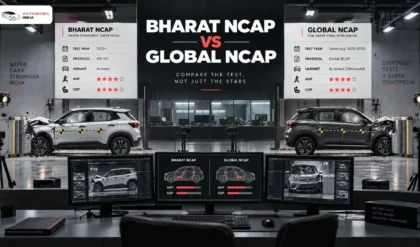
Bharat NCAP vs Global NCAP: What Is the Difference?
Indian buyers may encounter both Bharat NCAP and Global NCAP results while researching a car.
They should not be treated as interchangeable tests.
Bharat NCAP
Bharat NCAP is India’s official new-car assessment programme and uses its own Indian regulatory/testing framework.
Global NCAP
Global NCAP is an independent international consumer-testing programme that has also tested many Indian-market vehicles.
A car tested under one programme may not have an equivalent result under the other.
Therefore, when an article says a vehicle is “five-star rated”, always check:
- Which NCAP programme?
- What year was it tested?
- Which variant was tested?
- Which variants does the rating apply to?
- What were the AOP and COP scores?
This avoids comparing two ratings as though they were produced by exactly the same test protocol.
How to Compare the Safest Cars in India
A useful safety comparison should go beyond stars.
1. Check the AOP score
Adult Occupant Protection tells you how the vehicle performed in the adult occupant assessment.
A higher score within the same test programme indicates stronger performance against the programme’s assessed criteria.
However, the difference between two scores should not be interpreted as a simple percentage difference in real-world injury risk.
2. Check the COP score
Families should pay particular attention to Child Occupant Protection.
COP considers child-dummy performance and child-restraint-related factors.
A five-star adult result does not automatically mean identical child-protection performance.
3. Check variant applicability
This is one of the most overlooked points.
A manufacturer may advertise a model as five-star rated, but the BNCAP result may apply only to specified variants.
The official BNCAP database explicitly lists applicability for models such as the Brezza, Punch, Duster, Tekton and others.
Always check the exact variant before booking.
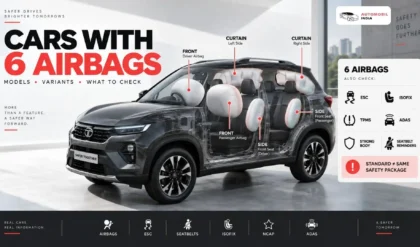
Are Six Airbags Enough to Make a Car Safe?
No.
Six airbags are useful, but airbags are only one part of a vehicle’s safety system.
A modern safety package should be considered as a combination of:
- Structural crash performance
- Seatbelts
- Pretensioners
- Load limiters
- Airbags
- ESC
- Brake performance
- Child-seat mounting points
- Pedestrian protection
- Seatbelt reminders
- Driver-assistance systems
A car with six airbags but weak structural performance cannot be described as automatically safer than a car with a strong crash-tested structure.
This is one reason NCAP testing is valuable: it evaluates the vehicle as a system.
What Is ADAS and Does It Make a Car Safer?
ADAS stands for Advanced Driver Assistance Systems.
These systems use cameras, radar and other sensors to assist the driver.
Depending on the vehicle, ADAS can include:
- Forward collision warning
- Automatic emergency braking
- Lane departure warning
- Lane keeping assistance
- Adaptive cruise control
- Blind-spot monitoring
- Rear cross-traffic warning
- Driver attention monitoring
- Traffic sign recognition
The Hyundai Venue, for example, offers Level 2 ADAS on higher variants, while the current Kia Seltos offers Level 2 ADAS with a broader suite of assistance functions.
But ADAS is not autonomous driving
ADAS is intended to assist the driver.
It cannot guarantee that an accident will be avoided, and the driver remains responsible for monitoring the road.
Kia itself states that ADAS is not a substitute for human attention and that its effectiveness can vary depending on the situation.
Active Safety vs Passive Safety
Understanding this distinction makes car-safety comparisons much easier.
Passive safety
Passive systems help protect occupants when a crash occurs.
Examples include:
- Airbags
- Seatbelts
- Seatbelt pretensioners
- Load limiters
- Crumple zones
- Strong passenger cell
- Side-impact protection
Active safety
Active systems attempt to help prevent or reduce the severity of a crash.
Examples include:
- ABS
- ESC
- Traction control
- Automatic emergency braking
- Lane keeping assistance
- Blind-spot monitoring
- Adaptive cruise control
A well-equipped modern vehicle needs both.
Why ESC Is So Important
Electronic Stability Control is one of the most important active-safety systems in a modern car.
If a driver suddenly swerves to avoid an obstacle, the vehicle can lose stability.
ESC can selectively brake individual wheels and reduce engine torque to help bring the vehicle back towards the driver’s intended path.
It cannot overcome the laws of physics, but it can provide an important layer of assistance.
This is also why BNCAP includes ESC among its identified Safety Assist Technologies.
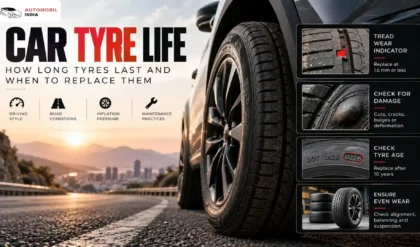
Why Tyres Matter More Than Many Buyers Realise
A five-star NCAP car can still behave poorly if its tyres are:
- Severely worn
- Under-inflated
- Over-inflated
- Incorrectly sized
- Poor quality
- Damaged
Tyres are the vehicle’s only contact with the road.
They influence:
- Braking distance
- Cornering grip
- Wet-road performance
- Emergency manoeuvring
- Ride stability
Therefore, tyre condition should be treated as a safety item, not merely a maintenance issue.
Safety Features to Check Before Buying a New Car
Use this checklist during your showroom visit.
Crash protection
- Bharat NCAP result checked
- AOP score checked
- COP score checked
- Variant applicability checked
- Structural safety information reviewed
Restraints
- Six airbags or appropriate airbag coverage
- Three-point seatbelts for all occupants
- Seatbelt reminders
- Pretensioners
- Load limiters
- ISOFIX mounts
Active safety
- ABS
- ESC
- Traction control
- Hill-start assistance
- Tyre-pressure monitoring
Driver assistance
- Forward collision warning
- Automatic emergency braking
- Lane-keeping assistance
- Blind-spot monitoring
- Rear cross-traffic warning
Parking
- Rear parking sensors
- Rear camera
- 360-degree camera where useful
Does a Bigger Car Automatically Mean a Safer Car?
No.
Vehicle size and weight can influence crash dynamics, but size alone does not determine occupant protection.
A smaller vehicle with a well-engineered passenger cell, effective restraint systems and strong crash-test performance can have an excellent safety rating.
Conversely, a large SUV should not be assumed to be safe simply because it is bigger.
This is precisely why independent crash testing is useful.
Does Higher Price Mean Better Safety?
Not necessarily.
Safety technology has become increasingly available in affordable cars.
The current BNCAP database includes five-star-rated vehicles across very different price categories, from compact SUVs such as the Tata Punch and Hyundai Venue to premium electric SUVs such as the Mahindra XEV 9e.
For example, Hyundai’s current Venue starts at ₹7.999 lakh ex-showroom and has a five-star BNCAP result, while the Maruti Suzuki Victoris starts at ₹10.499 lakh and also has a five-star result.
This makes safety technology considerably more accessible than it was a decade ago.
What About Cars Without a Bharat NCAP Rating?
No BNCAP rating does not automatically mean a car is unsafe.
There are several possible reasons a vehicle may not appear in the current database:
- It has not been tested yet.
- The manufacturer has not submitted it for assessment.
- It was tested under another NCAP programme.
- The model was introduced before BNCAP and has not received a current test.
- Its sales status has changed.
Therefore, an unrated car should be described as “not currently rated by Bharat NCAP”, rather than automatically labelled unsafe.
This distinction is particularly important when comparing cars such as the Honda City or other models whose current Indian-market versions may not have a published BNCAP result.
How Families Should Evaluate Car Safety
Families should think beyond the driver and front passenger.
Before buying, check:
Child-seat compatibility
Install the actual child seat if possible.
Check:
- ISOFIX accessibility
- Top-tether availability
- Door opening
- Rear-seat belt geometry
- Space around the child seat
Third-row safety
For a three-row SUV, check how easily children can enter and exit the third row.
Also check whether the third-row occupants have:
- Proper three-point belts
- Adequate head protection
- Usable head restraints
Everyday restraint use
The safest vehicle cannot protect an unbelted occupant effectively.
Every passenger should use the appropriate seatbelt on every journey.
Safest Cars in India: What Should You Prioritise?
Different buyers will naturally place different priorities on safety.
| Buyer requirement | What to examine |
|---|---|
| Maximum crash-test protection | AOP + COP scores |
| Family with children | COP + ISOFIX + rear restraint systems |
| Highway driving | ESC + ADAS + braking + tyre quality |
| City driving | AEB + parking sensors + camera + blind-spot systems |
| Frequent night driving | Lighting + visibility + driver assistance |
| Three-row family | Third-row restraints + accessibility |
| EV buyer | BNCAP result + battery safety information + ADAS |
| Budget buyer | Standard safety equipment + exact variant rating |
| Feature-focused buyer | ADAS, 360 camera and blind-spot systems |
| Long-term ownership | Safety equipment across the entire variant range |
A Safety Rating Should Be the Starting Point, Not the Final Decision
Bharat NCAP has made safety comparisons considerably more transparent, but buyers should avoid reducing the decision to a single star count.
A better process is:
- Check whether the car has a current NCAP result.
- Identify the testing programme.
- Check the AOP and COP scores.
- Check exactly which variants the rating applies to.
- Check standard safety equipment on your chosen variant.
- Check active-safety and ADAS availability.
- Consider child-seat practicality.
- Test the car yourself for visibility, seating and ergonomics.
- Check tyre and braking specifications.
- Compare the final on-road price of the safety-equipped variant.
This approach gives you a much clearer picture than simply searching for the phrase “five-star safety”.
Final Takeaway
The current Indian market has a growing number of cars with strong Bharat NCAP results.
The Mahindra XEV 9e has a published 32/32 AOP and 45/49 COP result, while the Mahindra BE 6 scored 31.97/32 and 45/49. The Kia Seltos scored 31.70/32 and 45/49, while the Maruti Suzuki Victoris recorded 31.66/32 and 43/49.
The current five-star group also includes the Hyundai Venue, Tata Sierra, Tata Punch EV, Mahindra XUV 7XO, Tata Punch, Renault Duster, Nissan Tekton, Maruti Suzuki Brezza, Skoda Kylaq, Tata Nexon and Mahindra XUV 3XO, among other models.
But these results should not be interpreted as a simple safest-to-least-safe ranking.
The more useful comparison is to look at AOP, COP, variant applicability, structural performance, standard safety equipment and active-safety technology together.
For buyers, the most important lesson is simple:
That is the difference between understanding a safety rating and simply reading one.
Frequently Asked Questions