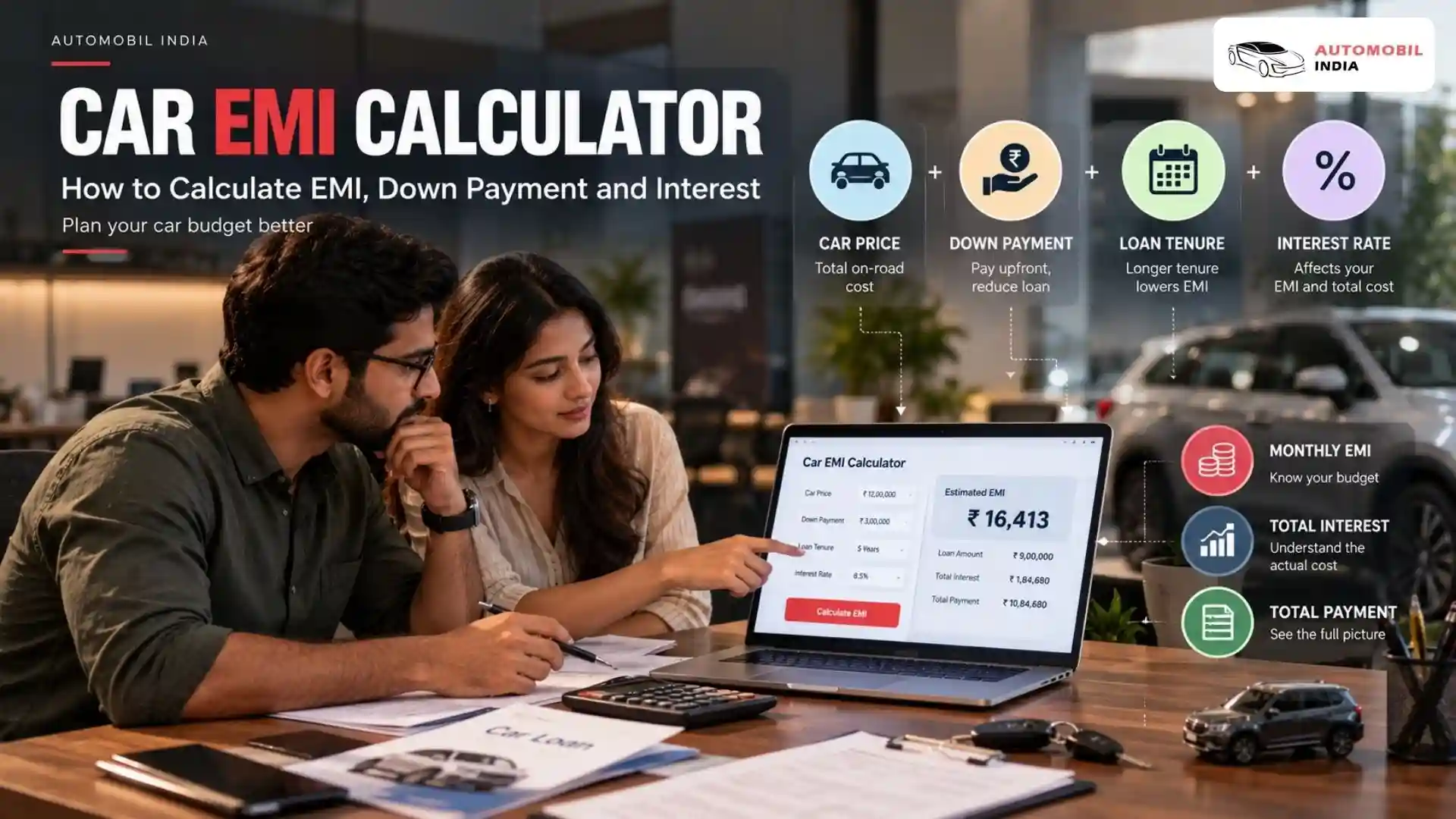
Buying a car on finance is not just about finding a monthly payment that fits your budget. The car EMI calculator helps you understand three important numbers before you commit to a loan: your monthly EMI, the total interest payable and the overall amount you will repay.
The calculation depends mainly on the loan amount, interest rate and loan tenure. A larger down payment reduces the amount borrowed, while a longer tenure lowers the monthly EMI but generally increases the total interest paid.
For example, on an ₹8 lakh loan at an illustrative 8.5% annual interest rate, the EMI would be about ₹16,413 for five years. Extending the same loan to seven years would reduce the EMI to about ₹12,669, but total interest would rise from roughly ₹1.85 lakh to ₹2.64 lakh.
That difference is why looking only at the EMI can be misleading.
What Is a Car EMI?
EMI stands for Equated Monthly Instalment. It is the regular amount paid to the lender towards a car loan.
Each EMI contains two components:
Principal: The portion that repays the amount borrowed.
Interest: The cost charged by the lender for providing the loan.
At the beginning of a typical amortising loan, a larger share of the EMI goes towards interest. As the outstanding principal reduces, the interest component generally falls and the principal component increases.
The exact structure depends on the loan agreement and interest-rate type.
How Does a Car EMI Calculator Work?
A car EMI calculator requires three main inputs:
Input
What it means
Why it matters
Loan amount
Amount financed by the lender
Higher loan = higher EMI
Interest rate
Annual interest rate on the loan
Higher rate = higher EMI and interest cost
Loan tenure
Repayment period
Longer tenure = lower EMI but usually higher total interest
The standard EMI formula is:
EMI = P × r × (1+r)n / [(1+r)n − 1]
Where:
P = principal or loan amount
r = monthly interest rate
n = total number of monthly instalments
A calculator performs this calculation automatically, making it easier to compare different financing scenarios.
Car EMI Calculator Example
Suppose you are purchasing a car and need a loan of ₹8 lakh.
For illustration:
Loan amount: ₹8,00,000
Interest rate: 8.5% per year
Tenure: 5 years
Number of EMIs: 60
The estimated result is:
Particular
Amount
Loan amount
₹8,00,000
Illustrative interest rate
8.5% p.a.
Tenure
5 years
Approx. monthly EMI
₹16,413
Approx. total repayment
₹9.85 lakh
Approx. total interest
₹1.85 lakh
These are illustrative calculations, not a quote from a particular bank or finance company. Your actual EMI can differ according to the lender’s rate, loan structure and applicable charges.
How Down Payment Affects Car EMI
The down payment is the amount you pay upfront rather than borrowing.
For example, assume a car has an on-road price of ₹12 lakh.
Scenario 1: ₹2 lakh down payment
Loan amount:
₹12 lakh − ₹2 lakh = ₹10 lakh
Scenario 2: ₹4 lakh down payment
Loan amount:
₹12 lakh − ₹4 lakh = ₹8 lakh
With the same interest rate and tenure, the second scenario will have a lower EMI because you are borrowing less.
A larger down payment can therefore reduce:
Monthly EMI
Total interest paid
Outstanding loan balance
However, putting too much cash into the car can also reduce the money available for emergencies and other financial needs. The right down payment is therefore a budgeting decision, not simply a race to minimise the EMI.
Car Price vs On-Road Price: Which One Should You Use?
This is one of the most important points when calculating a real-world car loan.
The ex-showroom price is not the same as the amount you ultimately pay for the car.
The on-road cost can include:
Ex-showroom price
Registration charges
Road tax
Insurance
FASTag
Applicable statutory charges
Optional accessories or other dealer-selected items
For an accurate purchase budget, calculate your financing requirement using the actual amount you intend to finance, rather than simply entering the ex-showroom price.
The final amount financed can also depend on the lender’s loan policy and what costs are included in the finance agreement.
Insurance is part of your on-road cost
Understanding what goes into the on-road price helps you plan the amount you need to finance. Explore car insurance options as part of your budget.
A longer tenure can make a car appear more affordable because the principal is spread across more instalments.
But the total cost of borrowing usually increases.
For example, using the same illustrative ₹8 lakh loan at 8.5%:
Tenure
Approx. EMI
Approx. Total Interest
5 years
₹16,413
₹1.85 lakh
7 years
₹12,669
₹2.64 lakh
The seven-year loan reduces the monthly payment by around ₹3,744, but adds roughly ₹79,400 in interest over the life of the loan.
This is why a car EMI calculator should be used to compare total repayment, not just monthly affordability.
Fixed vs Floating Car Loan Interest Rates
The interest-rate structure should also be understood before signing a loan.
A fixed-rate loan generally keeps the agreed interest rate unchanged for the relevant fixed period, subject to the terms of the agreement.
With a floating-rate structure, the applicable rate can change according to the loan’s benchmark and reset mechanism.
RBI rules require regulated entities to provide borrowers with relevant information concerning floating-rate EMI-based personal loans, including the impact of rate changes and available options when the rate rises.
Before accepting a loan, check:
Whether the rate is fixed or floating
The applicable annualised interest rate
APR, where applicable
Benchmark and reset mechanism for floating loans
Processing fee
Documentation charges
Prepayment or foreclosure conditions
Other applicable charges
Do not compare loans purely by looking at the advertised interest rate.
What Is APR and Why Does It Matter?
The interest rate tells you the cost of borrowing expressed as a rate.
APR, where applicable, is intended to provide a broader representation of the annualised cost of credit, subject to the applicable disclosure framework.
RBI’s framework requires the Key Facts Statement to disclose the annualised rate of interest/APR as applicable for relevant loans.
This makes the KFS an important document to examine before accepting a loan.
Car EMI Calculator: What You Should Enter
For a useful calculation, collect these figures first:
1. Final car price
Use the price relevant to your purchase, preferably the actual on-road amount for your location.
2. Down payment
Subtract the amount you plan to pay upfront from the amount that will be financed.
3. Interest rate
Enter the actual rate offered to you rather than an assumed market rate.
4. Loan tenure
Try multiple durations instead of checking only the longest tenure offered.
5. Additional charges
Keep processing fees and other applicable loan charges separate when assessing the total purchase cost.
How to Choose a Car EMI You Can Actually Afford
A calculator tells you what the EMI will be. It does not tell you whether the EMI is comfortable for your household.
Before taking a loan, account for the complete cost of owning the vehicle.
That can include:
EMI
Fuel or charging
Insurance
Scheduled servicing
Tyres
Parking
Toll expenses
Repairs and wear items
Accessories
Annual taxes or other applicable costs
A ₹15,000 EMI may look manageable on its own, but the actual monthly cost of running the car can be considerably higher.
For this reason, car EMI affordability should be assessed against your overall monthly budget rather than income alone.
Should You Choose a Bigger Down Payment or Lower EMI?
There is no universal answer.
A bigger down payment may make sense when:
You have sufficient emergency savings.
You want to reduce the amount borrowed.
You want a lower EMI.
You want to reduce total interest.
You are comfortable keeping less cash invested elsewhere.
A smaller down payment may make sense when:
Maintaining liquidity is important.
You need cash for other planned expenses.
The larger upfront payment would significantly reduce your emergency reserve.
The important point is to avoid using nearly all available savings simply to reduce the loan balance.
Should You Take a 5-Year or 7-Year Car Loan?
The choice depends on your cash flow.
A shorter loan generally means:
Higher EMI + lower total interest
A longer loan generally means:
Lower EMI + higher total interest
If the shorter tenure is comfortably affordable, it can reduce the overall financing cost. If it creates excessive monthly pressure, a somewhat longer tenure may provide more breathing room.
The car EMI calculator lets you compare both before making the decision.
What About a Balloon Payment or Guaranteed Buyback?
Some financing products can structure repayments differently from a conventional equal-EMI loan.
For example, certain products may have:
Lower periodic payments
A larger final payment
Guaranteed future-value structures
Buyback arrangements
These should not be compared with a conventional car loan solely on the monthly payment.
Always examine:
Total amount payable + final payment + applicable charges + ownership conditions.
The lowest advertised EMI is not necessarily the lowest overall financing cost.
Car EMI Calculator vs Manual Calculation
A manual calculation is useful for understanding how EMI works, but an online calculator is more practical for comparing scenarios.
You can change:
Loan amount
Down payment
Interest rate
Tenure
and immediately see how the EMI changes.
For example, instead of asking:
“Can I afford this ₹15,000 EMI?”
you can test:
₹15,000 EMI for five years
₹13,000 EMI for seven years
A larger down payment with a shorter tenure
A smaller loan with the same tenure
This gives you a much clearer picture of the trade-offs.
Common Car Loan Mistakes to Avoid
Looking only at the EMI
A low EMI can hide a longer tenure and greater total interest.
Using the ex-showroom price
Your actual purchase cost can be substantially different from the ex-showroom figure.
Ignoring loan charges
Processing, documentation and other applicable charges can increase the effective cost.
Taking the maximum loan available
A lender’s eligibility is not the same as your ideal budget.
Using all your savings as a down payment
Keeping an emergency reserve is important.
Not checking the loan agreement
Read the interest-rate structure, repayment schedule, prepayment terms and applicable charges before signing.
Comparing only interest rates
Compare the overall cost and terms of the loan, not just the headline rate.
Car EMI Calculator: A Simple Decision Framework
Before booking a car, work through these five steps:
Step 1: Find the actual on-road purchase cost.
Step 2: Decide how much you can comfortably pay upfront.
Step 3: Calculate the required loan amount.
Step 4: Run the EMI for at least two or three different tenures.
Step 5: Compare total repayment and interest, not just EMI.
This turns the car EMI calculator from a simple payment tool into a proper car-buying budget tool.
Plan your car finance
Use the car EMI calculator before booking your next car to compare different down payments, interest rates and loan tenures—and check the lender’s final loan terms before signing.
A car EMI calculator estimates your monthly loan repayment using the loan amount, interest rate and repayment tenure.
How is car EMI calculated?
EMI is calculated using the principal amount, monthly interest rate and total number of instalments. The standard amortisation formula calculates the monthly payment.
Does a higher down payment reduce EMI?
Yes. If the interest rate and tenure remain the same, borrowing less generally reduces the monthly EMI.
Does a longer car loan reduce EMI?
Yes. Spreading the same principal over a longer period generally reduces the monthly EMI, but it can increase the total interest paid.
Is a five-year or seven-year car loan better?
Neither is universally better. A five-year loan generally results in a higher EMI but lower total interest, while a seven-year loan generally lowers the EMI but increases the interest cost.
Should I calculate EMI using the ex-showroom price?
For budgeting, it is better to start with the actual on-road purchase cost and then determine how much you will finance.
Does the car EMI include insurance and registration?
Not necessarily. Whether these costs are financed depends on the lender and the specific loan arrangement. Check the sanctioned loan amount and agreement.
Can my car EMI change after taking the loan?
It can depend on the interest-rate structure. Floating-rate loans can be affected by changes in the applicable benchmark and reset mechanism, subject to the loan terms and regulatory framework.
What should I check before accepting a car loan?
Check the interest rate, APR where applicable, EMI, tenure, total repayment, processing fees, prepayment terms and other applicable charges. Also read the Key Facts Statement and loan agreement.
Is the lowest EMI always the cheapest car loan?
No. A lower EMI can result from a longer tenure, which may increase the total interest paid. Compare the overall repayment amount before choosing.
This article is for general informational purposes and does not constitute financial advice. EMI examples are illustrative and actual rates, charges, loan eligibility, tenure and repayment terms vary by lender and borrower. Always verify the final interest rate, APR where applicable, Key Facts Statement, fees and loan agreement with the lender before taking a car loan.
Have a question about financing a car?
Talk to the Automobil India team about your requirements.
Ashish Ahire is an automobile content writer with an interest in the automotive industry, new vehicle launches, automotive technology, and the latest developments in the mobility sector. Through his articles, he aims to present automobile news and updates in a clear, informative, and reader-friendly manner.