
The Kia Seltos base model is the HTE variant of the current 2026 Seltos. It starts at ₹10,99,900 ex-showroom and comes with the 1.5-litre naturally aspirated petrol engine paired with a 6-speed manual gearbox. A 1.5-litre diesel with a 6-speed manual is also available in the HTE variant at a higher price.
Unlike many entry-level SUV variants that remove most of the equipment, the current Seltos HTE includes several features that are normally associated with higher trims. These include a 10.25-inch touchscreen with wireless Android Auto and Apple CarPlay, a digital instrument cluster, rear-view camera, rear AC vents, LED headlamps and tail lamps, six airbags, ESC, VSM, highline TPMS and all-wheel disc brakes.
The compromises are mainly in areas such as alloy wheels, automatic climate control, sunroof, connected-car functions, premium audio, powered seats and ADAS. Those features are progressively added higher up the range.
For a buyer considering the Seltos base variant, therefore, the key question is not whether the HTE is adequately equipped. It is whether the features added by the next few variants justify the additional expenditure for your usage.
Kia Seltos Base Model Price
The current Kia Seltos HTE starts at ₹10,99,900 ex-showroom. Kia’s official booking page lists the HTE as the entry point to the 2026 Seltos range.
These are the current prices displayed by Kia India’s official booking page. Actual on-road prices vary by state, city, registration, insurance and applicable charges.
One important point: the HTE price applies to specific engine and transmission combinations. The entry petrol HTE is the 1.5-litre naturally aspirated petrol with a 6-speed manual. The diesel HTE is priced higher.
Kia Seltos Base Variant: Engine and Transmission
The petrol HTE uses Kia’s Smartstream G1.5 naturally aspirated petrol engine.
Kia’s technical specifications list the naturally aspirated 1.5-litre engine at 115 PS and 144 Nm. The engine is offered with a 6-speed manual or IVT elsewhere in the range, but the base HTE petrol is manual-only.
What does the 1.5-litre petrol mean for everyday driving?
The naturally aspirated engine is the straightforward choice in the Seltos range. It does not have the stronger low-rev torque of the turbo-petrol engine, but it also avoids the added complexity and performance-oriented character of the turbo powertrain.
For a buyer primarily driving in the city, commuting to work and occasionally taking highway trips, the 1.5-litre petrol manual provides a conventional and predictable powertrain.
If you specifically want an automatic, however, the HTE petrol does not offer the IVT. The IVT begins with the HTE(O).
Kia Seltos Base Model Diesel Option
The Seltos HTE is also available with Kia’s 1.5-litre CRDi VGT diesel engine and 6-speed manual gearbox.
The diesel produces:
- 116 PS
- 250 Nm
- 6-speed manual transmission
Kia’s official technical specifications list the diesel engine at 1,493cc, with 116 PS and 250 Nm.
The additional torque makes the diesel more relevant to buyers who regularly cover long distances or carry passengers and luggage on highways.
The trade-off is the higher purchase price. Therefore, the diesel makes more sense when your annual running is high enough for the fuel-cost advantage to matter over the ownership period.
Kia Seltos Base Variant Features
The HTE is much more comprehensively equipped than a typical stripped-down base trim.
- Infotainment and Connectivity
- The Seltos HTE gets:
- 26.04 cm (10.25-inch) HD touchscreen
- Wireless Android Auto
- Wireless Apple CarPlay
- 6 speakers
- Bluetooth connectivity
- Steering-mounted controls
- USB connectivity
These are standard HTE features in Kia’s current specification list.
This is one of the most important changes for buyers comparing the current Seltos with older-generation base variants.
You do not have to move to a mid-spec variant simply to get a factory touchscreen.
Does the Seltos base model have a touchscreen?
Yes.
The HTE gets a 10.25-inch touchscreen with wireless Android Auto and Apple CarPlay.
That makes the base variant considerably easier to live with for buyers who depend on smartphone navigation, music and calls.
Kia Seltos Base Model Interior Features
The HTE gets a Smoky Black and Grey two-tone interior with fabric seats. Other standard equipment includes:
- Digital instrument cluster
- 4.2-inch colour TFT MID
- Double D-cut steering wheel
- Leatherette dashboard centre garnish
- Metallic interior door handles
- Front and rear USB charging provisions
- All-door power windows
- Rear AC vents
- Manual air conditioning
- Rear-view camera
- Cruise control with manual speed-limit assist
Kia’s current specification page lists these features across the HTE equipment set.
For a base variant, the combination is useful because several everyday features are included without moving to a more expensive trim.
Does the Kia Seltos Base Model Have Rear AC Vents?
Yes.
Rear AC vents are included in the current Seltos HTE.
For Indian buyers who regularly carry rear passengers, this is a meaningful convenience feature, particularly during summer.
It is also a good example of why older Seltos HTE equipment lists should not be used to describe the current model.
Does the Seltos Base Model Have a Rear Parking Camera?
Yes.
The HTE gets a rear-view camera with dynamic guidelines, in addition to rear parking sensors.
This is useful in tight urban parking spaces, where the camera can provide a much clearer view of obstacles directly behind the vehicle than sensors alone.
A 360-degree camera, however, is reserved for higher variants with the ADAS package.
Kia Seltos Base Model Exterior Features
The HTE comes with:
- Star Map LED DRLs
- Ice Cube MFR LED headlamps
- Star Map LED tail lamps
- 16-inch steel wheels with covers
- Shark-fin antenna
- Integrated rear spoiler
- LED high-mounted stop lamp
- Manual door handles
- Front and rear skid plates with silver finish
- Aero-type wiper blades
Kia’s official specifications confirm the 16-inch steel wheels with covers and LED lighting elements on the HTE.
The biggest visual compromise compared with higher variants is the absence of alloy wheels.
However, steel wheels are not a mechanical disadvantage. They primarily affect the appearance and, depending on wheel/tyre configuration, can have different ride and durability characteristics.
Kia Seltos Base Model Safety
Safety is one of the strongest parts of the current Seltos HTE specification.
The base variant includes:
- Front dual airbags
- Front-seat side airbags
- Side curtain airbags
- Highline tyre-pressure monitoring
- ABS
- Brake Assist System
- Electronic Stability Control
- Vehicle Stability Management
- Hill-start Assist Control
- All-wheel disc brakes
- Rear parking sensors
- Rear-view camera
- ISOFIX rear child-seat anchors
- Three-point seatbelts with reminders for all seats
- Rear Occupant Alert
- Downhill Brake Control
- Rollover sensor
- Speed-sensing door locks
- Impact-sensing automatic door unlock
Kia’s current trim comparison lists these safety systems as included across the Seltos range, including HTE.
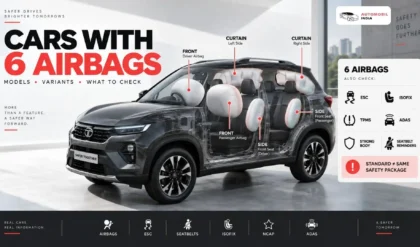
Six airbags are standard
The Seltos uses:
- Front driver airbag
- Front passenger airbag
- Front side airbags
- Curtain airbags
Together, these provide six airbags.
Kia also states that six airbags are standard on the all-new Seltos.
Does the Seltos base model have ESC?
Yes.
Electronic Stability Control is standard on the HTE. Vehicle Stability Management and Hill-start Assist Control are also included.
For everyday Indian driving, ESC is more significant from a safety perspective than cosmetic upgrades such as alloy wheels or a sunroof.
Kia Seltos Base Model Safety Rating
The current Seltos has received a 5-star Bharat NCAP safety rating, according to Kia’s current product communication. Kia highlights the 5-star BNCAP result on its official Seltos page.
The important distinction is that a crash-test rating evaluates the vehicle’s tested safety performance under the relevant assessment protocol; it should not be interpreted as a guarantee that occupants will avoid injury in every real-world crash.
For a buyer considering the HTE, the useful takeaway is that the base variant retains the core passive and electronic safety equipment rather than reserving it only for expensive trims.
What Is Missing From the Kia Seltos Base Model?
Despite its generous standard equipment, the HTE does not include several features found higher in the range.
Kia’s trim comparison confirms that the HTE is positioned below these convenience, premium and ADAS features.
Does the Kia Seltos Base Model Have a Sunroof?
No.
The HTE does not get the panoramic sunroof.
Kia introduces the dual-pane panoramic sunroof from the HTK(O) variant.
If the sunroof is a major reason for choosing the Seltos, the HTE therefore won’t satisfy that requirement.
But for buyers who don’t care about a sunroof, avoiding this feature can save a considerable amount of money.
Does the Seltos Base Model Have Alloy Wheels?
No.
The HTE uses 16-inch steel wheels with wheel covers.
Higher variants move to 16-inch styled steel wheels or 17-inch/18-inch alloy wheels depending on trim and powertrain.
This is primarily a styling difference. If you prefer alloy wheels, aftermarket options exist, but changing wheel and tyre specifications can affect ride, handling and warranty considerations, so the factory configuration should be understood before making modifications.
Does the Seltos Base Model Have ADAS?
No.
The HTE does not have Kia’s ADAS package.
The current Seltos offers ADAS Level 2 on selected higher variants, with features such as forward collision warning, lane-keeping assistance, lane-following assistance and other driver-assistance functions. The trim comparison shows these systems becoming available with the HTX(A) and above, rather than the HTE.
This is an important distinction:
ESC is not ADAS.
The HTE has electronic stability control and other active safety systems, but it does not have the camera/radar-based driver-assistance package offered on higher variants.
Does the Kia Seltos Base Model Have Automatic Climate Control?
No.
The HTE uses conventional manual air conditioning.
Higher variants add more advanced climate-control equipment, with Kia’s higher trims offering a touchscreen-based dual-zone automatic temperature-control system.
For most buyers, the manual AC is functional and straightforward. The question is whether you consider automatic climate control worth paying extra for.
Kia Seltos Base Model Dimensions and Practicality
The new Seltos has grown significantly compared with its predecessor.
Kia’s current specifications list a 4,460mm overall length, 1,830mm width and 2,690mm wheelbase. The luggage volume is listed at 433 litres.
What do these dimensions mean in India?
The 4.46-metre length gives the Seltos a substantial footprint for a compact SUV.
The longer wheelbase is particularly relevant to rear-seat passengers because it gives Kia more space to work with between the front and rear axles.
At the same time, the larger body means first-time SUV buyers should consider parking space and narrow-lane usage before purchasing. A smaller hatchback will naturally be easier to manoeuvre in extremely tight areas.
The 433-litre boot is sufficient for typical family luggage and weekend travel, although actual usable capacity depends on the size and shape of the luggage.
Kia Seltos Base Model Mileage
For the 1.5-litre petrol manual, current published figures put the claimed mileage at around 16.5–17 kmpl, depending on the source and certification update. Autocar India currently lists 16.5 kmpl for the HTE petrol manual.
The important point is that claimed mileage is not the same as real-world mileage.
Actual fuel economy depends on:
- Traffic
- Driving style
- Air-conditioner usage
- Road gradient
- Vehicle load
- Tyre pressures
- Highway/city mix
For a buyer calculating ownership cost, it is better to use a conservative real-world assumption rather than planning the budget around the maximum certified figure.
Kia Seltos Base Model vs HTE(O): What Changes?
The HTE(O) is particularly important for someone considering the base variant because it adds convenience equipment while retaining the same basic Seltos platform.
Depending on powertrain, HTE(O) adds features such as:
- Convenience and styling upgrades
- Rear-seat centre armrest
- 60:40 split rear seats with recline
- Electric parking brake with Auto Hold on automatic versions
- Drive modes on automatic versions
- Paddle shifters on automatic versions
- Additional exterior and interior equipment
Kia’s current specification comparison shows HTE(O) positioned immediately above HTE, while the HTE itself already includes the major infotainment and safety equipment.
The price difference is substantial enough that buyers should compare the exact features they want rather than automatically stepping up.
HTE vs HTK: Where Does the Seltos Start Feeling More Premium?
The HTK adds several convenience features that are more noticeable during everyday ownership.
These include equipment such as:
- Push-button start/stop
- Rear washer/wiper
- Auto-folding ORVMs
- More advanced exterior detailing
- Additional wheel options depending on powertrain
Autocar India’s current variant guide identifies these as key additions with the HTK.
This makes HTK relevant to buyers who are less concerned about luxury features and more interested in everyday convenience.
Which Kia Seltos Base Model Powertrain Makes Sense?
There are three broad considerations.
1. 1.5 Petrol Manual
This is the entry point at ₹10.99 lakh.
It suits buyers who:
- Want the lowest Seltos purchase price
- Prefer a manual gearbox
- Drive primarily in the city
- Have moderate annual running
- Want the naturally aspirated petrol engine
2. 1.5 Diesel Manual
The diesel HTE costs more but provides substantially higher torque at 250 Nm.
It may make more sense for:
- High annual mileage
- Frequent highway driving
- Buyers who value strong mid-range torque
- Regular long-distance travel
The higher purchase price needs to be weighed against your expected fuel savings.
3. 1.5 Petrol Automatic
If you want the naturally aspirated petrol with an automatic transmission, the HTE is not the starting point.
The IVT begins with HTE(O).
For heavy urban traffic, this is an important distinction because the convenience of an automatic can be more meaningful than several cosmetic features.
Is the Kia Seltos Base Model Good Value?
The HTE’s value proposition comes largely from what Kia has not removed.
It has:
- 10.25-inch touchscreen
- Wireless Android Auto/Apple CarPlay
- Six airbags
- ESC
- VSM
- Highline TPMS
- Rear camera
- Rear parking sensors
- LED headlamps
- LED tail lamps
- Rear AC vents
- All-wheel disc brakes
- Digital instrument cluster
The missing features are mostly associated with premium convenience, styling and advanced driver assistance.
That makes the HTE particularly relevant for buyers who care more about the fundamental car and safety equipment than features such as a sunroof, alloy wheels, powered seats or ADAS.
However, there is a significant jump from HTE to HTE(O), and the higher variants progressively add equipment. Therefore, the right choice depends on whether the specific additions are useful to you rather than simply choosing a higher trim because it is more expensive.
Who Should Consider the Kia Seltos HTE?
The base HTE makes sense to buyers who:
Want a midsize/compact SUV around the ₹11 lakh ex-showroom mark
Prefer the naturally aspirated petrol engine
Are comfortable with a manual gearbox
- Want a factory touchscreen without moving up the range
- Want six airbags and ESC as standard
- Want a rear camera
- Don’t particularly need a sunroof
- Don’t require ADAS
- Are comfortable with steel wheels
- Want a relatively straightforward ownership package
For a family buyer, the standard rear AC vents, rear camera, all-seat three-point seatbelts and six-airbag setup are useful equipment rather than showroom-only features.
Who Should Consider a Higher Variant?
Moving up the Seltos range becomes more relevant if you specifically want:
- Automatic transmission
- Panoramic sunroof
- Push-button start
- Auto-folding ORVMs
- Wireless charger
- Rear-seat comfort upgrades
- Ventilated seats
- Powered driver seat
- Bose audio
- Ambient lighting
- 360-degree camera
- ADAS
- Advanced connected-car functions
The HTX and HTX(A), in particular, introduce significantly more technology and convenience equipment. Kia’s current specification sheet lists features such as the 12.3-inch display, dual-zone climate control, Bose audio, ambient lighting, 360-degree camera and ADAS at higher trim levels.
Kia Seltos Base Model: Pros and Cons
What the HTE gets right
Competitive entry price for the Seltos range
- 1.5-litre naturally aspirated petrol
- 6-speed manual gearbox
- Six airbags
- ESC and VSM
- All-wheel disc brakes
- Highline TPMS
- Rear parking sensors
- Rear camera
- 10.25-inch touchscreen
- Wireless Android Auto and Apple CarPlay
- LED headlamps and tail lamps
- Rear AC vents
- Digital instrument cluster
- 433-litre boot
What you give up
- No automatic transmission in HTE
- No alloy wheels
- No panoramic sunroof
- No push-button start
- No auto-folding ORVMs
- No wireless charger
- No powered driver seat
- No ventilated seats
- No Bose audio
- No 360-degree camera
- No ADAS
- No premium connected-car equipment
This split is useful because it shows that the HTE is not simply a “cheap Seltos”. Its equipment is concentrated around the core driving, safety and infotainment requirements, while premium features are reserved for more expensive variants.
Kia Seltos Base Model: Final Takeaway
The current Kia Seltos HTE is a very different proposition from the stripped-down base variants many buyers may remember from older Seltos generations.
At ₹10,99,900 ex-showroom, the petrol-manual HTE already gets a 10.25-inch touchscreen, wireless smartphone connectivity, rear camera, LED lighting, six airbags, ESC, VSM, highline TPMS, all-wheel disc brakes and rear AC vents.
What it does not provide is mostly higher-end equipment: sunroof, alloy wheels, automatic transmission, powered seats, ventilated seats, premium audio, 360-degree camera and ADAS.
For a buyer who wants the core Seltos experience without paying for luxury features, the HTE is worth examining closely.
For buyers who want an automatic, sunroof, advanced parking equipment or ADAS, the higher variants become relevant quickly.
The important part is to compare the exact equipment and powertrain you need against the additional amount you will spend, rather than assuming that the most expensive variant is automatically the right one.
Frequently Asked Questions
What is the Kia Seltos base model?
The current base variant of the Kia Seltos in India is the HTE. The petrol-manual version starts at ₹10,99,900 ex-showroom.
What is the Kia Seltos base model price?
The Seltos HTE starts at ₹10,99,900 ex-showroom for the 1.5-litre petrol with a 6-speed manual gearbox.
Does the Kia Seltos base model have six airbags?
Yes. The HTE gets front, side and curtain airbags, giving it a six-airbag configuration.
Does the Seltos base variant have a touchscreen?
Yes. The HTE gets a 10.25-inch touchscreen with wireless Android Auto and Apple CarPlay.
Does the Kia Seltos HTE have a rear camera?
Yes. A rear-view camera with dynamic guidelines is standard on the HTE.
Does the Seltos base model have a sunroof?
No. The panoramic sunroof is available on higher variants, beginning with HTK(O).
Does the Kia Seltos HTE have automatic transmission?
The base HTE petrol is manual-only. The 1.5-litre petrol IVT automatic starts with HTE(O).
Does the Seltos base model have ADAS?
No. The HTE does not get the ADAS package. Kia introduces its Level 2 ADAS package on higher variants such as HTX(A).
Does the Kia Seltos base model have alloy wheels?
No. The HTE uses 16-inch steel wheels with covers. Alloy wheels are available on higher variants.
Does the Seltos base model have rear AC vents?
Yes. Rear AC vents are included on the HTE.