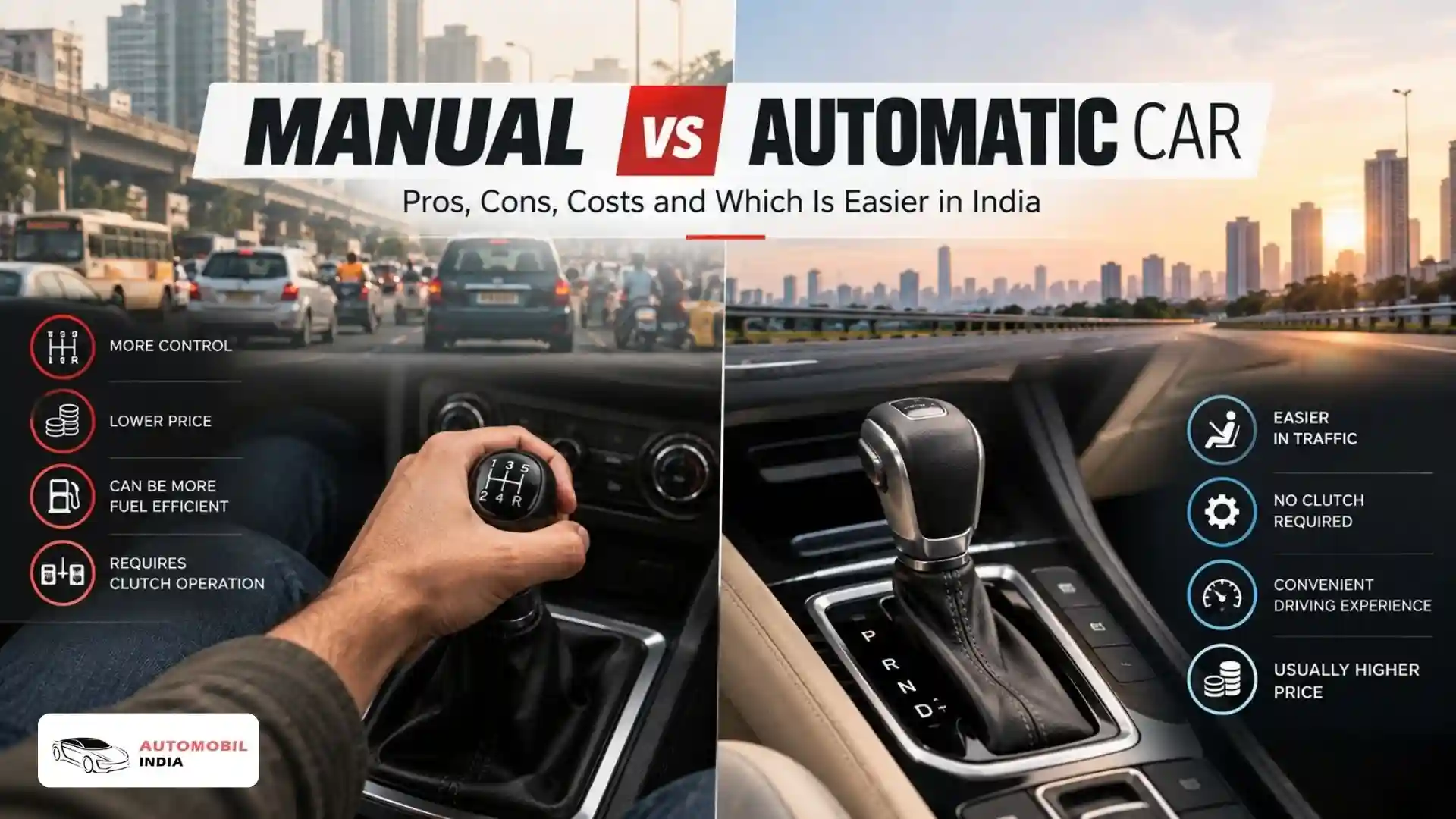
Choosing between a manual and automatic car is no longer simply a question of driving preference. For Indian buyers, the decision can affect purchase price, daily driving effort, fuel consumption, maintenance, resale considerations and how comfortable the car feels in traffic.
The short answer: a manual car generally gives the driver more direct control and can cost less to buy, while an automatic car removes clutch operation and frequent gear changes, making it particularly convenient in stop-and-go traffic. However, “automatic” covers several different transmission technologies, and their driving characteristics and ownership costs can vary significantly.
The right choice therefore depends less on whether one transmission is universally better and more on where, how and how often you drive.
Manual vs Automatic Car: Key Differences at a Glance
| Factor | Manual | Automatic |
|---|---|---|
| Clutch pedal | Yes | No |
| Gear changes | Driver-operated | Transmission-operated |
| Heavy traffic | More effort | Easier |
| Purchase price | Usually lower | Usually higher |
| Driver control | Direct gear selection | Gear selection handled automatically |
| Learning curve | Requires clutch and gear coordination | Generally easier for new drivers |
| Fuel efficiency | Can be very efficient | Depends heavily on transmission type |
| Highway driving | Strong driver control | Convenient, especially on long drives |
| Maintenance | Generally straightforward | Depends on gearbox type |
| Best suited to | Buyers prioritising control and lower entry cost | Buyers prioritising convenience and reduced driving effort |
Modern automatic transmissions are not one single technology. Indian cars use AMTs, torque-converter automatics, CVTs/IVTs and DCTs, among others. Each has different characteristics.
What Is a Manual Car?
A manual transmission requires the driver to operate both the clutch pedal and gear lever.
When changing gears, the driver presses the clutch, selects the appropriate gear and then releases the clutch while applying the accelerator. This gives the driver direct control over which gear the car uses and when it changes.
That control can be useful when driving on steep roads, overtaking or approaching corners because the driver can deliberately select the gear rather than relying on an automatic transmission’s shift logic.
Manual gearboxes also continue to appeal to buyers who enjoy a more involved driving experience.
Advantages of a manual car
- Usually lower purchase price than the equivalent automatic.
- Direct control over gear selection.
- Familiar technology for most Indian drivers.
- Can offer strong fuel efficiency when driven efficiently.
- Generally straightforward mechanically.
- Useful for drivers who frequently want to control engine braking and gear selection.
Disadvantages of a manual car
- Clutch operation can become tiring in heavy traffic.
- Requires more coordination from the driver.
- Stop-start driving involves repeated clutch and gear operation.
- New drivers may take longer to become comfortable with hill starts and smooth gear changes.
- Poor clutch technique can accelerate clutch wear.
For someone driving long distances through congested urban roads every day, these disadvantages can become more noticeable.
What Is an Automatic Car?
An automatic car changes gears without requiring the driver to operate a clutch pedal manually. Depending on the transmission, the system determines when to shift based on factors such as vehicle speed, engine load and accelerator input.
This does not mean every automatic drives in exactly the same way.
The main automatic gearbox types in India
AMT — Automated Manual Transmission
AMT is essentially a manual gearbox where the clutch and gear changes are operated electronically rather than by the driver.
It is generally among the more affordable automatic options and can provide fuel efficiency close to manual versions. However, gear changes can be more noticeable, particularly at lower speeds.
Best suited to: Buyers who want two-pedal convenience without paying a large premium.
Torque Converter Automatic
A conventional torque-converter automatic uses a torque converter and planetary gearset to automatically change ratios.
It is generally associated with smooth low-speed operation and is widely used in SUVs and larger cars.
Best suited to: Buyers who regularly drive in traffic but also want comfortable highway performance.
CVT / IVT
A continuously variable transmission does not use conventional fixed gear ratios in the same way as a traditional automatic. It can provide smooth acceleration and is particularly suited to relaxed city driving.
The downside is that acceleration can sometimes feel different from a conventional geared automatic, especially when the driver demands rapid acceleration.
Best suited to: City-focused buyers who prioritise smoothness.
DCT — Dual-Clutch Transmission
A DCT uses two clutches to manage different gear sets and can deliver very quick gear changes.
It can suit drivers looking for stronger performance and a more responsive driving experience. However, transmission behaviour at very low speeds and in prolonged stop-start traffic depends on the specific gearbox and calibration.
Best suited to: Buyers who place greater emphasis on performance and quick shifts.
Manual vs Automatic Car: Which Is Easier to Drive?
For most drivers, an automatic is easier in heavy stop-start traffic because there is no clutch pedal to operate and the transmission handles gear changes.
This becomes especially relevant in cities where a commute can involve repeated braking, crawling and acceleration.
A manual requires the driver to repeatedly coordinate:
Clutch → Gear → Accelerator → Clutch release
An automatic reduces that process to:
Brake → Accelerator
Maruti Suzuki, for example, describes its automatic systems as eliminating manual clutch and gear operation, while Hyundai similarly highlights reduced effort in traffic as one of the key differences between automatic and manual cars.
However, “easier” is different from “better”. A driver who enjoys controlling gears or regularly drives on roads where engine braking and gear selection matter may still prefer a manual.
Manual vs Automatic Car: Which Gives Better Mileage?
There is no universal answer.
Older assumptions that an automatic car will always deliver lower mileage than a manual are no longer reliable. Fuel consumption depends on the engine, transmission technology, vehicle weight, gearing, traffic conditions and driving style.
For example, an AMT can deliver fuel efficiency close to a comparable manual because its basic gearbox architecture is derived from a manual transmission. CVTs can also be efficient because they can keep the engine operating within an efficient operating range.
The more useful question is therefore:
Look at the manufacturer’s certified figures, but remember that real-world mileage depends heavily on driving conditions.
City driving
In dense traffic, an automatic can make driving easier and potentially allow more consistent acceleration and braking. But actual mileage will depend on the transmission type and how aggressively the car is driven.
Highway driving
Both manual and automatic cars can be efficient on highways. A modern automatic can keep the engine in an appropriate operating range without requiring constant driver intervention.
Manual vs Automatic Car: Purchase Cost
The automatic version of a car generally costs more than its equivalent manual version, although the premium varies substantially by model and transmission.
This difference should not be considered in isolation.
Suppose the automatic costs significantly more but your daily commute involves severe traffic. The additional purchase cost effectively buys a reduction in driving effort every day.
On the other hand, if the car is mainly used occasionally on open roads, the additional automatic premium may be harder to justify purely from a convenience perspective.
Manual vs Automatic Car: Maintenance and Repair Costs
Maintenance costs depend heavily on the specific transmission.
A manual gearbox is mechanically relatively straightforward, but the clutch is a wear component. Aggressive driving, riding the clutch or frequent hill starts can shorten clutch life.
Automatic transmission maintenance varies considerably:
| Transmission | General ownership consideration |
|---|---|
| Manual | Straightforward gearbox; clutch is a wear item |
| AMT | Relatively simple automatic technology; automated clutch still requires consideration |
| CVT | Transmission fluid and specific servicing requirements matter |
| Torque converter AT | ATF/service requirements depend on manufacturer |
| DCT | More complex system; specialised servicing may be required |
Autocar India’s current guidance notes that automatic maintenance costs vary significantly by transmission type, with AMTs generally being among the more affordable options, while CVTs, torque converters and DCTs can have different fluid and servicing requirements.
The safest approach is to follow the manufacturer’s exact service schedule rather than assuming that every automatic requires the same maintenance.
Manual vs Automatic Car: Driving Experience
This is where the difference becomes subjective.
Manual
A manual gives the driver control over:
- When to shift.
- Which gear to use.
- Engine braking.
- How the engine responds during overtaking.
- Gear selection on hills and winding roads.
For enthusiastic drivers, this can make the car feel more involving.
Automatic
An automatic prioritises convenience.
The driver can concentrate more on:
- Traffic.
- Steering.
- Braking.
- Surrounding vehicles.
- Road conditions.
This is particularly useful in congested urban environments.
Neither approach is inherently correct for every driver. The important difference is who controls the gear changes.
Manual vs Automatic Car for Indian City Traffic
For a daily commute involving frequent traffic jams, an automatic can substantially reduce physical effort.
This is particularly noticeable when traffic repeatedly moves a few metres and stops again. With a manual, the driver may repeatedly operate the clutch and shift between first and second gears.
With an automatic, the driver primarily controls the accelerator and brake.
However, the type of automatic matters.
An AMT may be affordable but can produce more noticeable gear changes. A CVT can feel smoother in city driving. A torque converter can offer a relaxed combination of low-speed behaviour and highway usability, while a DCT can prioritise quick shifts and performance.
Manual vs Automatic Car for Highway Driving
Both can work well on highways.
A manual gives the driver direct control over gear selection, which can be useful during overtaking or on hilly routes.
An automatic reduces the need to shift repeatedly, particularly during long-distance driving.
For frequent highway users, the choice should therefore consider more than transmission type:
- Engine performance.
- Gearbox response.
- Overtaking behaviour.
- High-speed refinement.
- Cruise control availability.
- Vehicle stability.
- Seating comfort.
- Fuel efficiency.
Manual vs Automatic Car for Hills
Hilly driving highlights the differences between transmission types.
A manual gives the driver direct control over lower gears and engine braking. This can be useful when descending steep roads or managing slow climbs.
Modern automatics can also handle gradients effectively, but their behaviour differs according to gearbox type. Some provide manual or sequential modes that allow the driver to request lower gears.
If you regularly travel through the Western Ghats, Himalayas or other steep terrain, it is worth taking the exact car and transmission combination for a test drive rather than judging the gearbox only by its name.
Manual vs Automatic Car: Pros and Cons
| Manual | Automatic | |
|---|---|---|
| Purchase price | Usually lower | Usually higher |
| Traffic comfort | Lower | Higher |
| Driver involvement | Higher | Lower |
| Gear control | Direct | Automatic |
| Clutch fatigue | Possible | Eliminated |
| Mileage | Can be excellent | Highly transmission-dependent |
| Maintenance | Relatively straightforward | Transmission-dependent |
| Performance feel | Driver-controlled | Depends on gearbox |
| Best use | Control, budget, involvement | Convenience, traffic, ease |
Which Automatic Transmission Should You Choose?
There is no single automatic gearbox that suits every buyer.
Choose an AMT if:
- Your budget is limited.
- You primarily drive in cities.
- You want two-pedal convenience at a relatively accessible price.
- You can accept more noticeable gear changes.
Consider a CVT/IVT if:
- Most of your driving is urban.
- Smooth acceleration is important.
- You prefer relaxed driving.
Consider a torque converter if:
- You frequently drive in heavy traffic.
- You want smooth low-speed behaviour.
- You also undertake regular highway trips.
Consider a DCT if:
- Quick gear changes matter.
- You value performance.
- You understand that the gearbox’s characteristics depend on its specific design and calibration.
These are broad guidelines rather than universal rules; the exact engine-gearbox combination matters.
Manual vs Automatic Car: What Should First-Time Buyers Consider?
First-time buyers often focus heavily on the price difference.
Instead, calculate your actual usage.
Ask yourself:
- How many kilometres do I drive every month?
- How much of that driving is in traffic?
- Do I regularly drive on highways?
- Do I live in a hilly area?
- Will multiple family members drive the car?
- Am I comfortable operating a clutch?
- How long do I intend to keep the car?
- Is the automatic available in the variant I actually want?
- What is the manufacturer’s service schedule?
- Does the automatic gearbox feel comfortable during a proper test drive?
This gives a much more useful answer than simply asking whether manual or automatic cars are better.
Manual vs Automatic Car: A Practical Decision Guide
| Your priority | Transmission to consider |
|---|---|
| Lowest purchase cost | Manual |
| Heavy daily traffic | Automatic |
| Maximum involvement | Manual |
| Simple driving experience | Automatic |
| Occasional city use | Either |
| Frequent highway trips | Either, depending on gearbox |
| Hilly driving | Either; test the specific gearbox |
| Performance-focused driving | Manual or performance-oriented automatic |
| Budget-focused automatic ownership | AMT may be worth considering |
| Smooth city driving | CVT/IVT or suitable torque converter |
Frequently Asked Questions
Is a manual or automatic car better for Indian traffic?
An automatic is generally easier to operate in heavy stop-start traffic because it eliminates manual clutch operation and gear changes.
Which gives better mileage, manual or automatic?
Neither transmission type guarantees better mileage. Engine, gearbox technology, vehicle weight, traffic and driving style all affect fuel consumption.
Are automatic cars more expensive to maintain?
Not necessarily in every case. Maintenance depends on the type of automatic gearbox and the manufacturer’s service requirements. AMTs can have relatively straightforward servicing, while some CVTs, torque converters and DCTs have different fluid and component requirements.
Is AMT the same as an automatic?
AMT is an automated manual transmission. It uses a manual-type gearbox but automates clutch operation and gear changes. It provides two-pedal driving but can feel different from a torque-converter, CVT or DCT automatic.
Is a manual car better for highways?
A manual can give the driver greater control over gear selection, but an automatic can also be very comfortable for highway driving. The engine and specific gearbox are more important than the transmission label alone.
Which automatic gearbox is smoothest?
There is no universal answer, but CVTs are known for smooth ratio changes, while torque converters can also provide smooth low-speed operation. Actual behaviour depends on the particular vehicle and calibration.
Does an automatic car have a clutch?
It depends on the transmission. Automatic gearboxes can use different clutch arrangements internally, but the driver does not manually operate a clutch pedal. AMTs automate the clutch operation, while other automatic technologies use different mechanisms.
Is a manual car cheaper to buy?
Generally, the manual version of a car costs less than the equivalent automatic version, although the actual price difference varies by model and variant.
Which is easier for a new driver?
An automatic is generally easier initially because the driver does not need to coordinate a clutch pedal with gear changes. A manual requires additional coordination but gives the driver direct control over gear selection.
Should I buy a manual or automatic car in India?
Base the decision on your driving environment, budget and preferred driving experience. Heavy urban traffic generally makes an automatic more convenient, while buyers prioritising lower purchase cost and direct gear control may prefer a manual.