
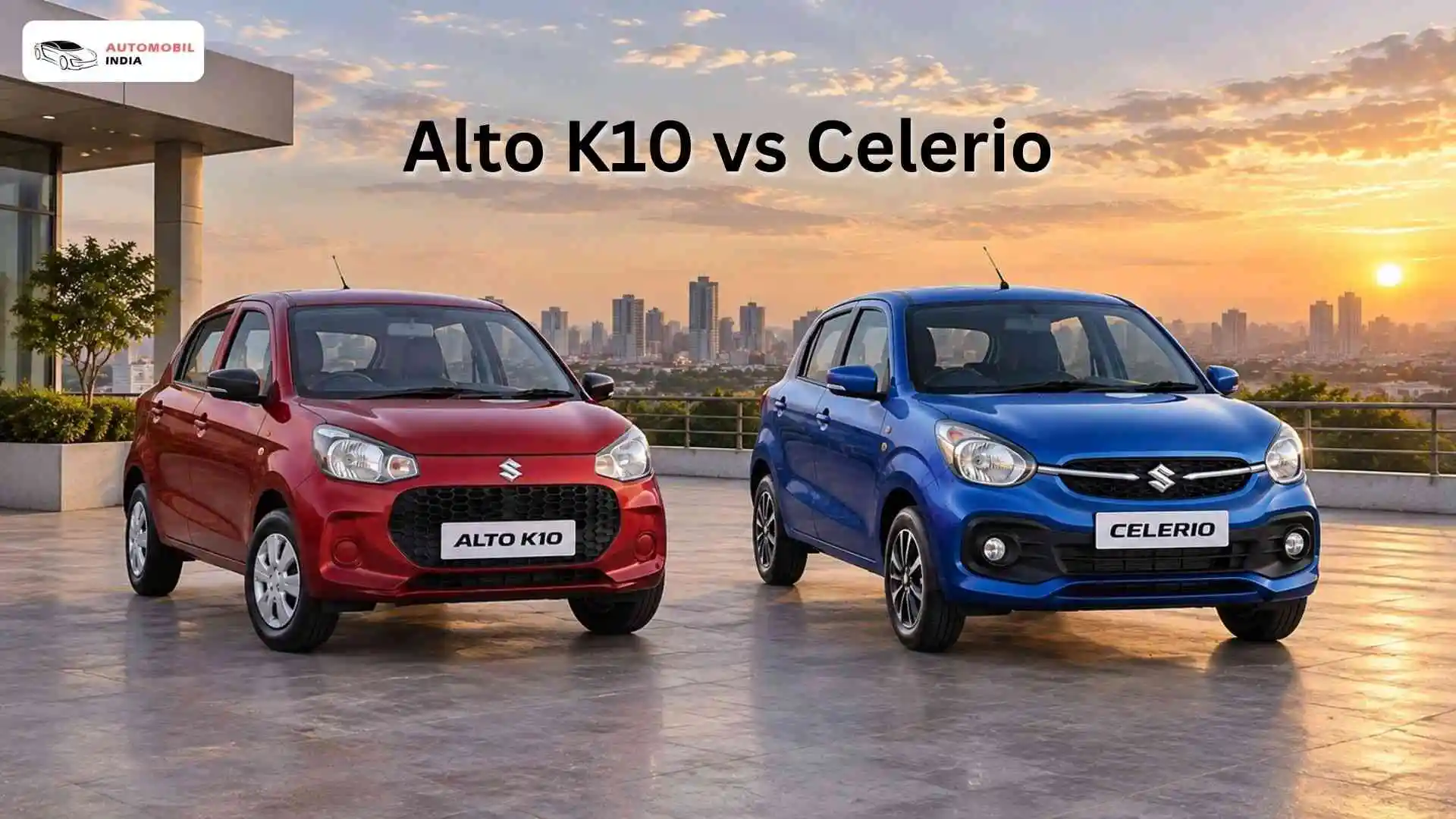
The Alto K10 vs Celerio comparison is essentially a choice between two small Maruti hatchbacks that share the same 998cc K-Series engine family but target slightly different buyers.
The Alto K10 is the more affordable and compact option, making it particularly suitable for first-time car buyers, small families and people who spend most of their time in congested city traffic. The Celerio costs more but offers a larger body, more cabin and boot space, a more spacious-feeling interior and higher claimed fuel efficiency.
Both are available with petrol, CNG and Maruti’s AGS automated-manual transmission, while both now get six airbags as standard. The biggest differences are therefore price, dimensions, practicality, equipment and the way each car uses the same basic 1.0-litre engine.
As of September 2026, the Alto K10 starts at ₹3.69 lakh ex-showroom, while the Celerio starts at ₹4.69 lakh. The price gap is significant at this end of the market, particularly for buyers working with a strict ₹5 lakh budget.
So, Alto K10 or Celerio? The answer depends on whether your priority is the lowest purchase cost and maximum city manoeuvrability, or a slightly more spacious hatchback with better claimed fuel economy and additional features.
Alto K10 vs Celerio: Quick Comparison
| Parameter | Maruti Alto K10 | Maruti Celerio |
|---|---|---|
| Seating capacity | 5 | 5 |
| Petrol engine | 998cc K10C | 998cc K10C |
| Cylinders | 3 | 3 |
| Petrol power | 68.5 PS | 68.5 PS |
| Petrol torque | 91.1 Nm | 91.1 Nm |
| CNG power | 56.7 PS approx. | 56.7 PS approx. |
| CNG torque | 82.1 Nm | 82.1 Nm |
| Petrol manual mileage | 24.39 km/l | Up to 25.24 km/l |
| Petrol AGS mileage | 24.90 km/l | Up to 26.00 km/l |
| CNG mileage | 33.40 km/kg | 34.43 km/kg |
| Manual gearbox | 5-speed | 5-speed |
| Automatic | 5-speed AGS | 5-speed AGS |
| Length | 3,530 mm | 3,695 mm |
| Width | 1,490 mm | 1,655 mm |
| Height | 1,520 mm | 1,555 mm |
| Wheelbase | 2,380 mm | 2,435 mm |
| Boot space | 214 litres | 292 litres |
| Fuel tank | 27 litres | 32 litres |
| Ground clearance | Approx. 160 mm | Approx. 170 mm |
| Starting price | ₹3.69 lakh | ₹4.69 lakh |
Alto K10 vs Celerio Price
Price is the first major difference between these two cars.
The Alto K10 starts at ₹3.69 lakh ex-showroom, while the Celerio starts at ₹4.69 lakh.
That creates a starting-price difference of approximately ₹1 lakh.
For buyers shopping below ₹5 lakh, this is not a small amount. It can affect the down payment, monthly EMI and the overall cost of ownership.
Current Alto K10 price range
The Alto K10 range currently includes:
- Std (O)
- LXi (O)
- VXi (O)
- VXi+ (O)
- LXi (O) CNG
- VXi (O) CNG
- VXi (O) AGS
- VXi+ (O) AGS
The petrol range starts at ₹3.69 lakh, while the top VXi+ AGS is listed at around ₹5.45 lakh ex-showroom.
Current Celerio price range
The Celerio range includes:
- LXi
- VXi
- ZXi
- ZXi+
- VXi CNG
- AGS versions of selected variants
The Celerio starts at ₹4.69 lakh, while the ZXi+ AGS reaches approximately ₹6.75 lakh.
What does the price difference mean?
The Celerio is not simply a more expensive Alto K10.
You are paying for a larger vehicle with:
- More cabin space
- A larger boot
- A longer wheelbase
- A wider body
- More premium equipment on higher variants
Therefore, the relevant comparison is not necessarily Alto K10 base vs Celerio base.
If your budget is around ₹5 lakh, the Alto K10 gives you considerably more flexibility to buy a higher variant or automatic without moving too far beyond the budget.
If you can stretch beyond ₹6 lakh, the Celerio opens up more equipment and space.
Compare EMI options before you finalise the variant, so the on-road price fits your monthly plan.
Alto K10 vs Celerio: Engine and Performance
Both cars use Maruti Suzuki’s 998cc K10C three-cylinder petrol engine.
The petrol engine produces:
- 68.5 PS
- 91.1 Nm
The engine is paired with either a five-speed manual or five-speed AGS automatic.
This is one area where the Alto K10 and Celerio are fundamentally similar.
The difference comes primarily from their size and weight rather than engine output.
Alto K10 performance
The Alto K10 is smaller and lighter.
That means the 68.5 PS engine has less mass to move, which suits the car’s intended urban role.
For city driving, the Alto K10’s compact dimensions and relatively low weight make it easy to place on the road.
It is not designed to be a highway performance car, but its engine is adequate for normal urban commuting and occasional highway use.
Celerio performance
The Celerio uses the same basic engine and therefore produces the same peak power and torque.
However, it is physically larger.
The extra size gives it a more substantial cabin but also means the engine is moving a somewhat larger vehicle.
For normal city use, the difference is unlikely to be the primary deciding factor.
If you frequently drive on highways with four or five occupants and luggage, neither car should be confused with a performance-oriented hatchback. Their strengths lie in efficiency and easy everyday operation.
Alto K10 vs Celerio Mileage
Mileage is one of the biggest reasons buyers consider both cars.
According to Maruti Suzuki’s current figures:
Alto K10
- Petrol manual: 24.39 km/l
- Petrol AGS: 24.90 km/l
- CNG: 33.40 km/kg
Celerio
- Petrol manual: up to 25.24 km/l
- Petrol AGS: 26.00 km/l
- CNG: 34.43 km/kg
This gives the Celerio a small advantage in claimed fuel efficiency.
However, the difference should be viewed in context.
A car returning 25 km/l rather than 24 km/l sounds significant on paper, but actual fuel savings depend on how much you drive.
For example, a person covering 500–600km a month may save relatively little fuel money from a small mileage advantage.
Someone covering 2,000km every month will notice the difference more.
For a deeper look at how these figures stack up against the wider segment, see our round-up of the best mileage cars in India.
Claimed mileage vs real-world mileage
The figures above are certified/manufacturer figures.
Actual mileage can vary because of:
- Traffic conditions
- Driving style
- Average speed
- Air-conditioning usage
- Tyre pressure
- Passenger load
- Road conditions
Therefore, Alto K10 vs Celerio mileage should not be judged only from the brochure figures.
Alto K10 vs Celerio CNG
Both cars are available with factory-fitted S-CNG technology.
This is important for buyers who have easy access to CNG and drive substantial distances every month.
The claimed figures are:
| CNG parameter | Alto K10 | Celerio |
|---|---|---|
| Engine | 998cc | 998cc |
| Transmission | 5MT | 5MT |
| Claimed efficiency | 33.40 km/kg | 34.43 km/kg |
| Petrol-mode power | 68.5 PS | 68.5 PS |
| CNG-mode power | Approx. 56.7 PS | Approx. 56.7 PS |
The Celerio has the slightly higher certified efficiency figure.
But the Alto K10 CNG has one major financial advantage: the entry price is lower.
For a commercial user, delivery driver or high-mileage city commuter, calculating the payback period between petrol and CNG is more useful than simply looking at km/kg. It is also worth checking how both cars fit into our broader list of the top CNG cars in India.
Alto K10 vs Celerio Dimensions
This is where the Celerio clearly separates itself from the Alto K10.
| Dimension | Alto K10 | Celerio |
|---|---|---|
| Length | 3,530 mm | 3,695 mm |
| Width | 1,490 mm | 1,655 mm |
| Height | 1,520 mm | 1,555 mm |
| Wheelbase | 2,380 mm | 2,435 mm |
| Boot | 214 litres | 292 litres |
The Celerio is:
- 165mm longer
- 165mm wider
- 35mm taller
- 55mm longer in wheelbase
Those are meaningful differences for a small hatchback.
The Celerio’s wider body and longer wheelbase give it a more spacious cabin, while the larger boot is useful for family shopping and luggage.
The Alto K10’s smaller footprint is its advantage in narrow streets and tight parking spaces.
Alto K10 vs Celerio: Which Has More Space?
The Celerio has the more spacious cabin.
Its 2,435mm wheelbase is 55mm longer than the Alto K10’s 2,380mm wheelbase.
That doesn’t sound dramatic in isolation, but in a small car every millimetre of additional cabin packaging matters.
The Celerio is also substantially wider.
For a small family, the difference becomes noticeable when:
- Two adults sit in the front
- Two adults sit in the rear
- A child seat is installed
- You need to carry luggage
The Alto K10 remains usable as a five-seater, but it is better understood as a compact city hatchback rather than a spacious family hatchback.
Rear-seat practicality
For occasional rear-seat passengers, the Alto K10 works.
For frequent four- or five-person use, the Celerio’s additional width and wheelbase make it the more comfortable proposition.
This is one of the strongest practical reasons to spend more on the Celerio.
Alto K10 vs Celerio: Boot Space
The Celerio has a 292-litre boot, compared with approximately 214 litres in the Alto K10.
That is a difference of around 78 litres, or more than 35%.
This is much more meaningful than the small difference in claimed mileage.
For a couple using the car mainly in the city, the Alto’s boot may be enough.
For a family carrying:
- Shopping bags
- Small suitcases
- Baby equipment
- Weekend luggage
the Celerio’s larger boot is easier to live with.
If you regularly travel with four or five people and luggage, the Celerio’s additional boot space becomes one of the strongest reasons to choose it.
Alto K10 vs Celerio Features
The two cars follow different equipment strategies.
The Alto K10 concentrates on essential convenience features at a low price, while the Celerio offers a more premium equipment package as you move up the range.
Alto K10 features
Depending on the variant, the Alto K10 offers:
- 17.78cm SmartPlay Studio touchscreen
- Android Auto and Apple CarPlay
- Steering-mounted audio and calling controls
- Digital speedometer
- Electrically adjustable/foldable ORVMs
- Keyless entry
- Power windows
- Rear parcel tray
- USB connectivity
- SmartPlay Dock on selected variants
The VXi+ variant adds the larger SmartPlay Studio system.
Celerio features
Depending on the variant, the Celerio offers:
- SmartPlay Studio system
- Android Auto and Apple CarPlay on applicable versions
- Steering-mounted controls
- Keyless entry
- Power windows
- Electrically adjustable ORVMs
- Rear wiper and washer
- Rear defogger
- Alloy wheels on higher variants
- Engine start/stop button on higher variants
- Hill Hold Assist with AGS variants
The Celerio’s higher variants therefore feel more like a conventional family hatchback than an entry-level city car.
Which has better features?
It depends on the price point.
If you compare similarly priced versions, the Alto K10 may give you a surprisingly good equipment list for the money.
If you compare the highest versions of both, the Celerio provides the more substantial overall package, particularly because the cabin itself is larger.
Talk to the Automobil India team for variant-level guidance before you book a test drive.
Alto K10 vs Celerio: Automatic Transmission
Both cars use Maruti Suzuki’s Auto Gear Shift (AGS) system.
This is an automated manual transmission rather than a conventional torque-converter automatic or CVT.
That distinction matters.
AGS essentially automates the clutch and gear-selection process of a manual gearbox.
Advantages
- Easier than using a clutch in traffic
- Lower mechanical complexity than some automatic technologies
- Good claimed fuel efficiency
- Relatively affordable automatic option
Limitation
Gear changes can be more noticeable than in a conventional automatic.
If you are moving from a manual car, the system is easy to understand.
If you are used to a smooth torque-converter automatic or CVT, you may notice the pauses between shifts.
For city commuting, the AGS is particularly useful for buyers who want to avoid constant clutch operation without spending heavily on a more sophisticated automatic. See our wider guide to the best automatic cars under ₹10 lakh for how the AGS compares with other budget automatics.
Alto K10 vs Celerio: Safety
Safety deserves more attention than it traditionally received in this segment.
Both cars now come with six airbags as standard, following Maruti Suzuki’s 2025 update to its Arena range.
Both also have safety equipment such as:
- ABS with EBD
- Electronic Stability Program
- Reverse parking sensors
- Three-point seatbelts
- Seatbelt reminders
- ISOFIX child-seat mounting points, depending on the applicable specification
Maruti Suzuki announced six airbags as standard across the Alto K10 and Celerio in May 2025, alongside existing safety systems including ESP, ABS with EBD and, where applicable, Hill Hold Assist.
However, airbags and crash-test performance are not the same thing.
That distinction is important when comparing these two cars.
Alto K10 vs Celerio Safety Rating
Alto K10 Global NCAP result
The Alto K10 was tested by Global NCAP in 2023.
It scored:
- 2 stars for adult occupant protection
- 0 stars for child occupant protection
- 21.67/34 points for adult protection
- 3.52/49 points for child protection
Global NCAP’s fact sheet identifies the tested vehicle as an India-market Alto K10.
The test predates Maruti Suzuki’s subsequent standardisation of six airbags across the Alto K10 range.
Therefore, the 2023 crash-test result should not be described as a test of today’s six-airbag specification.
Celerio Global NCAP result
The current six-airbag Celerio was tested by Global NCAP in 2025.
It achieved:
- 3 stars for adult occupant protection
- 2 stars for child occupant protection
- 18.04/34 points for adult protection
- 18.57/49 points for child protection
Global NCAP also tested a two-airbag Celerio, which scored lower.
The six-airbag result is the relevant one for the updated Celerio specification identified by the test.
However, Global NCAP noted an unstable bodyshell and limitations in child protection.
What does this mean for buyers?
The important takeaway is not simply that one car has a higher star number.
The tests were conducted in different years, and safety equipment on both models has changed.
The current Alto K10 and Celerio both have six airbags and ESP, but neither should be described as having a five-star crash-test record.
For buyers who place a particularly high priority on independently tested crash protection, the Global NCAP results should be considered alongside the cars’ current equipment and test applicability.
Alto K10 vs Celerio: Comfort and Everyday Driving
The Celerio has an advantage in cabin comfort because of its larger dimensions.
Its wider body gives occupants more shoulder room, while the longer wheelbase helps cabin packaging.
The Alto K10’s smaller dimensions make it easier to drive through narrow roads.
This matters in cities such as:
- Mumbai
- Pune
- Nashik
- Bengaluru
- Delhi
- Hyderabad
where parking and road width can be more frustrating than outright engine performance.
Alto K10 for city use
Its strengths include:
- Small turning footprint
- Easy parking
- Light controls
- Compact body
- Lower purchase price
- Low running costs
Celerio for mixed usage
Its strengths include:
- More interior room
- Larger boot
- Better long-distance practicality
- Slightly higher claimed fuel efficiency
- More substantial cabin
If the car will regularly carry four adults, the Celerio’s additional space becomes more valuable.
Alto K10 vs Celerio: Which Is Easier to Own?
Both benefit from Maruti Suzuki’s large sales and service network.
For buyers in smaller towns and cities, this can be an important ownership consideration.
Routine maintenance availability, parts accessibility and the ability to find authorised service facilities can influence the long-term experience just as much as the initial price.
Both also have relatively simple three-cylinder petrol engines and straightforward mechanical layouts.
However, buyers should still compare:
- Insurance premium
- Service costs
- Extended warranty
- CNG running costs
- Tyre prices
- Resale expectations
- Financing costs
before making a final decision.
Compare car insurance options for your chosen Alto K10 or Celerio variant before booking.
Alto K10 vs Celerio: Which One Should You Buy?
There is no need to choose a universal winner because the two cars serve slightly different needs.
Choose the Alto K10 if you prioritise:
- Lowest purchase price
- Maximum city manoeuvrability
- Small exterior dimensions
- Affordable automatic option
- Low-cost CNG entry point
- Occasional rear-seat use
- Primarily urban driving
The Alto K10 is particularly relevant for first-time buyers who want a new car without stretching their budget.
Choose the Celerio if you prioritise:
- More cabin space
- Larger boot
- Better family practicality
- Slightly higher claimed mileage
- A more substantial highway-going hatchback
- More premium equipment on higher variants
- More comfortable use with four or five occupants
The Celerio’s additional ₹1 lakh starting price buys more than equipment. It buys a physically larger car.
Alto K10 vs Celerio: Best Choice by Buyer Type
| Buyer requirement | More relevant option |
|---|---|
| Lowest purchase price | Alto K10 |
| First new car | Alto K10 |
| Very narrow city roads | Alto K10 |
| Frequent four/five-person use | Celerio |
| Larger boot required | Celerio |
| Maximum claimed petrol mileage | Celerio |
| Maximum claimed CNG mileage | Celerio |
| Lowest CNG entry price | Alto K10 |
| Automatic under a tight budget | Alto K10 |
| More spacious cabin | Celerio |
| Primarily urban use | Alto K10 |
| Mixed city/highway family use | Celerio |
| Safety equipment | Both have six airbags and ESP |
| Independently tested safety record | Compare the respective Global NCAP results and test dates |
Alto K10 or Celerio: The Budget Question
This may ultimately be the biggest factor.
Suppose your budget is strictly around ₹5 lakh ex-showroom.
The Alto K10 gives you several ways to stay within that budget, including higher petrol variants, AGS and CNG.
The Celerio’s base price already starts close to ₹4.70 lakh, meaning the more desirable variants quickly move beyond ₹5 lakh.
That makes the Alto K10 particularly relevant to buyers who are financing their first car and want to keep the EMI under control.
But if you can comfortably move toward ₹6–7 lakh, the Celerio becomes much more interesting because its additional space and equipment become easier to justify.
Alto K10 vs Celerio: What About Rivals?
Buyers considering either Maruti hatchback should also look at:
- Maruti S-Presso
- Maruti WagonR
- Maruti Swift
- Renault Kwid
- Hyundai Grand i10 Nios
The WagonR is particularly relevant if rear-seat space is a priority while staying within the Maruti ecosystem.
The Grand i10 Nios is worth considering if you want a more premium small-hatchback experience.
The S-Presso targets buyers who prioritise a very compact footprint and tall-boy seating position.
Final Verdict: Alto K10 vs Celerio
The Alto K10 vs Celerio decision comes down primarily to budget and space.
The Alto K10 is the more affordable, compact choice. It makes sense for buyers who spend most of their time in cities, need an easy-to-park car and want to minimise the initial purchase price.
The Celerio costs more but gives you a larger body, a longer wheelbase, a 292-litre boot and slightly better certified fuel-efficiency figures.
For a single driver or small family that mainly needs an affordable urban runabout, the Alto K10’s compact dimensions and lower price can be more important than the Celerio’s additional space.
For a family that regularly carries four or five people, the Celerio’s larger cabin and boot make the additional expenditure easier to justify.
The most useful way to make the decision is therefore to compare the exact variants at your budget, rather than comparing the two nameplates in isolation.
Before booking, check the on-road price in your city, compare the petrol and CNG running costs, and drive both manual and AGS versions if an automatic is on your shortlist.
Frequently Asked Questions
1. Which is better, Alto K10 or Celerio?
The answer depends on your requirements. The Alto K10 is smaller and cheaper, while the Celerio offers more cabin and boot space along with slightly higher claimed fuel efficiency.
2. Which has better mileage, Alto K10 or Celerio?
The Celerio has higher claimed figures. Its petrol manual is rated at up to 25.24 km/l and AGS at 26 km/l, while the Alto K10 is rated at 24.39 km/l and 24.90 km/l respectively. The Celerio CNG is rated at 34.43 km/kg compared with 33.40 km/kg for the Alto K10.
3. Is Celerio bigger than Alto K10?
Yes. The Celerio is 165mm longer and 165mm wider than the Alto K10. It also has a 55mm longer wheelbase.
4. Which has more boot space, Alto K10 or Celerio?
The Celerio has substantially more boot space. It offers 292 litres compared with approximately 214 litres in the Alto K10.
5. Does Alto K10 have CNG?
Yes. The Alto K10 is available with Maruti Suzuki’s factory-fitted S-CNG system and a five-speed manual transmission.
6. Does Celerio have an automatic?
Yes. The Celerio is available with Maruti Suzuki’s five-speed AGS automated-manual transmission on selected variants.
7. Which is cheaper to maintain, Alto K10 or Celerio?
Both use relatively simple petrol/CNG powertrains and benefit from Maruti Suzuki’s widespread service network. Actual ownership cost depends on usage, fuel type, service schedule, insurance and location, so a blanket maintenance-cost difference should not be assumed.
8. Is Alto K10 safe?
The current Alto K10 has six airbags, ABS with EBD, ESP and reverse parking sensors as standard. However, the India-market Alto K10 tested by Global NCAP in 2023 scored two stars for adult occupant protection and zero stars for child occupant protection. That test predates the current six-airbag standardisation.
9. Is Celerio safe?
The current Celerio has six airbags, ESP, ABS with EBD and other safety equipment as standard. The six-airbag India-spec Celerio tested by Global NCAP in 2025 scored three stars for adult occupant protection and two stars for child occupant protection. Global NCAP also identified structural and child-protection limitations.
10. Which is better for family use, Alto K10 or Celerio?
The Celerio is the more spacious family-oriented option because it has a longer wheelbase, wider body and 292-litre boot. The Alto K10 is more suitable when affordability and compact urban dimensions are the higher priorities.
Check the latest variant prices, compare on-road costs in your city and calculate your EMI before booking a test drive.