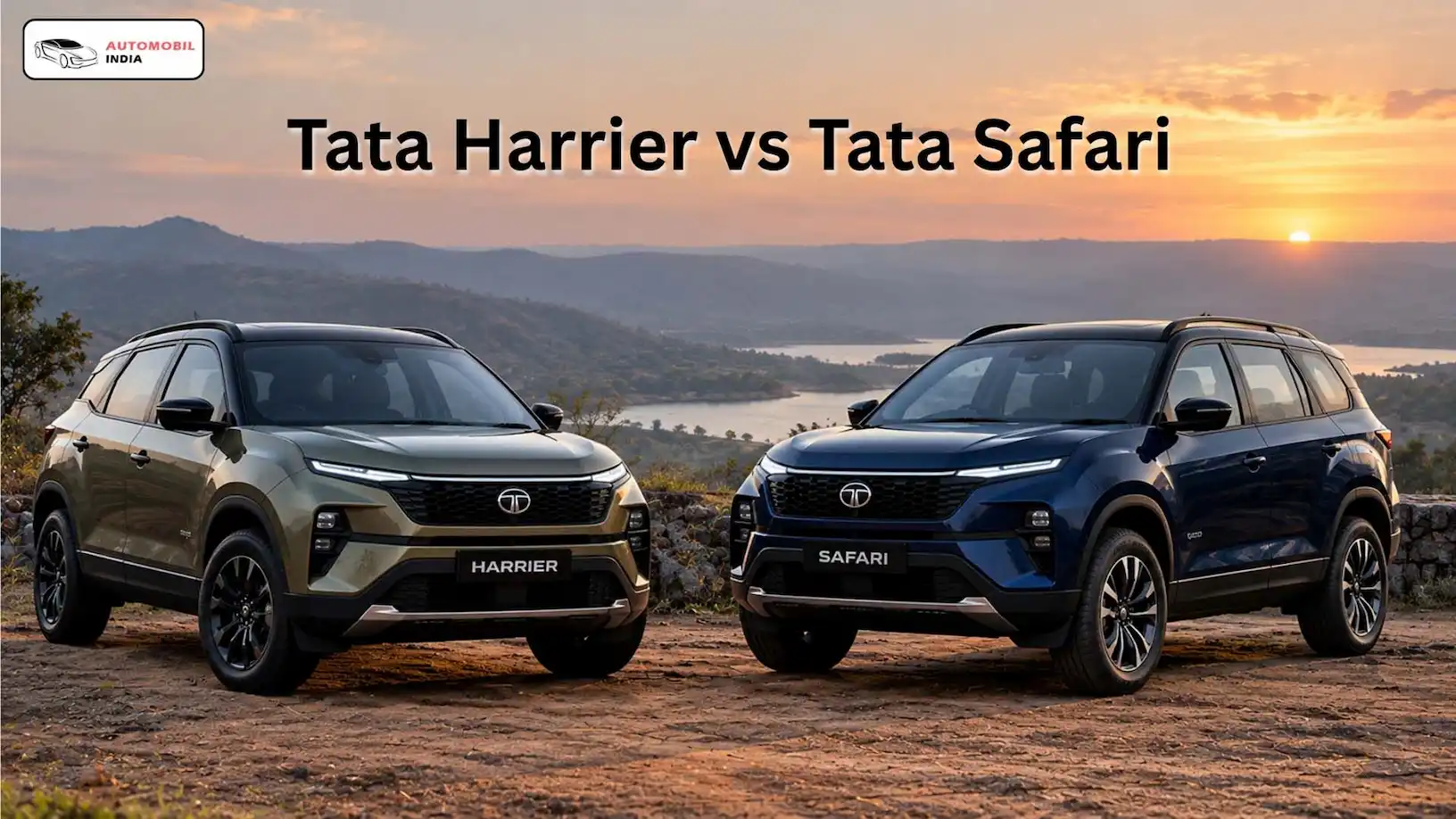
If you are deciding between the Tata Harrier and Tata Safari, the most important question is not simply which SUV has more features. It is whether you actually need the Safari’s third row.
The Harrier is a five-seat SUV, while the Safari is available in six- and seven-seat configurations. Both share the same 2,741mm wheelbase, use the same 1.5-litre turbo-petrol and 2.0-litre diesel powertrains, and have a five-star Bharat NCAP rating. The Harrier is shorter and has a larger five-seat boot, while the Safari adds two extra passenger positions and greater cabin height.
As of September 2026, the Harrier starts at ₹12.99 lakh ex-showroom, while the Safari starts at ₹13.40 lakh. Both ranges extend beyond ₹26 lakh depending on engine, transmission, variant and edition.
The choice therefore comes down largely to seating requirements, luggage needs, engine preference, variant equipment and budget rather than a simple size difference.
Tata Harrier vs Tata Safari: Quick Comparison
| Parameter | Tata Harrier | Tata Safari |
|---|---|---|
| Seating capacity | 5 | 6 / 7 |
| Petrol engine | 1.5-litre Turbo-GDI | 1.5-litre Turbo-GDI |
| Petrol power | 170 hp | 170 hp |
| Petrol torque | 280 Nm | 280 Nm |
| Diesel engine | 2.0-litre turbo-diesel | 2.0-litre turbo-diesel |
| Diesel power | 170 hp | 170 hp |
| Diesel torque | 350 Nm | 350 Nm |
| Manual gearbox | 6-speed | 6-speed |
| Automatic | 6-speed AT | 6-speed AT |
| Length | 4,605 mm | 4,668 mm |
| Width | 1,922 mm | 1,922 mm |
| Height | 1,718 mm | 1,795 mm |
| Wheelbase | 2,741 mm | 2,741 mm |
| Boot capacity* | 445 litres | 420 litres |
| Fuel tank | 50 litres | 50 litres |
| Bharat NCAP | 5 stars | 5 stars |
Tata Harrier vs Safari Price in India
Current ex-showroom pricing in September 2026 is approximately:
| SUV | Starting price | Approx. top-end price |
|---|---|---|
| Tata Harrier | ₹12.99 lakh | ₹26.91 lakh* |
| Tata Safari | ₹13.40 lakh | ₹26.91 lakh |
The entry-level gap is only about ₹40,000, but that does not mean the two cars are equivalent at those prices.
The Tata Harrier’s base version is a five-seat petrol manual, whereas the Safari’s base version is a seven-seat petrol manual. So, for a buyer who needs seven seats, the relatively small starting-price difference is potentially more meaningful than the headline price itself.
Tata’s current range includes several personas and combinations of petrol/diesel, manual/automatic and, in the Safari’s case, six- or seven-seat layouts.
What about the Stealth Edition?
Tata also offers Stealth versions of both SUVs. The 2026 Stealth Edition is based on the higher-end Harrier Fearless Ultra and Safari Accomplished Ultra configurations and is available with petrol and diesel powertrains.
That makes the Stealth primarily an appearance and equipment-led choice, rather than a fundamentally different SUV underneath.
Compare EMI options before you finalise the variant, so the on-road price fits your monthly plan.
Harrier vs Safari: Engine and Performance
Both SUVs use two engine options.
1.5-litre Turbo-GDI petrol
The petrol engine produces:
- 170 hp
- 280 Nm
- 6-speed manual
- 6-speed automatic
- Front-wheel drive
This engine gives buyers an alternative to the diesel and is particularly relevant for those whose annual running is moderate or whose usage is predominantly urban.
The 280 Nm torque output is healthy for a petrol SUV of this size. However, the diesel still has a 70 Nm advantage, which becomes relevant when the vehicle is fully loaded.
2.0-litre diesel
The 1,956cc diesel produces:
- 170 hp
- 350 Nm
- 6-speed manual
- 6-speed automatic
The diesel’s 350 Nm is available from 1,750–2,500rpm, according to Tata’s technical documentation.
That broad torque delivery is useful on Indian highways, especially when overtaking or climbing with passengers and luggage.
Tata has been using this 2.0-litre diesel in the Safari and Harrier for several years, and the current output remains 170 PS/350 Nm.
Which engine makes more sense?
- Petrol: Consider it if you have moderate annual running, mostly city usage or simply prefer a petrol powertrain.
- Diesel: Makes more sense to investigate if you frequently travel long distances, carry a full load or want the stronger low- and mid-range torque.
There is no universal answer because the financial benefit of a diesel depends on annual kilometres, fuel prices and the price difference between comparable variants.
Harrier vs Safari Mileage
Mileage figures should not be confused with what every owner will achieve in everyday driving.
Certified fuel-economy figures are produced under controlled test conditions. Actual consumption depends on:
- Traffic
- Driving style
- Average speed
- Air-conditioning use
- Passenger and luggage load
- Tyre pressures
- Road conditions
- Manual or automatic transmission
For that reason, buyers should use the manufacturer’s applicable certified figure for the exact variant they are considering and then keep a realistic margin for real-world driving.
For a high-running buyer, the more useful exercise is to calculate annual fuel expenditure rather than choosing a vehicle purely on its claimed km/l figure.
Harrier vs Safari: Dimensions and Space
The Safari is visibly the larger vehicle, although both SUVs share the same wheelbase.
| Dimension | Harrier | Safari |
|---|---|---|
| Length | 4,605 mm | 4,668 mm |
| Width | 1,922 mm | 1,922 mm |
| Height | 1,718 mm | 1,795 mm |
| Wheelbase | 2,741 mm | 2,741 mm |
| Seating | 5 | 6/7 |
The extra 63mm of length and 77mm of height on the Safari are not simply cosmetic. They help accommodate the third-row seating arrangement.
However, the shared wheelbase means the Safari isn’t dramatically longer between the front and rear axles. Its main packaging advantage comes from the way Tata has configured the cabin.
Harrier Space: Better for a Five-Person Family?
The Harrier’s biggest practical advantage is simplicity.
There are only two rows, so the rear passengers don’t have to share cabin space with a permanently available third row. It also leaves a useful luggage compartment behind the rear seats.
The current Harrier has a 445-litre boot, according to current specifications.
For a family of four or five, that layout can be more useful than buying a three-row SUV and leaving its third row folded most of the time.
Safari Space: When Does the Third Row Matter?
The Safari’s fundamental advantage is passenger capacity.
It can be configured as:
- 7 seats, with a conventional second-row bench
- 6 seats, with second-row captain chairs on selected variants
The seven-seat layout is the more flexible option when carrying more people is a regular requirement.
The six-seat layout is more relevant to buyers who prioritise second-row individual seating and a more premium second-row experience.
The trade-off is luggage space. With the third row occupied, there is naturally less room for luggage than in a five-seat Harrier.
That is why a buyer should ask a simple question:
If the answer is only once or twice a year, the Harrier’s simpler layout may be more practical. If you regularly travel with six or seven people, the Safari solves a problem the Harrier cannot.
Harrier vs Safari: Features
The two SUVs share a considerable amount of technology.
Depending on the variant, the Harrier and Safari offer features such as:
- Panoramic sunroof
- Digital instrument cluster
- Large touchscreen infotainment system
- Wireless Android Auto and Apple CarPlay
- Connected-car technology
- 360-degree camera
- Powered driver’s seat
- Ventilated front seats
- Two-zone climate control
- Powered tailgate
- Electronic parking brake
- Auto Hold
- Multiple drive modes
- ADAS
- Adaptive cruise control on applicable automatic variants
The exact equipment varies significantly between variants.
Tata’s Adventure X persona, for example, introduced equipment including ADAS with Adaptive Cruise Control on AT versions, a 360-degree HD surround-view system, Trail Hold EPB with Auto Hold, Trail Response Modes and a memory-equipped Ergo Lux driver’s seat.
This is important because the cheapest Harrier and cheapest Safari should not be compared with a fully loaded variant simply because they carry the same nameplate.
Harrier Safari features: what should you prioritise?
Rather than choosing a variant because it has the longest feature list, consider features according to your use:
Mostly city driving
A 360-degree camera, automatic transmission, parking sensors and a good reversing camera can be more useful every day than cosmetic equipment.
Highway driving
Adaptive cruise control and other ADAS functions can reduce driver workload, although they are not substitutes for attentive driving.
Family use
Rear AC, second-row comfort, easy access and seating flexibility matter more than having the biggest touchscreen.
Talk to the Automobil India team for variant-level guidance before you book a test drive.
Harrier vs Safari Safety
Safety is one of the areas where the two SUVs have a common foundation.
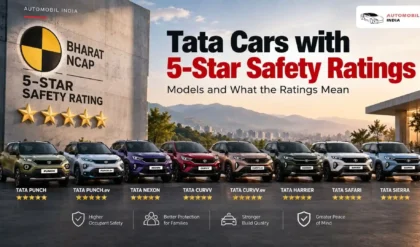
The Tata Safari/Harrier received a five-star Bharat NCAP rating, with:
- 30.08/32 for Adult Occupant Protection
- 44.54/49 for Child Occupant Protection
The Bharat NCAP database lists the tested Safari/Harrier as an ADV+ variant and specifies that the rating applies to the variants covered under its applicability documentation.
Current Harrier equipment listings include six airbags, electronic stability control, traction control, tyre-pressure monitoring and child-seat mounts across the range, with additional safety technology available on higher variants.
Does five-star Bharat NCAP mean every variant has identical safety equipment?
No.
A crash-test rating should not be interpreted as meaning that every variant has exactly the same equipment.
For example, higher variants can add technologies such as:
- Blind-spot warning
- Cross-traffic alert
- Lane-departure warning
- Traffic-sign recognition
- Automatic high beam
- Adaptive cruise control
Therefore, buyers interested in Harrier Safari safety should check the equipment list of the exact variant they intend to purchase.
Harrier vs Safari ADAS: What Do You Get?
ADAS is available on selected variants rather than being an identical feature across the entire range.
Depending on the variant, the systems include functions such as:
- Adaptive cruise control
- Autonomous emergency braking
- Lane-departure warning
- Traffic-sign recognition
- Blind-spot monitoring-related functions
- Cross-traffic alerts
- Automatic high-beam assistance
Tata specifically introduced Adaptive Cruise Control with the Adventure X persona on automatic variants.
For Indian conditions, ADAS can be useful on controlled-access highways and long-distance routes. In dense urban traffic, however, drivers should understand its limitations and remain responsible for controlling the vehicle.
Tata Safari vs Harrier: Ride and Driving Experience
The Harrier and Safari share their basic architecture, engine options and wheelbase, so they have more in common dynamically than their different body styles might suggest.
The Harrier’s shorter body and lower height give it the more conventional five-seat SUV packaging.
The Safari’s taller body and third-row configuration make it more focused on passenger flexibility.
Neither is a traditional four-wheel-drive SUV. Both are front-wheel-drive monocoque SUVs, with terrain-response systems intended to help manage different surfaces rather than turn the vehicles into dedicated off-roaders.
For most Indian buyers, the more relevant question is therefore how they behave on:
- Broken city roads
- Highway expansion joints
- Monsoon-affected roads
- Long-distance journeys
- Fully loaded family trips
Current road-test feedback highlights the Harrier’s ride quality as one of its strengths, particularly its ability to absorb poor surfaces while remaining settled at highway speeds.
Harrier vs Safari: Which Is More Practical?
Choose the Harrier if you primarily need five seats
The Harrier makes sense when:
- You normally carry up to five people
- You want a large two-row SUV
- Boot space is important
- The third row would rarely be used
- Most journeys are city and highway trips
- You prefer the shorter body
Its 445-litre boot is particularly relevant for families carrying shopping, airport luggage or weekend-trip bags.
Choose the Safari if you regularly need six or seven seats
The Safari becomes the more relevant option when:
- You regularly carry six or seven passengers
- You have a larger family
- Extended-family travel is common
- You want second-row captain chairs
- You need a flexible three-row layout
The important word is regularly.
Buying a three-row SUV purely for occasional use of the third row means carrying the packaging compromises every day for a feature you may rarely use.
Harrier vs Safari: Automatic or Manual?
Both SUVs offer six-speed manual and automatic options.
For city users who spend significant time in stop-go traffic, the automatic is easier to live with.
For buyers who enjoy controlling the gearbox themselves or want the lower purchase price of a manual, the six-speed manual remains available.
The automatic transmission should also be considered alongside annual usage. Paying extra for an automatic can be worthwhile if the vehicle spends a significant amount of time in urban congestion.
Harrier vs Safari: Ownership Considerations
The purchase price is only the beginning of the ownership calculation.
Before booking either SUV, consider:
1. Annual kilometres
A buyer covering 8,000–10,000km annually has a very different fuel-cost equation from someone driving 25,000km a year.
2. Petrol vs diesel
Do not automatically select diesel because it delivers better torque or potentially better highway economy. Calculate the purchase-price difference and expected annual fuel savings.
3. Automatic vs manual
If the SUV will spend much of its life in Pune, Mumbai, Bengaluru, Delhi or another congested city, the convenience of an automatic can be more valuable than the manual’s lower initial price.
4. Insurance and on-road price
The ex-showroom price does not represent the final amount you will pay.
Registration, insurance, accessories, extended warranty and other charges can substantially change the on-road price.
5. Variant availability
Tata’s variant structure is extensive. The exact combination of engine, gearbox, seating layout and features matters more than the name of the persona alone. Current listings show dozens of Harrier and Safari configurations.
Compare car insurance options for your chosen Harrier or Safari variant before booking.
Harrier vs Safari: Which Variant Should You Look At?
Rather than recommending one universal variant, the following approach is more useful:
| Your requirement | What to prioritise |
|---|---|
| Lowest purchase price | Base petrol manual |
| City-focused usage | Petrol automatic |
| High annual running | Diesel |
| Frequent highway trips | Diesel automatic/manual depending on preference |
| Five-person family | Harrier |
| Six/seven occupants | Safari |
| Maximum technology | Higher X+/Fearless/Accomplished variants |
| ADAS | Check applicable higher variants |
| Six-seat luxury layout | Safari 6-seat variant |
| Large luggage requirement | Harrier two-row layout |
The key is to compare like-for-like powertrains and equipment, rather than comparing the entry-level price of one with the top variant of the other.
Harrier vs Safari: What About Rivals?
The two Tata SUVs operate in a crowded part of the Indian SUV market.
Relevant alternatives include:
- Mahindra XUV 7XO
- Mahindra Scorpio N
- Hyundai Alcazar
- MG Hector
- MG Hector Plus
The XUV 7XO is particularly relevant for buyers looking at a feature-rich three-row SUV, while the Alcazar is worth considering if a somewhat different size and packaging proposition is preferred.
The Scorpio N appeals to a different set of buyers who may prioritise its traditional SUV character. If you are also looking lower down the Tata range, our Tata Nexon vs Mahindra XUV 3XO comparison covers the same Tata-versus-Mahindra question one segment below.
A useful shortlist should therefore be based on seat count, fuel type, transmission, budget and intended usage, rather than simply comparing every SUV in the ₹15–30 lakh bracket. It is also worth checking the upcoming cars from Tata Motors if you are not in a hurry to buy.
Harrier or Safari: Which One Should You Choose?
There is no need to treat the Harrier vs Safari decision as a universal winner-takes-all comparison.
The Harrier is the more straightforward choice for buyers who need five seats, particularly if they value a large two-row luggage area and have little need for a third row.
The Safari is designed for buyers who need six or seven seats, with the added flexibility of a six-seat captain-chair configuration on selected variants.
Both use the same fundamental engine choices, share the same wheelbase and carry the same five-star Bharat NCAP rating under the applicable assessment.
So the deciding question is simple:
If yes, the Safari’s additional seating capacity directly addresses that requirement.
If not, the Harrier’s five-seat layout provides a simpler package without sacrificing the core powertrains, safety rating or much of the available technology.
Tata Harrier vs Tata Safari: Key Takeaways
For five people
Harrier’s two-row layout is the more relevant package.
For six or seven people
Safari’s third row makes it the natural option to investigate.
For boot space
Harrier offers the larger quoted capacity in its standard five-seat configuration.
For petrol buyers
Both offer the 1.5-litre Turbo-GDI with 170 hp and 280 Nm.
For diesel buyers
Both use the 2.0-litre diesel producing 170 hp and 350 Nm.
For safety
Both carry a five-star Bharat NCAP rating under the applicable test and variant coverage.
For ADAS
Check the exact variant because the complete ADAS package is not standard across the entire range.
For automatic buyers
Both offer six-speed automatic versions, subject to variant and powertrain selection.
For families
Decide based on actual passenger requirements rather than simply choosing the larger-looking SUV.
Frequently Asked Questions
Is Harrier better than Safari?
The two SUVs target different requirements. The Harrier is a five-seater, while the Safari offers six- and seven-seat configurations. The appropriate choice depends mainly on passenger requirements, luggage needs and the way the SUV will be used.
Which is bigger, Harrier or Safari?
The Safari is longer and taller. It measures 4,668mm long and 1,795mm tall, compared with 4,605mm and 1,718mm for the Harrier. Both are 1,922mm wide and have a 2,741mm wheelbase.
Does the Harrier have seven seats?
No. The Tata Harrier is a five-seat SUV. The Safari is Tata’s corresponding six- or seven-seat option.
Does Tata Safari come with six seats?
Yes. Selected higher Safari variants are offered with six seats, using captain chairs in the second row. Seven-seat versions are also available.
Which is safer, Harrier or Safari?
Both have a five-star Bharat NCAP rating under the applicable assessment. The test recorded 30.08/32 for adult occupant protection and 44.54/49 for child occupant protection.
Do Harrier and Safari use the same engine?
Yes. Both currently use the 1.5-litre Turbo-GDI petrol and 2.0-litre diesel. The petrol produces 170 hp and 280 Nm, while the diesel produces 170 hp and 350 Nm.
Which has more boot space, Harrier or Safari?
The Harrier is listed with a 445-litre boot, while the Safari is listed at 420 litres under the standard quoted specification. The Safari’s luggage capacity changes depending on whether its third row is folded or occupied.
Is Harrier available with an automatic transmission?
Yes. The Harrier is available with a six-speed automatic on applicable petrol and diesel variants.
Is Safari available with an automatic transmission?
Yes. The Safari is available with a six-speed automatic on applicable variants. Current specifications list the automatic alongside its six-speed manual transmission.
Which should I buy, Harrier or Safari?
If you need five seats and don’t regularly require a third row, the Harrier is the more relevant configuration. If you regularly carry six or seven people, the Safari’s additional seating makes it the appropriate vehicle to consider.
Final Word
The Harrier vs Safari decision is ultimately less complicated than the number of variants suggests.
Both SUVs offer the same fundamental strengths: substantial dimensions, turbocharged petrol and diesel engines, automatic and manual transmissions, extensive equipment and a five-star Bharat NCAP result.
The difference that matters most in everyday use is the cabin layout.
The Harrier gives you a five-seat SUV with a larger conventional luggage area. The Safari gives you the flexibility of six or seven seats, at the cost of a more complex three-row packaging arrangement.
For a five-member family, the Harrier may be all the SUV you need. For a larger family or anyone who regularly carries additional passengers, the Safari’s third row can justify the additional size and cost.
Before making the final decision, compare the exact variants, on-road price in your city, engine, gearbox, ADAS equipment and seating configuration. A test drive with the people who will actually occupy the second and third rows can be more informative than a feature list.
Whether you are financing a new Harrier or Safari, or selling your current car to fund it, we can help.