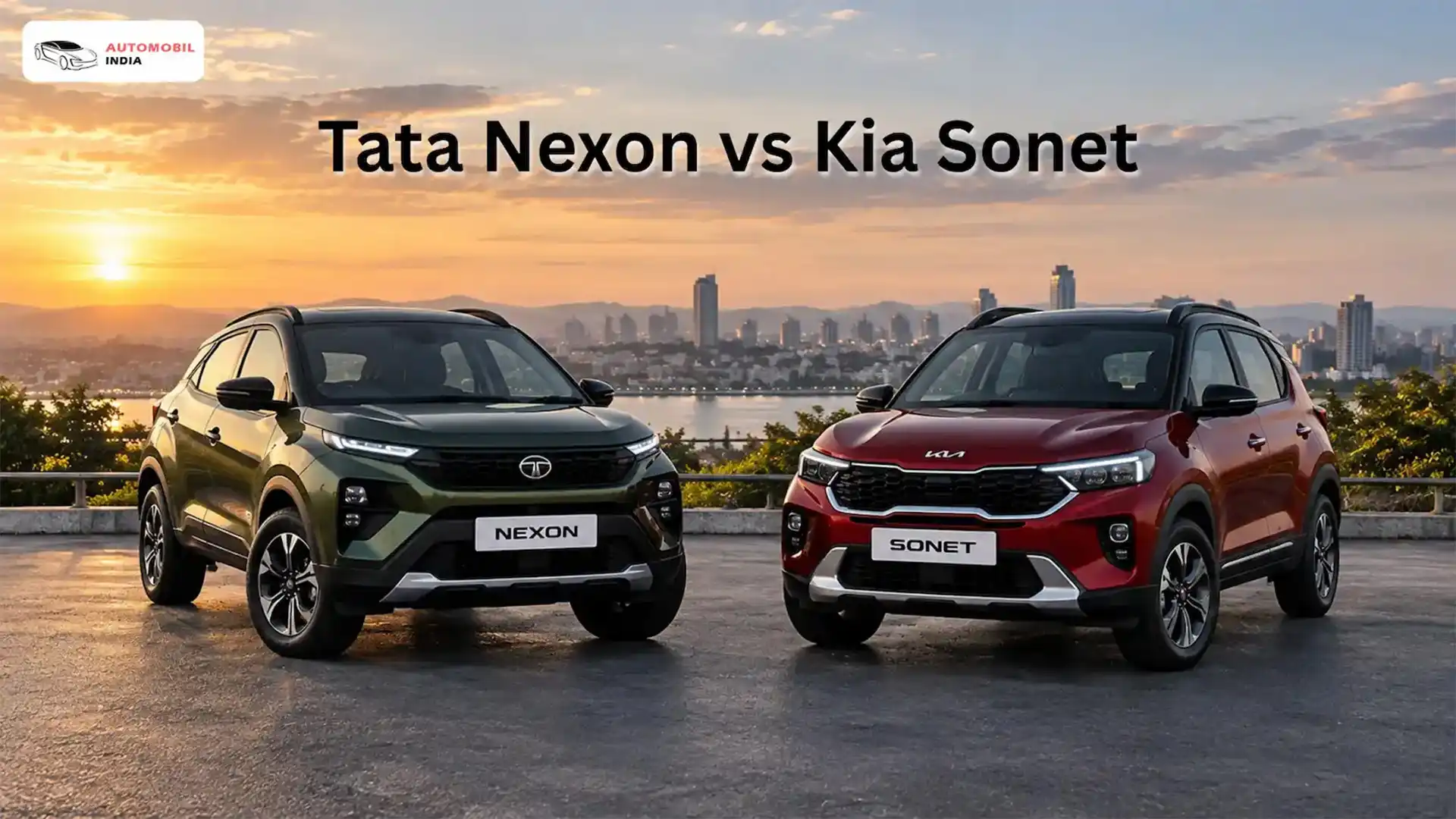
The Nexon vs Sonet decision comes down to two different interpretations of the compact SUV formula.
The Tata Nexon is the larger-feeling, more versatile package, with petrol, diesel and CNG powertrains, multiple automatic options and a 208mm ground clearance. The Kia Sonet is smaller externally but offers a similarly broad engine and gearbox selection, along with a strong equipment list and a particularly city-friendly footprint.
For September 2026, the Nexon starts at around ₹7.40 lakh ex-showroom, while the Sonet starts at ₹7.40 lakh ex-showroom after Kia’s latest price revision. The two SUVs overlap heavily in price, but their powertrain combinations and equipment differ considerably.
The choice becomes clearer once you look beyond the starting price.
Tata Nexon vs Kia Sonet: Quick Comparison
| Parameter | Tata Nexon | Kia Sonet |
|---|---|---|
| Seating capacity | 5 | 5 |
| Length | 3,995 mm | 3,995 mm |
| Width | 1,804 mm | 1,790 mm |
| Height | 1,620 mm | Up to 1,642 mm |
| Wheelbase | 2,498 mm | 2,500 mm |
| Ground clearance | Up to 208 mm | 205 mm |
| Boot space | 382 litres | 385 litres |
| Petrol engine | 1.2-litre turbo | 1.2-litre naturally aspirated / 1.0-litre turbo |
| Diesel engine | 1.5-litre turbo-diesel | 1.5-litre turbo-diesel |
| CNG | Yes | No |
| Petrol power | Up to 120 hp | Up to 120 hp |
| Diesel power | 115 hp | 115.6 hp |
| Diesel torque | 260 Nm | 250 Nm |
| Petrol transmissions | 5MT/6MT/6AMT/7DCT | 5MT/6iMT/7DCT |
| Diesel transmissions | 6MT/6AMT | 6MT/6AT |
| Drive | Front-wheel drive | Front-wheel drive |
| Airbags | 6 standard | 6 standard |
| ADAS | Available on higher variants | Level 1 on GTX+/X-Line |
| Starting price | Around ₹7.40 lakh | ₹7.40 lakh |
Specifications vary by variant and powertrain. Kia lists the Sonet at 3,995mm long, 1,790mm wide and 2,500mm wheelbase, while current Nexon specifications list 3,995mm length, 1,804mm width and 2,498mm wheelbase.
Tata Nexon vs Kia Sonet Price in India
The two SUVs now start at almost exactly the same headline price.
Tata Nexon
The Nexon starts at approximately ₹7.40 lakh ex-showroom. Current variants extend into the mid-₹14 lakh range, depending on fuel type, gearbox and edition.
The range includes:
- Petrol
- CNG
- Diesel
- Manual
- AMT
- DCT
The Nexon is therefore unusual in offering such a broad combination of powertrains and transmissions in this segment. Our detailed Tata Nexon review goes deeper into how those variants are packaged.
Kia Sonet
The Sonet currently starts at ₹7,40,900 ex-showroom, according to Kia India’s current pricing information. The range extends to around ₹13.8 lakh for the X-Line before considering applicable taxes and other on-road costs.
The Sonet is offered with:
- 1.2-litre petrol
- 1.0-litre turbo-petrol
- 1.5-litre diesel
- Manual
- iMT
- DCT
- Torque-converter automatic
Why the starting price doesn’t tell the whole story
The Nexon and Sonet have different approaches to variant packaging.
For example, the Nexon offers CNG at relatively accessible points in its range, while Kia’s automatic choices are spread across different engine families.
Therefore, instead of asking “Which one is cheaper?”, buyers should compare the two exact versions they can afford.
A ₹10 lakh petrol manual Nexon and a ₹10 lakh turbo-petrol Sonet may have completely different engine outputs and equipment.
Compare on-road pricing and EMI options for the exact Nexon or Sonet variant you are considering.
Nexon vs Sonet: Engine and Performance
This is one of the most important differences between the two SUVs.
Tata Nexon engines
The Nexon currently uses:
1.2-litre turbo-petrol
- 1,199cc
- 3-cylinder
- 120 hp
- 170 Nm
Depending on the variant, it can be paired with:
- 5-speed manual
- 6-speed manual
- 6-speed AMT
- 7-speed DCT
1.5-litre diesel
- 1,497cc
- 4-cylinder
- 115 hp
- 260 Nm
Transmission choices include:
- 6-speed manual
- 6-speed AMT
1.2-litre CNG
The Nexon also gets a factory-fitted CNG option using the 1.2-litre engine, paired with a 6-speed manual.
The CNG version is an important differentiator because the Sonet does not offer a factory CNG powertrain. Current specifications confirm the Nexon’s 120hp/170Nm turbo-petrol, 115hp/260Nm diesel and CNG configuration.
Kia Sonet engines
The Sonet has three engine choices.
1.2-litre petrol
- 1,197cc
- 4-cylinder
- 83 hp
- 115 Nm
- 5-speed manual
This is the entry-level petrol engine and is aimed primarily at buyers who want a straightforward naturally aspirated petrol powertrain.
1.0-litre turbo-petrol
- 998cc
- 3-cylinder
- 120 hp
- 172 Nm
- 6-speed iMT
- 7-speed DCT
This engine produces slightly more torque than the Nexon’s turbo-petrol on paper.
1.5-litre diesel
- 1,493cc
- 4-cylinder
- 115.6 hp
- 250 Nm
- 6-speed manual
- 6-speed automatic
Kia’s current specifications confirm the 115.6hp/250Nm diesel and its six-speed automatic transmission.
Nexon vs Sonet: Which Engine Is Better for You?
There isn’t a single answer because the two manufacturers have taken different approaches.
For a basic petrol city car
The Sonet’s 1.2-litre naturally aspirated petrol is the simpler option.
It produces less power and torque than the Nexon’s turbo-petrol, but buyers who mainly drive in town and don’t prioritise outright performance may prefer its straightforward character.
For performance-oriented petrol buyers
The Nexon’s 1.2-litre turbo and Sonet’s 1.0-litre turbo are the relevant comparison.
The Sonet turbo produces 120 hp and 172 Nm, while the Nexon produces 120 hp and 170 Nm. On paper, their peak outputs are almost identical.
The bigger distinction is how each engine is paired with its gearbox and how you prefer the vehicle to behave in traffic.
For high-mileage users
Both SUVs retain diesel options.
The Nexon diesel produces 260 Nm, compared with 250 Nm in the Sonet.
However, the Sonet diesel has a major transmission advantage: its six-speed torque-converter automatic.
The Nexon diesel is paired with a six-speed AMT.
For buyers who frequently drive in traffic but still want a diesel, this difference is worth experiencing during a test drive.
Nexon vs Sonet Mileage
Mileage figures need to be separated into certified figures and real-world test results.
For the Nexon, current ARAI figures include:
- Petrol manual: 17.44 kmpl
- Petrol AMT: 17.18 kmpl
- Petrol DCT: 17.01 kmpl
- CNG manual: 24 km/kg
Autocar India’s standardised testing recorded 16.03 kmpl for the petrol manual and 18.55 km/kg for the CNG.
For the Sonet, current figures include:
- 1.2 petrol manual: 18.8 kmpl
- 1.0 turbo DCT: 18.7 kmpl
- 1.5 diesel manual: 24.1 kmpl
- 1.5 diesel automatic: 18.6 kmpl
Autocar’s tested figures for the Sonet include around 14.05 kmpl for the turbo-petrol DCT and 16.3 kmpl for the diesel automatic.
What does this mean in everyday use?
The Sonet has an advantage on the published mileage numbers for several petrol and diesel configurations.
But buyers should not assume that an ARAI figure will be their actual fuel economy.
Traffic, driving style, air-conditioning, tyre pressure and road conditions can produce substantial differences.
For someone driving 1,500–2,000km every month, the diesel’s fuel consumption becomes more important. For someone driving 500–700km primarily in city traffic, the petrol’s refinement and gearbox behaviour may matter more than a small difference in claimed mileage.
Nexon vs Sonet Dimensions: Which Has More Space?
Although both are 3,995mm long, the Nexon is wider.
| Dimension | Tata Nexon | Kia Sonet |
|---|---|---|
| Length | 3,995 mm | 3,995 mm |
| Width | 1,804 mm | 1,790 mm |
| Height | 1,620 mm | Up to 1,642 mm |
| Wheelbase | 2,498 mm | 2,500 mm |
| Ground clearance | 208 mm | 205 mm |
| Boot | 382 litres | 385 litres |
The Sonet actually has a slightly longer wheelbase by 2mm and a marginally larger quoted boot.
But those numbers don’t tell the entire story.
The Nexon’s additional 14mm of width is more relevant to occupants than the tiny wheelbase difference. In practical terms, the Nexon has a more substantial cabin footprint.
The Sonet’s compact exterior dimensions, meanwhile, remain useful in urban environments.
Both are under four metres long, which is particularly important in India because of the tax structure that historically favours sub-four-metre cars.
Nexon vs Sonet: Rear Seat Space
If you regularly carry three adults in the rear, the Nexon’s greater width is worth considering.
The Sonet is not unusually cramped for its class, but its compact footprint prioritises manoeuvrability and urban usability.
For two adults in the rear, both can work well.
For a family with a child seat, luggage and occasional three-adult rear-seat use, the Nexon’s wider body can be useful.
This is an area where a showroom inspection is more valuable than a specification sheet.
Take the child seat, ask two adults to sit in the rear and check knee room, shoulder room and ease of getting in and out.
Nexon vs Sonet: Boot Space
The Sonet is listed with a 385-litre boot, while the Nexon is listed with 382 litres.
The difference is only three litres and should not be treated as meaningful by itself.
In everyday use, boot shape and loading height can matter more than the quoted capacity.
Both should comfortably handle everyday shopping and luggage for a small family, although carrying five people plus luggage for a long holiday requires some planning.
The Nexon’s CNG packaging is also worth noting. Tata’s twin-cylinder CNG arrangement is designed to preserve useful boot space compared with the large single-cylinder layouts used in some older CNG cars.
Nexon vs Sonet Features
Both SUVs have become heavily feature-loaded, but Kia and Tata package those features differently.
Tata Nexon features
Depending on the variant, the Nexon can offer:
- 10.25-inch digital instrument cluster
- Large touchscreen infotainment system
- Wireless Android Auto and Apple CarPlay on applicable variants
- Panoramic sunroof
- 360-degree camera
- Adaptive cruise control
- Blind-spot monitoring
- Ventilated front seats
- JBL audio system
- Connected-car technology
- OTA updates
- Voice commands
- Automatic climate control
Current 2026 variant information shows the higher Creative and Fearless variants adding equipment such as adaptive cruise control, climate control, blind-spot monitoring, wireless charging, ventilated seats and OTA updates.
Kia Sonet features
Depending on the variant, the Sonet offers:
- 10.25-inch touchscreen
- 10.25-inch digital instrument cluster
- Wireless Android Auto and Apple CarPlay on applicable variants
- Electric sunroof
- 360-degree camera
- Blind View Monitor
- Ventilated front seats
- 4-way powered driver’s seat
- Bose seven-speaker audio
- Air purifier
- Wireless charger
- Connected-car features
- OTA updates
- ADAS Level 1
Kia’s current specification sheet confirms the 10.25-inch screens, ventilated seats, powered driver’s seat, 360-degree camera and Bose audio on higher variants.
Which offers more features?
It depends heavily on the variant being compared.
Both can be extremely well equipped at the top of their respective ranges.
The more useful question is:
For example, if you primarily want a 360-degree camera, automatic climate control and a good infotainment system, there is little reason to pay for a top-spec variant just to get a powered driver’s seat or premium audio system.
Talk to the Automobil India team for variant-level guidance before you book a test drive.
Nexon vs Sonet Safety
Safety requires some context because the two cars have different crash-test histories.
Tata Nexon safety
The Nexon has a well-established crash-test record.
It was the first Indian car to receive a five-star Global NCAP rating, and the current Nexon has subsequently received a five-star Bharat NCAP rating. Current Nexon variants also have six airbags and electronic stability control as standard, according to current specifications.
Its safety equipment includes, depending on variant:
- Six airbags
- Electronic stability control
- ABS with EBD
- ISOFIX mounts
- Electronic stability-related systems
- Rear parking sensors
- 360-degree camera
- Blind-spot monitoring
- ADAS on higher variants
The Nexon’s five-star Bharat NCAP result is therefore a significant part of its safety proposition. If safety is your deciding factor, our Nexon vs XUV300 safety comparison looks at how it stacks up against another five-star rival.
Kia Sonet safety
The current India-spec Sonet gets six airbags as standard, along with ESC, hill-start assist, brake assist, vehicle stability management and ISOFIX child-seat mounts. Kia also offers Level 1 ADAS on higher variants.
However, there is an important distinction buyers should understand.
In June 2026, Global NCAP tested an India-made Sonet destined for the South African market, equipped with dual airbags and without ESC as standard. It scored one star for adult occupant protection and three stars for child occupant protection. The tested specification is different from the current Indian-market Sonet, so that result should not be presented as the crash-test rating of the India-spec Sonet.
As of the information available for this comparison, the India-spec Sonet does not have an equivalent Bharat NCAP crash-test rating that can be directly compared with the Nexon’s five-star result.
That distinction is important. Safety equipment and crash-test ratings are related but not interchangeable.
Nexon vs Sonet ADAS
Both models now offer advanced driver-assistance technology on higher variants.
Nexon
Higher Nexon variants offer systems including:
- Adaptive cruise control
- Lane-related assistance
- Blind-spot monitoring
- Other driver-assistance functions depending on variant
Sonet
The Sonet’s Level 1 ADAS package offers 10 autonomous features on the GTX+ and X-Line variants, according to Kia. It is paired with a 360-degree camera and Blind View Monitor.
For Indian buyers, however, ADAS should be viewed as an assistance system rather than a substitute for driving.
Adaptive cruise control can be particularly useful on highways, while camera- and radar-based assistance can become less predictable in complicated urban traffic, poor lane markings or heavy two-wheelers.
Nexon vs Sonet: Which Is Better for City Driving?
Both are fundamentally city-friendly SUVs because they stay under four metres.
But their strengths are slightly different.
Sonet for urban use
The Sonet’s compact width and dimensions make it easy to manoeuvre through:
- Narrow lanes
- Congested markets
- Tight parking spaces
- Busy residential streets
The availability of a diesel automatic is also useful for buyers who want diesel efficiency without a manual clutch.
Nexon for mixed city and highway use
The Nexon is slightly wider and has 208mm of ground clearance.
That can be useful on:
- Broken roads
- Tall speed breakers
- Rural roads
- Poorly surfaced urban streets
- Highway trips
Its broader powertrain range also gives buyers more ways to configure the car around their usage.
Nexon vs Sonet: Which Is Better for Highway Driving?
The answer depends on the engine and gearbox.
For frequent highway travel, the diesel versions of both SUVs deserve consideration.
The Nexon’s diesel has 260 Nm, while the Sonet’s has 250 Nm.
However, the Sonet’s diesel automatic uses a six-speed torque converter, whereas the Nexon diesel automatic uses an AMT.
If highway comfort and smooth automatic shifts are important, this difference should be part of the test drive.
The Nexon’s larger-feeling cabin and higher ground clearance can also appeal to buyers who frequently travel with family and luggage.
Nexon vs Sonet: Manual, AMT, iMT or DCT?
This is an area where the two cars differ considerably.
Nexon
The Nexon offers:
- 5-speed manual
- 6-speed manual
- 6-speed AMT
- 7-speed DCT
The DCT is available with the turbo-petrol, while the diesel gets an AMT.
Sonet
The Sonet offers:
- 5-speed manual
- 6-speed iMT
- 7-speed DCT
- 6-speed automatic
The diesel automatic is a conventional six-speed automatic rather than an AMT.
Which gearbox should you choose?
- Heavy city traffic: An automatic is generally easier to live with than a manual.
- Highway-focused driving: Both automatic and manual versions can work; engine characteristics become more important.
- Diesel + automatic: The Sonet’s torque-converter automatic is an important advantage to consider against the Nexon’s diesel AMT.
- Turbo-petrol + automatic: Both offer DCT options, although the exact variant and pricing need to be checked before booking.
- Budget-focused buyer: Manual versions remain the simplest way to keep the initial purchase price down.
Nexon vs Sonet: Ownership and Running Costs
The purchase price is only one part of the ownership equation.
If you drive fewer kilometres
A petrol version may make more sense.
The higher purchase price of a diesel is harder to recover when annual running is low.
If you drive long distances
Diesel becomes more relevant.
The Sonet’s current certified diesel-manual figure of 24.1kmpl is particularly strong on paper, while the Nexon diesel also has a strong efficiency proposition.
But real-world economy will depend on how and where you drive.
If you have access to CNG
The Nexon has a major advantage because Kia does not currently offer a factory CNG Sonet.
For buyers with a reliable CNG station near home or work and high daily running, this can materially change the running-cost calculation. It is worth seeing how it compares with the wider market in our round-up of the top CNG cars in India.
Nexon vs Sonet: Which One Should You Choose?
Rather than choosing an arbitrary overall winner, match the vehicle to your requirements.
Choose the Tata Nexon if you prioritise:
- A more substantial cabin
- 208mm ground clearance
- CNG availability
- Multiple petrol automatic choices
- A five-star Bharat NCAP rating
- Broad powertrain choice
- Strong highway and rough-road usability
- A wider body
Consider the Kia Sonet if you prioritise:
- Compact urban dimensions
- A strong feature list
- 1.0-litre turbo-petrol performance
- Diesel + conventional automatic combination
- 360-degree camera and Blind View Monitor on higher variants
- Level 1 ADAS
- Premium features such as Bose audio and ventilated seats
- Slightly higher certified mileage figures in several configurations
Nexon vs Sonet: Best Choice by Buyer Type
| Buyer requirement | SUV to investigate |
|---|---|
| Mostly city driving | Sonet or Nexon petrol |
| Frequent highway travel | Nexon/Sonet diesel |
| Diesel automatic | Sonet |
| CNG | Nexon |
| Maximum ground clearance | Nexon |
| Compact urban footprint | Sonet |
| Five-adult family use | Nexon gets a packaging advantage |
| Feature-focused buyer | Compare mid/high Sonet and Nexon variants |
| Strongest documented crash-test record | Nexon |
| Petrol DCT | Both |
| Diesel manual | Both |
| Lowest entry price | Essentially tied; compare exact variant |
| High annual running | Compare diesel/CNG economics |
Tata Nexon vs Kia Sonet: What About Rivals?
The compact SUV segment has become increasingly crowded.
Depending on your budget, other models worth considering include:
- Maruti Suzuki Brezza
- Hyundai Venue
- Mahindra XUV 3XO
- Skoda Kylaq
- Maruti Suzuki Fronx
The Mahindra XUV 3XO is particularly relevant if rear-seat space and performance are important. We have covered that match-up in detail in our Tata Nexon vs Mahindra XUV 3XO comparison.
The Maruti Suzuki Brezza remains worth considering for buyers who prioritise a naturally aspirated petrol engine, conventional automatic and CNG availability.
The Skoda Kylaq is another alternative for buyers who want a turbo-petrol compact SUV and are willing to consider a different ownership proposition.
This is why the Nexon vs Sonet comparison should be treated as a shortlist decision rather than the end of the buying process.
Tata Nexon vs Kia Sonet: Final Takeaway
The Nexon and Sonet are close enough in price to make the comparison genuinely useful, but they aren’t identical products.
The Nexon is the more powertrain-flexible option, with petrol, diesel and CNG choices, multiple automatic transmissions, 208mm ground clearance and a five-star Bharat NCAP rating.
The Sonet focuses strongly on urban usability and equipment, with a compact footprint, three engine choices, a diesel torque-converter automatic and an extensive technology package on higher variants.
For someone who spends most of their time in the city and wants a compact SUV with premium features, the Sonet deserves close consideration.
For someone who wants greater powertrain flexibility, CNG, more ground clearance and a strong independently assessed safety record, the Nexon has a different set of advantages.
The most useful final comparison is therefore not “Nexon vs Sonet: which is the winner?”
It is:
Before booking either SUV, compare the exact variants at the same price point, check the on-road price in your city and take both for a back-to-back test drive.
Frequently Asked Questions
1. Is Tata Nexon better than Kia Sonet?
The two SUVs have different strengths. The Nexon offers CNG, higher ground clearance and a five-star Bharat NCAP rating, while the Sonet offers a compact footprint, diesel automatic and an extensive feature list. The appropriate choice depends on the buyer’s priorities.
2. Which is bigger, Nexon or Sonet?
Both are 3,995mm long. The Nexon is wider at 1,804mm compared with 1,790mm for the Sonet, while their wheelbases are almost identical at 2,498mm and 2,500mm respectively.
3. Which has more boot space, Nexon or Sonet?
The Sonet is listed with 385 litres, while the Nexon is listed with 382 litres. The three-litre difference is too small to be a meaningful buying factor by itself.
4. Which has better mileage, Nexon or Sonet?
It depends on the powertrain. The Sonet’s current certified figures include 18.8kmpl for the 1.2 petrol manual and 24.1kmpl for the diesel manual. The Nexon is certified at 17.44kmpl for petrol manual and 24km/kg for CNG manual. Real-world mileage will vary.
5. Which is safer, Nexon or Sonet?
The Nexon has a five-star Bharat NCAP rating. The current India-spec Sonet has six airbags and ESC as standard, but it does not have an equivalent Bharat NCAP rating currently available for direct comparison. A one-star Global NCAP result published in 2026 applied to a different, dual-airbag South African-market specification of the India-made Sonet.
6. Does the Kia Sonet have ADAS?
Yes. Kia offers Level 1 ADAS with 10 autonomous features on higher Sonet variants including GTX+ and X-Line. These variants also get equipment such as a 360-degree camera and Blind View Monitor.
7. Does Tata Nexon have CNG?
Yes. The Nexon is available with a factory-fitted CNG powertrain and six-speed manual transmission. Its ARAI-certified fuel economy is listed at 24km/kg.
8. Which has a better diesel automatic, Nexon or Sonet?
The Sonet’s diesel automatic uses a six-speed torque-converter automatic, while the Nexon diesel automatic uses a six-speed AMT. Buyers who spend a lot of time in stop-start traffic should test both because their shift behaviour is different.
9. Which is better for highway driving, Nexon or Sonet?
Both can work well for highway use. The diesel versions are particularly relevant to high-mileage users. The Nexon offers 260Nm of diesel torque and 208mm ground clearance, while the Sonet combines its 250Nm diesel with a six-speed automatic option.
10. Which should I buy, Nexon or Sonet?
Start with your usage. The Nexon is worth prioritising if you need CNG, higher ground clearance or want a five-star Bharat NCAP-rated SUV. The Sonet is worth considering if you prioritise compact dimensions, premium features or specifically want a diesel with a conventional automatic gearbox.
Check the latest variant prices, compare on-road costs in your city and calculate the EMI before booking a test drive.