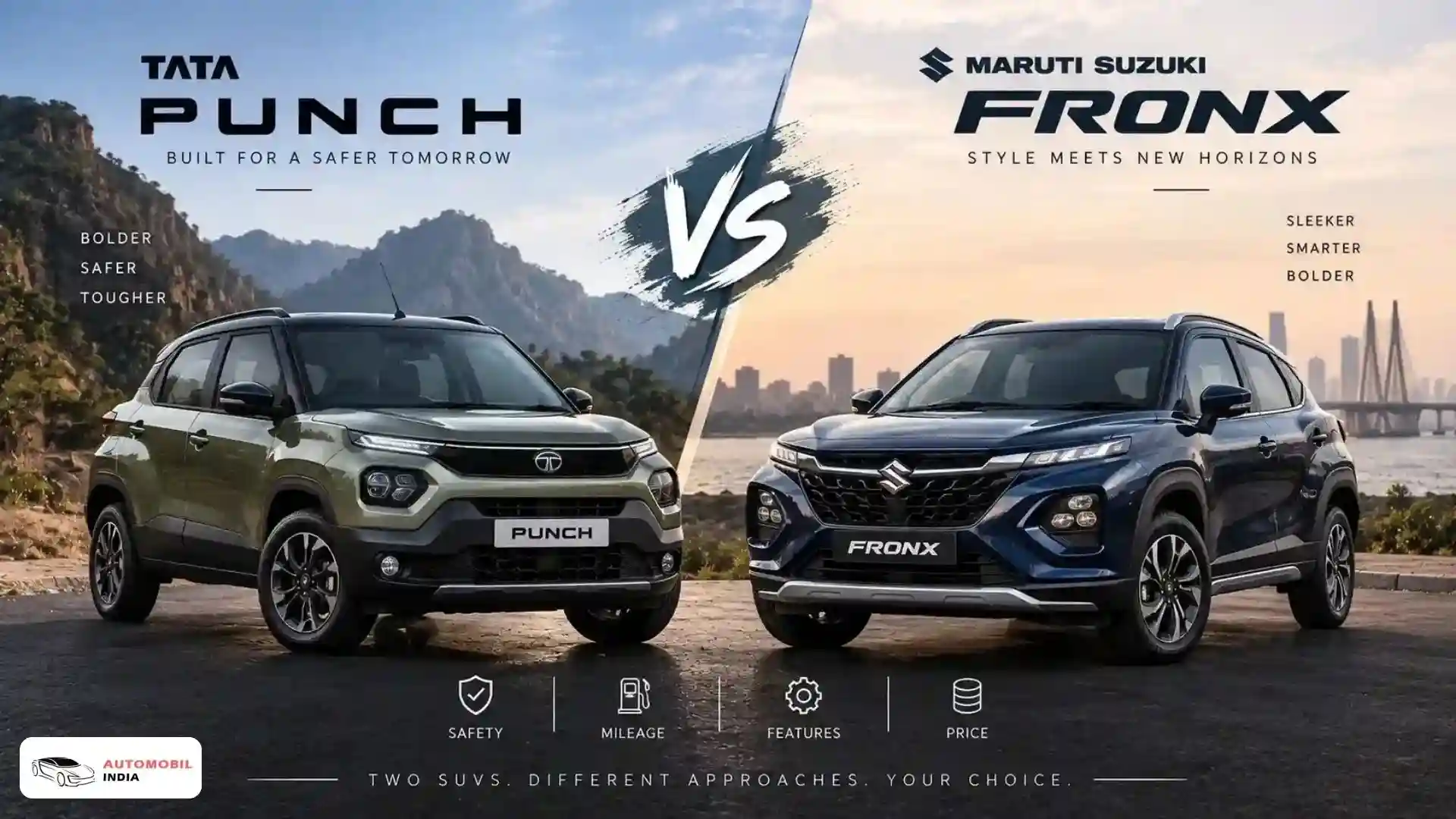
The Tata Punch vs Fronx comparison brings together two popular compact SUVs, but they approach the segment differently.
The Tata Punch is the smaller and more upright SUV, with a strong focus on ground clearance, safety equipment, city-friendly dimensions and multiple powertrain choices. The 2026 Punch added a 1.2-litre turbo-petrol engine to its existing naturally aspirated petrol and CNG options.
The Maruti Suzuki Fronx is longer and lower, with a more crossover-like profile. It offers a 1.2-litre naturally aspirated petrol engine, 1.2-litre CNG and a 1.0-litre turbo-petrol engine, along with manual, AMT and torque-converter automatic options depending on the powertrain.
For 2026, the Punch is priced from around ₹5.59 lakh ex-showroom, while the Fronx starts at ₹6.85 lakh on Maruti Suzuki\’s current NEXA website.
The bigger differences emerge when you look beyond price: the Punch has a published Bharat NCAP result, while the Fronx offers a broader range of automatic and turbo-petrol configurations and a longer body with a 2,520mm wheelbase.
Tata Punch vs Fronx: Quick Comparison
| Factor | Tata Punch | Maruti Suzuki Fronx |
|---|---|---|
| Starting price | Around ₹5.59 lakh | ₹6.85 lakh |
| Body style | Compact SUV | Crossover SUV |
| Seating | 5 | 5 |
| Main petrol engine | 1.2L 3-cylinder | 1.2L 4-cylinder |
| Turbo-petrol | 1.2L turbo | 1.0L turbo |
| CNG | Yes | Yes |
| Automatic | 5-speed AMT | 5-speed AMT / 6-speed AT |
| Turbo automatic | No | Yes |
| Punch claimed petrol mileage | Up to around 20 kmpl | Up to 22.89 kmpl |
| CNG claimed mileage | Up to around 26.99 km/kg | 28.51 km/kg |
| Punch safety assessment | 5-star Bharat NCAP, specified variants | No Bharat NCAP rating currently listed |
| Boot space | 366 litres petrol | 308 litres |
| Wheelbase | 2,445 mm | 2,520 mm |
| Ground clearance | Around 193 mm | Around 190 mm |
| Character | Upright, SUV-focused | Sleeker, crossover-focused |
Tata Punch vs Fronx Price
Price is one of the clearest differences between the two.
The current Tata Punch starts at ₹5.59 lakh ex-showroom, while the current Maruti Suzuki NEXA website lists the Fronx from ₹6.85 lakh.
Tata Punch price range
The 2026 Punch is available in several trims, with the range broadly structured around Smart, Pure, Pure+, Adventure, Accomplished and Accomplished+ S.
Current published introductory pricing includes:
| Punch variant | Petrol MT | Petrol AMT | Turbo MT | CNG MT | CNG AMT |
|---|---|---|---|---|---|
| Smart | ₹5.59 lakh | — | — | ₹6.69 lakh | — |
| Pure | ₹6.49 lakh | — | — | ₹7.49 lakh | — |
| Pure+ | ₹6.99 lakh | ₹7.54 lakh | — | ₹7.99 lakh | ₹8.54 lakh |
| Adventure | ₹7.59 lakh | ₹8.14 lakh | ₹8.29 lakh | ₹8.59 lakh | ₹9.14 lakh |
| Accomplished | ₹8.29 lakh | ₹8.84 lakh | — | ₹9.29 lakh | — |
| Accomplished+ S | ₹8.99 lakh | ₹9.54 lakh | ₹9.79 lakh | — | ₹10.54 lakh |
Maruti Fronx price
The current NEXA website lists the Fronx at approximately ₹6.85 lakh to ₹11.98 lakh ex-showroom.
The Fronx range includes:
- Sigma
- Delta
- Delta+
- Zeta
- Alpha
Depending on the variant, buyers can choose between 1.2-litre petrol, 1.2-litre CNG and 1.0-litre turbo-petrol powertrains.
What does the price difference mean?
The Punch has the lower entry price.
That makes it particularly relevant for first-time buyers working with a strict budget.
The Fronx starts higher, but the additional expenditure gives access to a longer body, a 1.0-litre turbo-petrol engine, a 6-speed automatic option and a more premium NEXA-oriented equipment package on higher variants.
Compare the exact variants that fit your budget and see what’s available near you before booking a test drive.
Tata Punch vs Fronx Specifications
The two cars are similar in overall purpose but noticeably different in dimensions.
| Specification | Tata Punch | Maruti Fronx |
|---|---|---|
| Length | 3,876 mm | 3,995 mm |
| Width | 1,742 mm | 1,765 mm |
| Height | 1,615 mm | 1,550 mm |
| Wheelbase | 2,445 mm | 2,520 mm |
| Boot space | 366 litres | 308 litres |
| Seating | 5 | 5 |
| Turning radius | — | 4.9 m |
| Ground clearance | Around 193 mm | Around 190 mm |
The Fronx is 119 mm longer and has a 75 mm longer wheelbase, while the Punch is taller and offers a larger published petrol boot capacity.
The dimensional difference is noticeable on the road. The Punch has a more upright SUV stance, while the Fronx is closer to a raised hatchback/crossover in its proportions.
Fronx’s official specifications list a 3,995mm length, 1,765mm width, 1,550mm height, 2,520mm wheelbase and 308-litre boot. Tata lists the Punch with a 366-litre boot and highlights its SUV-oriented packaging.
Tata Punch vs Fronx Engine Options
This is one of the biggest differences in the comparison.
Tata Punch engine options
The 2026 Punch is available with:
- 1.2-litre naturally aspirated petrol
- 1.2-litre turbo-petrol
- 1.2-litre CNG
The naturally aspirated petrol produces around 88 PS and 115 Nm, while the new turbo-petrol produces 120 PS and 170 Nm. The turbo is paired with a 6-speed manual gearbox.
The CNG version produces lower output than the petrol and is available with manual and, in selected variants, AMT transmission.
Maruti Fronx engine options
The Fronx offers:
1.2-litre petrol
- 1,197cc
- Around 90 PS
- 113 Nm
- 5-speed manual
- 5-speed AMT
1.2-litre CNG
- Around 77.5 PS in CNG mode
- 98.5 Nm
- 5-speed manual
1.0-litre turbo-petrol
- 998cc
- Around 100 PS
- 147.6 Nm
- 5-speed manual
- 6-speed torque-converter automatic
Maruti’s official technical data confirms these engine and transmission combinations.
Tata Punch vs Fronx Performance
For buyers comparing performance, the two turbo engines are particularly interesting.
The Punch’s new 1.2-litre turbo-petrol produces 120 PS and 170 Nm, giving it a larger displacement and higher peak output than the Fronx’s 1.0-litre turbo, which produces around 100 PS and 147.6 Nm.
However, engine output is only part of the driving experience.
The Fronx turbo gets a 6-speed automatic option, which the Punch turbo does not currently offer. This makes the Fronx particularly relevant to buyers who want turbo-petrol performance combined with automatic transmission.
For city driving
The naturally aspirated Punch and Fronx petrol engines are sufficient for routine commuting.
For highway use
The turbo versions provide a stronger performance reserve for overtaking and high-speed driving.
For automatic buyers
The Fronx offers more choice because it combines its turbo engine with a 6-speed automatic.
Tata Punch vs Fronx Mileage
Mileage is one area where the Fronx has a strong specification-sheet advantage.
Maruti’s official figures list:
- Fronx 1.2 petrol MT: 21.79 km/l
- Fronx 1.2 petrol AMT: 22.89 km/l
- Fronx 1.2 CNG: 28.51 km/kg
- Fronx 1.0 turbo MT: 21.5 km/l
- Fronx 1.0 turbo AT: 20.01 km/l
The 2026 Punch’s published petrol figures are around 20.09 km/l for the manual and 18.8 km/l for the AMT, while its CNG figure is around 26.99 km/kg.
| Powertrain | Tata Punch | Maruti Fronx |
|---|---|---|
| Petrol MT | ~20.09 km/l | 21.79 km/l |
| Petrol AMT | ~18.8 km/l | 22.89 km/l |
| CNG MT | ~26.99 km/kg | 28.51 km/kg |
| Turbo MT | ~20 km/l class | 21.5 km/l |
| Turbo AT | Not available | 20.01 km/l |
Tata Punch vs Fronx CNG
Both cars are available with factory-fitted CNG systems.
The Fronx CNG is rated at 28.51 km/kg and uses the 1.2-litre naturally aspirated engine.
The Punch CNG is rated at around 26.99 km/kg.
For buyers doing high annual mileage, CNG can significantly reduce fuel expenditure compared with petrol, assuming convenient access to CNG stations.
However, CNG versions generally involve compromises in outright performance and luggage packaging compared with their petrol counterparts.
The choice therefore depends on whether your priority is:
Lower running cost → CNG
or
More flexible refuelling and stronger performance → Petrol/Turbo
Tata Punch vs Fronx Safety
Safety is one of the most important differences in this comparison.
Tata Punch safety
The current 2026 Punch has a 5-star Bharat NCAP rating for the variants covered by the published assessment.
Bharat NCAP records:
The published assessment applies to specified Punch variants, including Pure+ CNG AMT and Accomplished CNG MT, so the rating should not automatically be interpreted as a rating for every possible Punch configuration.
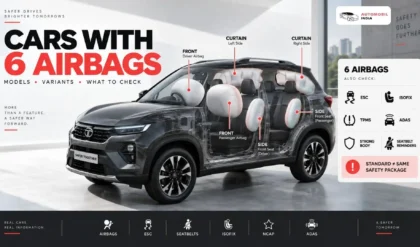
The Punch also offers six airbags, ESC, hill-hold assist, ISOFIX and TPMS. The current base Smart trim itself gets six airbags, TPMS and ESC.
Fronx safety equipment
The Fronx gets:
- Six airbags
- ESP
- Hill Hold Assist
- ABS with EBD
- Brake Assist
- ISOFIX
- Three-point ELR seatbelts
Maruti Suzuki says six airbags are standard on the Fronx.
However, the Fronx does not currently appear in Bharat NCAP‘s published India test results.
Safety equipment comparison
| Safety feature | Tata Punch | Maruti Fronx |
|---|---|---|
| Six airbags | Yes | Yes |
| ESC/ESP | Yes | Yes |
| Hill-hold assist | Yes | Yes |
| ABS with EBD | Yes | Yes |
| ISOFIX | Yes | Yes |
| TPMS | Yes | Depending on variant |
| Bharat NCAP rating | 5-star, specified variants | Not currently listed |
| ADAS | No | No |
The important distinction is between safety equipment and crash-test performance. Having six airbags and ESC does not by itself establish how a vehicle will perform in a crash.
Estimate EMIs and compare interest rates for the Punch or Fronx variant you’re considering.
Tata Punch vs Fronx Features
The two cars take different approaches to equipment.
Tata Punch features
Depending on variant, the Punch offers:
- 10.25-inch touchscreen
- Wireless Android Auto and Apple CarPlay
- Digital instrument cluster
- Wireless charger
- Rear AC vents
- Cruise control
- Sunroof
- 360-degree camera
- Connected-car technology
- Air purifier
- Ventilated seats
- Turbo-petrol engine
- AMT
- CNG AMT
Tata’s current Punch product page highlights features such as 366-litre boot space, rear AC vents, rear armrest, steering-mounted controls, cruise control and the 1.2-litre turbo engine.
Fronx features
Higher Fronx variants offer:
- 9-inch SmartPlay Pro+ infotainment
- Wireless Android Auto and Apple CarPlay
- Head-up display
- 360-degree camera
- Wireless charger
- Cruise control
- Suzuki Connect
- Automatic climate control
- LED lighting
- Paddle shifters with automatic transmission
- Turbo-petrol engine
- 6-speed automatic
Maruti’s official Fronx information highlights the 9-inch SmartPlay Pro+ system, HUD, 360-degree camera and connected-car technology on higher variants.
Tata Punch vs Fronx: Infotainment and Technology
The Fronx has an interesting advantage in its higher trims because of the 9-inch SmartPlay Pro+ system, head-up display and Suzuki Connect.
The Punch counters with a 10.25-inch touchscreen on higher variants and adds features such as connected technology, wireless charging and a 360-degree camera.
The screen size alone should not determine the choice.
A buyer should look at:
- Smartphone connectivity
- Navigation
- Camera quality
- Audio system
- Connected features
- Physical controls
- Display readability
- Ease of use
Both cars offer substantially more technology than their entry-level variants.
Tata Punch vs Fronx: Space and Practicality
The Fronx has the longer wheelbase, but the Punch has the larger published boot volume.
Punch
- Wheelbase: 2,445mm
- Boot: 366 litres
Fronx
- Wheelbase: 2,520mm
- Boot: 308 litres
The longer Fronx wheelbase can help with cabin packaging, while the Punch’s more upright shape and larger published boot volume can be useful for buyers who prioritise luggage capacity.
Neither is a large family SUV, though.
For four adults, both can work for everyday use. If you regularly carry five adults and substantial luggage, it is worth physically testing both cars rather than relying solely on dimensional numbers.
Tata Punch vs Fronx: City Driving
For Indian cities, both have useful characteristics.
Punch
The Punch’s upright seating position, compact length and relatively high ground clearance make it easy to place on crowded roads and over uneven surfaces.
Its smaller dimensions can also be useful in older urban areas where parking spaces are tight.
Fronx
The Fronx is longer but has a 4.9-metre turning radius, according to Maruti’s technical specifications.
Its lower roofline and longer body make it feel more like a crossover than the Punch.
If your daily commute involves narrow streets and tight parking, the Punch’s compact proportions may be easier to manage. If you spend more time on open roads and expressways, the Fronx’s longer wheelbase and turbo/automatic options become more relevant.
Tata Punch vs Fronx: Highway Driving
The Fronx has an important advantage for highway-oriented buyers: the 1.0-litre turbo-petrol can be paired with a 6-speed automatic.
The Punch’s new turbo-petrol produces more peak power and torque, but it is currently paired with a 6-speed manual.
Therefore:
- Punch turbo: stronger output, manual only
- Fronx turbo: lower output, but manual or 6-speed automatic
For drivers who enjoy changing gears themselves, the Punch turbo’s 120 PS/170 Nm package is relevant.
For drivers who want effortless automatic highway cruising, the Fronx turbo AT provides the more appropriate configuration.
Tata Punch vs Fronx: Ride and Ground Clearance
The Punch’s design gives it a distinctly SUV-like stance, and its ground clearance is around 193mm in current specifications.
The Fronx has around 190mm of ground clearance.
The difference is small on paper.
In practice, tyre size, suspension tuning, wheelbase and approach/departure geometry also affect how confidently a car handles broken roads.
For buyers in cities with frequent potholes, speed breakers and rough access roads, both offer useful clearance. The Punch’s upright proportions reinforce its SUV-oriented character.
Tata Punch vs Fronx: Which Has Better Mileage?
The published figures favour the Fronx across comparable petrol and CNG configurations.
Its 1.2-litre petrol is rated at up to 22.89 km/l with AMT, while the CNG version is rated at 28.51 km/kg.
The Punch’s petrol figures are around 20.09 km/l for manual and 18.8 km/l for AMT, with CNG around 26.99 km/kg.
These figures are certification results rather than promises of real-world economy.
Actual consumption can differ considerably, particularly in congested city traffic.
Tata Punch vs Fronx: Which Has More Features?
Neither car is universally more feature-rich across every variant.
The Fronx has notable technology such as:
- Head-up display
- 360-degree camera
- Suzuki Connect
- 6-speed turbo automatic
- Paddle shifters
The Punch offers:
- 10.25-inch touchscreen
- 360-degree camera
- Connected-car technology
- Ventilated seats on higher variants
- Panoramic/sunroof availability
- Turbo-petrol option
- CNG AMT
The exact equipment depends heavily on the variant, so comparing Punch Accomplished/Accomplished+ S against Fronx Alpha is more meaningful than comparing the two model names generally.
Tata Punch vs Fronx: Variant Strategy
A useful way to approach the comparison is to decide your powertrain first.
If your budget is below ₹7 lakh
The Punch has a lower entry point.
Its Smart petrol starts around ₹5.59 lakh, while the Fronx starts at ₹6.85 lakh.
If you want an affordable automatic
Both offer AMT options with their naturally aspirated petrol engines, but the Fronx also provides a turbo-petrol torque-converter automatic.
If you want CNG
Both offer factory-fitted CNG.
The Fronx claims the higher certified CNG efficiency figure.
If you want a turbo-petrol manual
Both now provide this option.
The Punch’s turbo is larger and produces 120 PS/170 Nm, while the Fronx uses a 1.0-litre turbo producing around 100 PS/147.6 Nm.
If you want a turbo automatic
The Fronx is the relevant choice because its 1.0-litre turbo is available with a 6-speed automatic.
Tata Punch vs Fronx: Ownership Considerations
Purchase price is only one part of the ownership equation.
Fuel cost
The Fronx’s higher claimed mileage can be relevant for buyers covering substantial annual distances.
Service and maintenance
Both are mass-market models with established manufacturer service networks, but actual service costs vary by variant, city and maintenance schedule.
Resale
Resale depends on factors such as:
- Variant
- Fuel type
- Age
- Mileage
- Condition
- Service history
- Local demand
It is better to compare current used-car listings for your city than assume one model will always have a particular resale value.
CNG ownership
For CNG buyers, access to refuelling stations near home and work is more important than a small difference in certified efficiency.
Tata Punch vs Fronx: Which One Suits Which Buyer?
Instead of choosing an overall winner, the differences can be mapped to specific requirements.
- Lower entry price
- Upright SUV styling
- Compact city-friendly dimensions
- Higher published boot capacity
- Published 5-star Bharat NCAP rating for specified variants
- Stronger 1.2-litre turbo-petrol output
- CNG AMT availability
- SUV-like seating position
- Higher claimed fuel efficiency
- Longer wheelbase
- 1.0-litre turbo-petrol
- Turbo-petrol automatic
- 6-speed torque-converter automatic
- Head-up display
- Suzuki Connect
- NEXA retail experience
- Sleeker crossover styling
These are suitability differences rather than an overall ranking.
Tata Punch vs Fronx: Final Takeaway
The Tata Punch vs Fronx comparison is not simply a contest between two similarly priced SUVs.
The Punch is the more compact, upright SUV with a lower starting price, a published 5-star Bharat NCAP result for specified variants and a new 120 PS turbo-petrol option.
The Fronx is longer, offers higher claimed fuel-efficiency figures, has a wider range of automatic choices and provides a 1.0-litre turbo-petrol with a 6-speed torque-converter automatic.
For a buyer primarily concerned with entry price, SUV packaging and documented crash-test performance, the Punch’s characteristics are particularly relevant.
For someone prioritising fuel efficiency, highway usability and automatic powertrain choices, the Fronx’s specifications deserve closer consideration.
The best way to narrow the choice is therefore to start with your budget, annual running, fuel preference and transmission requirement, and then compare the exact variants that fit those requirements.
Browse current listings and connect with sellers or dealers before you decide which one fits your needs.
Frequently Asked Questions
Which is cheaper, Tata Punch or Maruti Fronx?
The Tata Punch has the lower starting price. The 2026 Punch starts at around ₹5.59 lakh ex-showroom, while the current NEXA website lists the Fronx from ₹6.85 lakh.
Which has better mileage, Punch or Fronx?
The Fronx has higher claimed mileage figures. Its 1.2-litre petrol AMT is rated at 22.89 km/l and CNG at 28.51 km/kg, compared with around 18.8 km/l for the Punch petrol AMT and 26.99 km/kg for Punch CNG.
Which is safer, Tata Punch or Fronx?
The 2026 Punch has a published 5-star Bharat NCAP rating applicable to specified variants, with scores of 30.58/32 for adult occupant protection and 45/49 for child occupant protection. The Fronx does not currently appear in Bharat NCAP’s published India results.
Does the Tata Punch have a turbo-petrol engine?
Yes. The 2026 Punch introduced a 1.2-litre turbo-petrol engine producing 120 PS and 170 Nm, paired with a 6-speed manual gearbox.
Does the Maruti Fronx have a turbo-petrol engine?
Yes. The Fronx uses a 1.0-litre Turbo Boosterjet producing around 100 PS and 147.6 Nm. It is available with a 5-speed manual and 6-speed automatic.
Which has more boot space, Punch or Fronx?
The Punch has the larger published boot capacity at 366 litres, compared with 308 litres for the Fronx.
Which has the larger wheelbase?
The Fronx has the longer wheelbase at 2,520mm, compared with 2,445mm for the Punch. The longer wheelbase can benefit cabin packaging, although actual rear-seat comfort should be assessed in person.
Does the Punch or Fronx offer CNG?
Both do. The Punch offers a factory-fitted CNG powertrain, including CNG AMT on selected variants, while the Fronx CNG uses the 1.2-litre engine with a 5-speed manual.
Which has an automatic turbo-petrol option?
The Maruti Fronx. Its 1.0-litre turbo-petrol can be paired with a 6-speed automatic transmission. The Punch turbo-petrol is currently offered with a 6-speed manual.
Which is better for city driving?
Both can work well in urban conditions. The Punch’s shorter body and upright design can be useful in tight streets and parking spaces, while the Fronx offers automatic options including the turbo-petrol AT. The more suitable choice depends on whether compact dimensions or automatic convenience is the higher priority.
Prices, features, variants, mileage figures and specifications can change without prior notice and may vary by city or variant. Claimed mileage is obtained under prescribed test conditions and may differ significantly in real-world driving. Crash-test ratings apply only to the variants and specifications covered by the relevant assessment. Always confirm the latest price, equipment and safety specifications with the respective manufacturer or authorised dealer before purchasing.