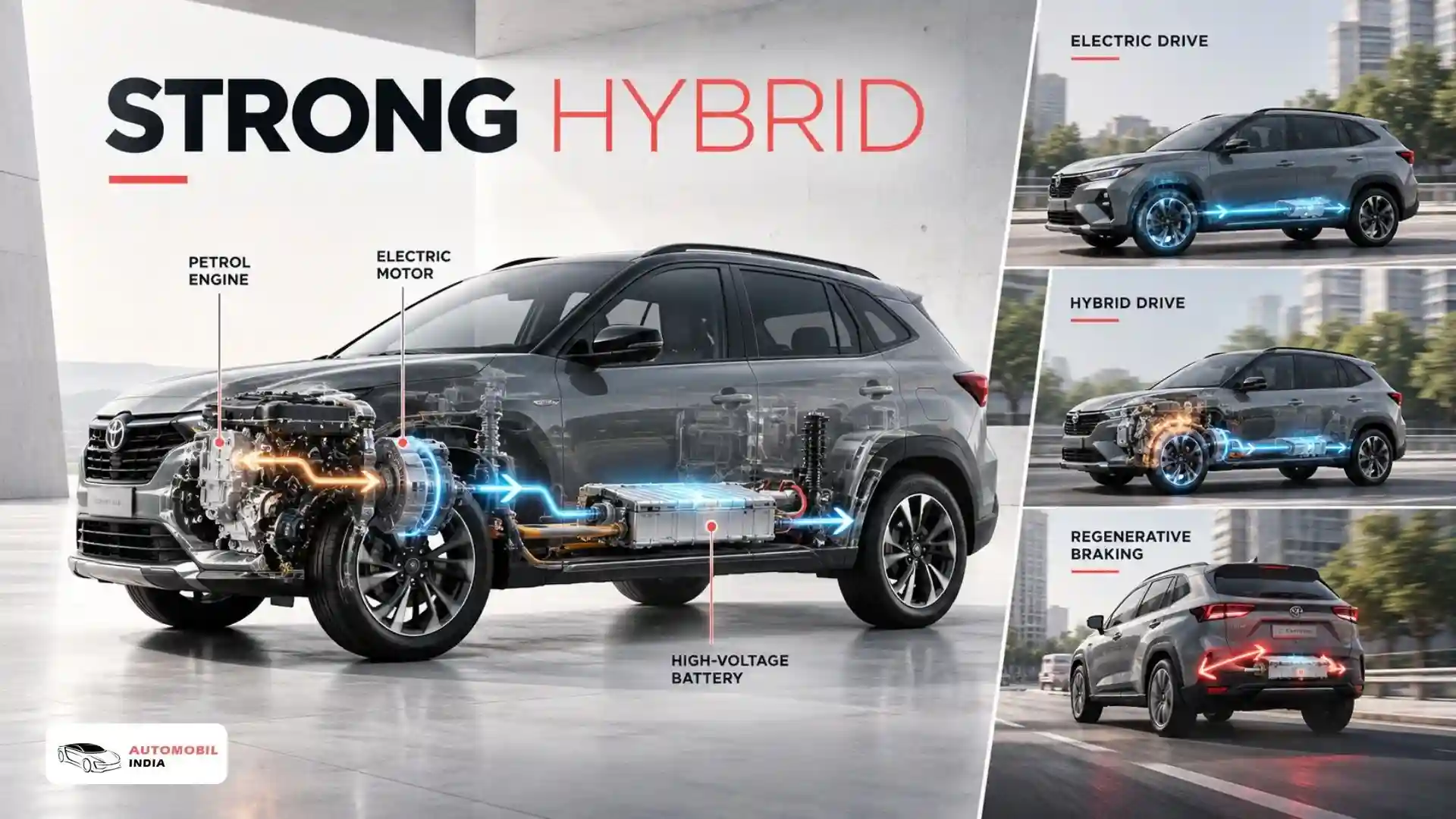
A strong hybrid car combines a petrol engine with an electric motor and a high-voltage battery. Unlike a mild hybrid, the electric motor in a strong hybrid can actually drive the car on its own for short periods under suitable conditions.
The battery is charged automatically through regenerative braking and the hybrid system, so a conventional strong hybrid does not need to be plugged into a charger. The car continuously decides whether to use the electric motor, petrol engine or both to balance efficiency and performance.
In India, strong hybrids are becoming an important alternative to conventional petrol cars and EVs. Models such as the Maruti Suzuki Grand Vitara, Maruti Suzuki Victoris, Toyota Urban Cruiser Hyryder, Honda City e:HEV, Toyota Innova HyCross and Maruti Suzuki Invicto use strong-hybrid technology.
The key advantage is straightforward: you get some of the efficiency benefits of electric driving without depending on external charging infrastructure.
However, strong hybrids also have limitations, including a higher purchase price, additional powertrain complexity and the fact that their electric-only driving capability is much more limited than that of a pure EV.
What Is a Strong Hybrid Car?
A strong hybrid, also called a full hybrid or self-charging hybrid, has three major propulsion components:
- Internal-combustion petrol engine
- Electric motor
- High-voltage battery
A sophisticated control system determines how these components work together. Depending on the driving situation, the car can operate in:
- Electric drive
- Petrol-engine drive
- Combined hybrid drive
Maruti Suzuki’s strong-hybrid system, for example, can switch between electric, engine and combined operation, while regenerative braking helps recharge the battery.
Honda’s e:HEV system similarly operates through three basic modes — EV Drive, Hybrid Drive and Engine Drive.
This is the fundamental difference between a strong hybrid and a mild hybrid. A mild hybrid primarily assists the petrol engine. A strong hybrid can propel the vehicle using electric power under suitable conditions.
How Does a Strong Hybrid Car Work?
The easiest way to understand a strong hybrid is to follow what happens during a typical journey.
1. Starting from a Standstill
Moving a stationary vehicle requires significant energy. In a strong hybrid, the electric motor can provide the initial propulsion using energy stored in the high-voltage battery. This is particularly useful in city traffic because the petrol engine does not necessarily need to start every time the vehicle moves away from a signal.
Maruti explains that its strong-hybrid system can use electric drive during initial acceleration and at low speeds when conditions allow.
Why this matters: Electric motors produce strong torque from very low speeds. As a result, a strong hybrid can feel particularly smooth when:
- Moving away from traffic lights
- Crawling through parking areas
- Joining slow-moving traffic
- Manoeuvring at low speeds
2. When More Power Is Needed
If you press the accelerator harder, the hybrid system can bring the petrol engine into operation. The electric motor can continue assisting the engine. This creates hybrid drive, where the engine and electric motor work together.
The benefit is not simply more power. The control system can use the two power sources to reduce the amount of work the petrol engine needs to do in certain situations. Maruti describes this combined operation as a way of providing stronger acceleration while improving efficiency.
3. During Cruising
At a steady speed, the system can choose the most efficient way to provide propulsion. Depending on the vehicle and operating conditions, this could involve:
- Petrol engine driving the vehicle
- Electric motor assisting
- Engine generating electrical energy
- A combination of engine and motor
The exact operating strategy differs between manufacturers. This is why it is better to think of a strong hybrid as an energy-management system, rather than simply a petrol car with an electric motor added to it.
4. When You Brake
This is one of the most important parts of hybrid technology. In a conventional petrol car, some of the vehicle’s kinetic energy is converted into heat through the brakes. A strong hybrid can recover some of that energy.
The electric motor operates as a generator during deceleration, converting some kinetic energy into electrical energy and storing it in the high-voltage battery. This is called regenerative braking. Maruti describes regenerative braking as converting braking energy into electricity for storage in the hybrid battery.
Why this is especially useful in cities: Indian urban driving often involves accelerate → brake → stop → accelerate → brake. A strong hybrid can recover some energy during those repeated deceleration events and reuse it later. That is one of the reasons strong hybrids can deliver particularly good fuel efficiency in city driving.
How Is a Strong Hybrid Battery Charged?
A conventional strong hybrid does not require an external charger. The battery is replenished mainly through:
Regenerative braking
Energy is recovered whenever the vehicle decelerates under suitable conditions.
Engine-generated electricity
The petrol engine can also operate the generator to produce electrical energy for the hybrid system.
Hybrid energy management
The system constantly monitors battery charge and driving conditions and manages when energy is stored or used.
Maruti explicitly states that its strong-hybrid cars do not need to be plugged in, while the engine and regenerative braking help recharge the battery. This is one of the strongest practical differences between a conventional strong hybrid and an EV.
Strong Hybrid vs Mild Hybrid
The two terms are often confused because both contain the word “hybrid”. Technically, however, they are quite different.
| Feature | Strong Hybrid | Mild Hybrid |
|---|---|---|
| Petrol engine | Yes | Yes |
| Electric motor | Traction motor | Motor-generator/ISG |
| Can drive car using electric motor | Yes | Generally no |
| High-voltage traction battery | Yes | Usually no |
| Regenerative braking | Yes | Yes |
| Engine stop-start | Yes | Yes |
| Torque assistance | Yes | Yes |
| External charging | No | No |
| Electric-only operation | Possible | Not meaningful |
| Main objective | Significant electrification + efficiency | Engine assistance + efficiency |
Maruti’s Smart Hybrid system uses an Integrated Starter Generator to provide functions such as torque assistance, idle start-stop and brake-energy regeneration. That is different from Maruti’s Intelligent Electric/Strong Hybrid system, which uses a traction motor and can propel the vehicle electrically.
A simple way to remember it
Mild hybrid: The electric system helps the petrol engine.
Strong hybrid: The electric system can help or actually drive the car.
Strong Hybrid vs Petrol Car
A conventional petrol car gets all of its propulsion from the engine. A strong hybrid can use three operating strategies: electric → petrol → electric + petrol. This allows it to recover braking energy and use electric propulsion where appropriate.
| Factor | Petrol | Strong Hybrid |
|---|---|---|
| Engine | Petrol | Petrol |
| Electric propulsion | No | Yes |
| Regenerative braking | No | Yes |
| External charging | No | No |
| City efficiency potential | Moderate | Higher |
| Purchase price | Usually lower | Usually higher |
| Powertrain complexity | Lower | Higher |
| Long-distance refuelling | Easy | Easy |
The biggest practical difference appears in stop-start traffic. A conventional petrol engine has to repeatedly convert fuel into mechanical energy to accelerate the car. A strong hybrid can use stored electrical energy for some of those low-speed events and recover part of the energy during braking.
Strong Hybrid vs Electric Car
A strong hybrid and an EV both use electric motors, but the ownership experience is very different.
| Factor | Strong Hybrid | EV |
|---|---|---|
| Petrol engine | Yes | No |
| Electric motor | Yes | Yes |
| External charging | No | Required |
| Petrol refuelling | Yes | No |
| Electric-only driving | Limited | Primary mode |
| Long-distance refuelling | Conventional fuel stations | Depends on charging network |
| Tailpipe emissions | Yes | None while driving |
| Battery size | Relatively small | Much larger |
A strong hybrid therefore acts as a bridge between conventional petrol ownership and full electrification. For someone who cannot install a home charger or regularly drives long distances through areas with limited charging infrastructure, this can be a meaningful advantage. For someone with reliable home charging and predictable daily driving, an EV may offer a different set of benefits.
Why Do Strong Hybrid Cars Give High Mileage?
Strong-hybrid fuel efficiency comes from several systems working together rather than one technology alone.
Electric propulsion
The motor can handle certain low-speed driving situations without requiring the petrol engine to run continuously.
Regenerative braking
Some energy that would otherwise be lost during braking can be recovered.
Engine stop-start
The petrol engine can switch off when its operation is unnecessary.
Efficient engine operation
The hybrid system can manage engine operation around conditions where it is more efficient.
Electric motor assistance
The motor can assist the petrol engine during acceleration.
This combination is why mainstream strong hybrids in India can post certified fuel-efficiency figures in the high-20km/l range. For example, Maruti currently lists:
- Grand Vitara Strong Hybrid: 27.97 km/l
- Invicto Strong Hybrid: 22.16 km/l
The Victoris strong hybrid is rated at 28.65 km/l. Honda’s current City e:HEV brochure quotes 27.26 km/l and 253Nm of torque for its two-motor hybrid system. These are certified figures, not guaranteed real-world mileage.
What Is the Real-World Mileage of a Strong Hybrid?
There is no single number. Actual fuel economy depends on:
- Traffic
- Driving style
- Average speed
- Air-conditioning use
- Road gradient
- Tyre pressure
- Passenger load
- Temperature
- City/highway driving split
Strong hybrids generally have a particularly useful efficiency advantage in stop-start urban driving, because that environment creates more opportunities for electric propulsion and regenerative braking. Autocar India’s current hybrid guide also notes that city driving provides more opportunities for the hybrid system to recover and reuse energy than steady highway running.
What Is the Price of a Strong Hybrid Car in India?
There is no single strong-hybrid price because the technology is available across several vehicle segments. Some current examples include:
| Strong-hybrid model | Approximate positioning |
|---|---|
| Maruti Suzuki Grand Vitara | From about ₹17 lakh for strong-hybrid variants |
| Toyota Urban Cruiser Hyryder | Around ₹17 lakh+ for strong-hybrid variants |
| Maruti Suzuki Victoris | About ₹16.4 lakh+ for strong hybrid |
| Honda City e:HEV | Premium City range |
| Toyota Innova HyCross Hybrid | ₹26 lakh+ depending on variant |
| Maruti Suzuki Invicto | ₹25 lakh+ |
| Toyota Camry Hybrid | Premium segment |
| Honda ZR-V e:HEV | ₹47.99 lakh introductory launch price |
The exact price depends on variant, location, tax, registration and manufacturer updates. The important point is that the hybrid system itself adds cost compared with a conventional petrol powertrain. That is why buyers should calculate whether the expected fuel savings justify the additional purchase price.
See current on-road prices across Maruti, Toyota and Honda strong-hybrid models before you decide.
What Are the Main Features of a Strong Hybrid Car?
The exact equipment varies by model, but strong-hybrid vehicles generally have several technology-related features.
Electric drive
Allows the vehicle to move using the electric motor under suitable conditions.
Regenerative braking
Converts some kinetic energy into electrical energy.
High-voltage battery
Stores energy for the traction motor.
Power Control Unit
Manages the flow of electrical energy between the battery, motor, generator and engine.
Hybrid energy management
Automatically determines which propulsion source should be used.
e-CVT or similar hybrid transmission
Many mainstream strong hybrids use an electronically controlled continuously variable transmission or an equivalent hybrid power-management system. Maruti describes its e-CVT as a system that manages engine power, vehicle speed and driver inputs to maintain efficient operation. Honda’s e:HEV uses a two-motor system with a traction motor, generator motor, power-control unit and engine-linked clutch.
What Happens When the Strong Hybrid Battery Gets Low?
This is a common concern among people considering a hybrid for the first time. You do not normally need to stop and recharge the battery manually. The system continuously manages its state of charge. When the battery needs energy, the system can use:
- Regenerative braking
- Engine-generated electricity
- Hybrid operation
Maruti explains that when the battery needs topping up, the system can automatically use the engine and generator without driver intervention. Honda’s e:HEV documentation similarly states that the high-voltage battery can be charged through the engine-driven generator or regenerative braking.
Does a Strong Hybrid Drive Like an EV?
Not exactly. A strong hybrid can provide an EV-like experience in certain situations:
- Silent low-speed movement
- Electric acceleration
- Engine-off operation
- Regenerative braking
But it is still fundamentally a dual-powertrain vehicle. The petrol engine remains an important part of the system. Electric-only operation is generally limited by factors such as:
- Battery state of charge
- Vehicle speed
- Accelerator demand
- Temperature
- System design
Honda’s e:HEV system, for example, automatically chooses between EV Drive, Hybrid Drive and Engine Drive according to conditions. Therefore, it is more accurate to say a strong hybrid can drive electrically, rather than calling it a small EV.
Benefits of a Strong Hybrid Car
1. High fuel-efficiency potential
The combination of electric propulsion, regenerative braking and engine management can significantly reduce petrol consumption.
2. Excellent city suitability
Stop-start traffic gives the system more opportunities to use electric propulsion and recover energy.
3. No external charging
You can refuel at a petrol station like a conventional car.
4. Smooth low-speed driving
Electric motors provide immediate torque and can make low-speed movement very smooth.
5. Good long-distance convenience
You do not need to plan every trip around charging stations.
6. Lower fuel consumption than comparable petrol versions
The exact saving depends on the vehicle and driving conditions, but strong hybrids are specifically engineered to improve efficiency.
7. Reduced tailpipe emissions
Lower fuel consumption generally means lower tailpipe CO₂ emissions per kilometre.
Limitations of Strong Hybrid Cars
Strong hybrids are not a perfect solution for every buyer.
1. Higher purchase price
The hybrid battery, electric motor, power electronics and associated hardware increase the cost of the vehicle.
2. More complex powertrain
There are more components than in a conventional petrol car.
3. Limited electric-only range
A strong hybrid is not intended to replace an EV for long-distance electric driving.
4. Efficiency advantage depends on usage
A buyer who drives mostly on open highways may see a smaller hybrid advantage than someone driving heavily in urban traffic.
5. Battery packaging
The hybrid battery and associated components can influence vehicle packaging and, depending on the model, luggage space.
6. The premium may take time to recover
If annual driving is low, the fuel savings may not justify the additional purchase price during your ownership period.
Compare hybrid and petrol variants on price, mileage and running costs before you commit to the extra premium.
Are Strong Hybrid Cars Reliable?
The technology itself has been used globally for decades, but reliability should be evaluated model by model, not simply by calling all hybrids reliable or unreliable. A buyer should look at:
- Manufacturer’s hybrid track record
- Battery warranty
- Powertrain warranty
- Service network
- Availability of trained technicians
- Cost of scheduled maintenance
- Long-term ownership reports
The high-voltage battery is one of the components buyers naturally worry about, so the manufacturer’s warranty deserves particular attention. For example, Toyota and Maruti have offered extended hybrid-battery warranty coverage on relevant models, but the exact duration and conditions vary by manufacturer, model and programme. Always check the latest warranty documentation before purchase.
Does a Strong Hybrid Need Special Maintenance?
The regular petrol engine still needs conventional maintenance such as:
- Engine oil
- Filters
- Coolant
- Spark plugs where applicable
- Tyres
- Suspension inspection
The hybrid system adds components such as:
- High-voltage battery
- Electric motor
- Inverter
- Power-control electronics
- Hybrid cooling systems
However, owners do not normally service these components like conventional consumables. The more important consideration is whether the vehicle has an established authorised service network capable of diagnosing its hybrid systems. For mainstream models from manufacturers such as Toyota, Maruti Suzuki and Honda, hybrid technology is integrated into the manufacturer’s service ecosystem.
Strong Hybrid Cars Available in India
The technology is no longer limited to one manufacturer.
Maruti Suzuki
Current strong-hybrid examples include:
- Grand Vitara
- Victoris
- Invicto
Maruti’s current strong-hybrid page lists the Grand Vitara and Invicto, while the Victoris is also offered with the technology.
Toyota
Toyota’s Indian range includes strong-hybrid models such as:
- Urban Cruiser Hyryder
- Innova HyCross
- Camry
Honda
Honda offers:
- City e:HEV
- ZR-V e:HEV
The City uses Honda’s two-motor e:HEV architecture, while the ZR-V brings Honda’s hybrid technology into a premium SUV.
The broader Indian market also contains premium and luxury vehicles using hybrid or plug-in hybrid systems, but their technology and price positioning are very different from mainstream strong hybrids.
Strong Hybrid vs Mild Hybrid vs EV vs Petrol: At a Glance
| Factor | Petrol | Mild Hybrid | Strong Hybrid | EV |
|---|---|---|---|---|
| Petrol engine | Yes | Yes | Yes | No |
| Electric motor | No | Assistance motor | Traction motor | Traction motor |
| Can drive electrically | No | Generally no | Yes, under suitable conditions | Yes |
| External charging | No | No | No | Yes |
| Regenerative braking | No | Yes | Yes | Yes |
| City efficiency potential | Moderate | Better | High | Very high |
| Long-distance refuelling | Easy | Easy | Easy | Charging required |
| Purchase price | Usually lower | Slightly higher | Higher | Varies |
| Powertrain complexity | Lowest | Moderate | Higher | Different type of complexity |
| Best suited to | General use | Cost-conscious efficiency | High urban use + long trips | Charging-friendly ownership |
Is a Strong Hybrid Better Than an EV?
Not universally. The two powertrains solve different problems.
A strong hybrid can make sense if:
- You cannot install a home charger.
- You frequently drive long distances.
- You want high efficiency without changing refuelling habits.
- You regularly drive in city traffic.
- You want an electric-assisted driving experience without depending on charging infrastructure.
An EV can make sense if:
- You have reliable home or workplace charging.
- Your daily driving is predictable.
- You want to eliminate petrol use.
- You are comfortable planning longer trips around charging.
- Your usage pattern allows you to exploit the EV’s low running-energy cost.
The choice therefore depends more on usage pattern and infrastructure than on which technology is inherently superior.
Is a Strong Hybrid Worth Buying in India?
For many urban drivers, a strong hybrid can be an interesting alternative to both conventional petrol cars and EVs. But the calculation should start with your driving pattern. Ask yourself:
- How many kilometres do I drive each year?
- How much of that is in traffic?
- Do I have access to home charging?
- How long will I keep the car?
- How much more does the hybrid variant cost?
- How much fuel can I realistically save?
For example, someone driving 18,000 km annually through a congested city may have many opportunities to benefit from electric propulsion and regenerative braking. Someone driving only 5,000 km annually may find it harder to recover a large hybrid price premium through fuel savings.
Talk to our team about which strong-hybrid model suits your driving pattern, budget and ownership plans.
The Bottom Line: What Is a Strong Hybrid Car?
The technology works particularly well in Indian city conditions because frequent braking, low-speed movement and stop-start traffic give the system opportunities to:
- Drive electrically
- Switch the engine off
- Recover braking energy
- Assist the petrol engine
- Reduce fuel consumption
Its biggest limitations are the higher purchase price, greater powertrain complexity and limited electric-only capability compared with a full EV.
For Indian buyers, the strongest argument for a strong hybrid is therefore simple: it provides meaningful electrification without requiring you to change the way you refuel your car. That makes it particularly relevant to buyers who want better efficiency but are not yet ready to move completely to an electric vehicle.
Frequently Asked Questions
What is a strong hybrid car?
A strong hybrid car combines a petrol engine, electric traction motor and high-voltage battery. Unlike a mild hybrid, its electric motor can independently propel the vehicle under suitable conditions.
Does a strong hybrid need to be charged?
No. Conventional self-charging strong hybrids do not need to be plugged in. The battery is replenished through regenerative braking and energy generated by the hybrid system.
What is the difference between strong hybrid and mild hybrid?
A strong hybrid has an electric traction motor capable of driving the vehicle. A mild hybrid primarily uses an integrated starter-generator or similar system to assist the petrol engine, recover braking energy and support start-stop operation.
What mileage does a strong hybrid car give?
Mileage varies by vehicle and driving conditions. Current Indian strong hybrids have certified figures ranging from roughly the low-20s to the high-20s km/l. For example, Maruti quotes 28.65 km/l for the Victoris Strong Hybrid and 27.97 km/l for the Grand Vitara.
Can a strong hybrid run only on battery?
It can run on electric power under suitable conditions, but it is not designed for long EV-only distances. The petrol engine automatically takes over or assists when required.
Is a strong hybrid better than an EV?
They have different strengths. A strong hybrid does not require external charging and is convenient for long-distance travel, while an EV can provide substantially more electric-only driving but requires access to charging.
Are strong hybrid cars expensive to maintain?
They contain additional electrical and hybrid components, but routine maintenance still includes many familiar petrol-car items. Battery warranty and authorised-service support should be checked before purchase.
Is a strong hybrid good for city driving?
Yes. City traffic can provide frequent opportunities for electric propulsion and regenerative braking, making strong hybrids particularly well suited to stop-start driving.
What are examples of strong hybrid cars in India?
Examples include the Maruti Suzuki Grand Vitara, Maruti Suzuki Victoris, Toyota Urban Cruiser Hyryder, Honda City e:HEV, Toyota Innova HyCross and Maruti Suzuki Invicto. Premium examples include the Toyota Camry and Honda ZR-V e:HEV.
Is a strong hybrid worth the extra price?
It depends on annual mileage, city usage, petrol prices, ownership period and the price difference between the hybrid and petrol versions. Higher annual driving generally gives the efficiency advantage more opportunity to offset the initial premium.