The XUV7XO vs Harrier comparison has changed significantly for 2026. Mahindra has replaced the XUV700 with the XUV 7XO, a heavily updated version that retains the XUV700’s basic platform and powertrain philosophy while adding major technology, safety and comfort upgrades. Tata has also expanded the Harrier range with a new 1.5-litre turbo-petrol engine alongside its established 2.0-litre diesel.
Both SUVs sit in the premium midsize SUV space, but they are not identical propositions.
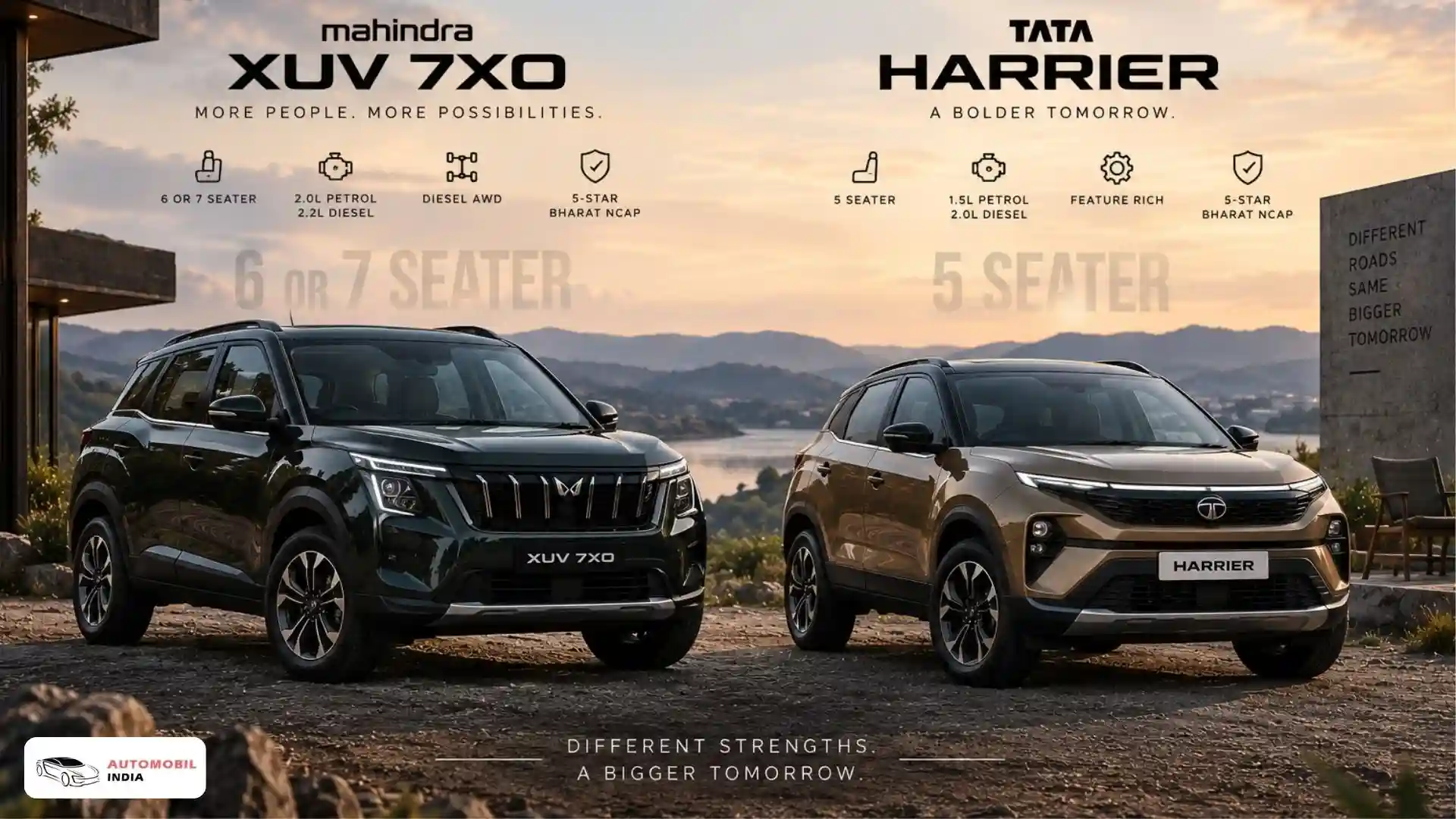
The XUV 7XO is available as a 6- or 7-seater, while the Harrier remains a 5-seater SUV. The Mahindra is also larger overall and offers an available diesel-AWD combination. The Harrier, meanwhile, focuses on a five-seat cabin, strong diesel performance, a new petrol engine and a feature-rich range.
The current XUV 7XO starts at about ₹13.99 lakh ex-showroom after its introductory pricing period, while the Harrier starts at around ₹15.35 lakh in the current published variant listings. Prices vary by variant and location.
So, the decision comes down less to a simple “which is better?” question and more to how many people you need to carry, what kind of performance you want, how much technology you value and how you intend to use the SUV.
XUV7XO vs Harrier: Quick Comparison
| Factor | Mahindra XUV 7XO | Tata Harrier |
|---|---|---|
| Current model status | XUV700 successor | Current Harrier |
| Seating | 6 or 7 | 5 |
| Petrol engine | 2.0L turbo | 1.5L turbo-GDI |
| Diesel engine | 2.2L turbo-diesel | 2.0L turbo-diesel |
| Petrol power | 203hp | 170hp |
| Petrol torque | 380Nm | 280Nm |
| Diesel power | 185hp | 170hp |
| Diesel torque | 420Nm MT / 450Nm AT | 350Nm |
| Gearboxes | 6MT / 6AT | 6MT / 6AT |
| AWD | Diesel AT | Not available |
| Length | 4,695mm | 4,605mm |
| Width | 1,890mm | 1,922mm |
| Wheelbase | 2,750mm | 2,741mm |
| Boot | Limited with all three rows in use | 445 litres |
| Bharat NCAP | 5 stars | 5 stars |
| ADAS | Level 2 on higher variants | ADAS on higher variants |
| Warranty | 3 years/unlimited km | 3 years/1 lakh km standard |
The most important difference is immediately visible: the XUV 7XO is a three-row SUV, whereas the Harrier is a five-seater.
XUV7XO vs Harrier Price in India
The XUV700 name is no longer used for Mahindra’s current flagship ICE SUV. The updated model is now sold as the XUV 7XO.
The XUV 7XO’s current range has six main trim levels:
- AX
- AX3
- AX5
- AX7
- AX7T
- AX7 Luxury
Current published prices range from approximately ₹13.99 lakh to ₹25.94 lakh ex-showroom, depending on engine, gearbox, seating configuration and AWD.
The Harrier currently has a much larger number of individual variant combinations, beginning with the Smart trim and extending through Pure X, Adventure X/X+, Fearless X/X+ and Fearless Ultra versions. Current published prices run from approximately ₹15.35 lakh to ₹31.73 lakh for the listed variants and special editions.
Price positioning
At the entry level, the Mahindra gives buyers a lower starting point.
However, the comparison becomes more complicated as you move up the range because both manufacturers use different variant structures and equipment packages.
For example, a buyer comparing a seven-seat XUV 7XO with a similarly equipped Harrier should look at actual equipment and powertrain, rather than comparing the badge price alone.
XUV7XO vs Harrier: Engine and Performance
This is one of the most significant areas of difference.
Mahindra XUV 7XO Engines
The XUV 7XO uses two turbocharged engines:
2.0-litre turbo-petrol
- 1,997cc
- 203hp
- 380Nm
- 6-speed manual
- 6-speed automatic
2.2-litre turbo-diesel
- 2,184cc
- 185hp
- 420Nm with manual
- 450Nm with automatic
- 6-speed manual
- 6-speed automatic
- AWD available with diesel automatic on higher variants
Mahindra’s published technical information confirms the 2.0-litre petrol and 2.2-litre diesel combination, while the current XUV 7XO specification sheet lists the diesel at 185hp and up to 450Nm.
The diesel AWD automatic is particularly relevant for buyers who regularly travel through steep, slippery or poorly surfaced roads. It is not intended to turn the XUV 7XO into a hardcore off-roader, but the extra driven axle can improve traction in appropriate conditions.
Tata Harrier Engines
The current Harrier has two engine choices.
1.5-litre turbo-petrol
- 1,498cc
- 170hp
- 280Nm
- 6-speed manual
- 6-speed automatic
2.0-litre diesel
- 1,956cc
- 170hp
- 350Nm
- 6-speed manual
- 6-speed automatic
Both Harrier engines can be paired with either a six-speed manual or six-speed automatic, but the SUV remains front-wheel drive.
XUV7XO vs Harrier: Which Has More Performance?
On paper, the XUV 7XO has the stronger engines.
The 2.0-litre petrol produces 203hp and 380Nm, compared with the Harrier petrol’s 170hp and 280Nm.
The diesel difference is also substantial: the XUV 7XO produces up to 185hp and 450Nm, while the Harrier diesel produces 170hp and 350Nm.
That does not mean every buyer will experience the difference in exactly the same way.
The XUV 7XO is a larger three-row vehicle, so its additional output is partly being used to move a larger SUV. The Harrier’s petrol is also around 80kg lighter than its diesel counterpart, according to current specifications.
For highway users
The XUV 7XO’s stronger torque output is particularly relevant when the SUV is heavily loaded.
For a family travelling with six or seven occupants plus luggage, the diesel automatic’s 450Nm provides substantial reserve torque.
The Harrier diesel’s 350Nm is still substantial for highway use, and its five-seat configuration means there is no requirement to package a third row.
XUV7XO vs Harrier Mileage
Fuel efficiency needs some caution because Mahindra has not published a fresh ARAI mileage figure for the XUV 7XO.
The current XUV 7XO carries over the broad engine family from the XUV700, and Autocar notes the older XUV700’s ARAI figures of approximately:
- Petrol manual: 15 km/l
- Petrol automatic: 13 km/l
- Diesel manual: 17 km/l
- Diesel automatic: 16.57 km/l
These should not be presented as official XUV 7XO mileage figures, because Mahindra has not quoted new fuel-efficiency numbers for the updated model.
For the Harrier, the diesel has an official ARAI figure of 16.8 km/l for both manual and automatic versions. Autocar’s testing returned 10.8 km/l in the city and 15.3 km/l on the highway for the diesel manual, while the automatic returned 9.6 km/l and 14.4 km/l respectively.
Tata’s current published material does not provide an official ARAI petrol mileage figure for the new Harrier petrol.
What should buyers take from this?
Do not choose between these SUVs purely from their claimed mileage.
If your annual running is high, the diesel versions deserve attention. If most driving is urban and annual kilometres are relatively low, the petrol versions can make more sense because the higher purchase price and additional diesel-system complexity may not be justified by your usage.
XUV7XO vs Harrier: Dimensions and Space
The XUV 7XO is longer and has a marginally longer wheelbase, while the Harrier is wider.
| Dimension | XUV 7XO | Tata Harrier |
|---|---|---|
| Length | 4,695mm | 4,605mm |
| Width | 1,890mm | 1,922mm |
| Height | 1,755mm | 1,718mm |
| Wheelbase | 2,750mm | 2,741mm |
| Seating | 6/7 | 5 |
The XUV 7XO’s 2,750mm wheelbase gives it a strong foundation for three-row packaging. The Harrier’s 2,741mm wheelbase is almost identical, but Tata uses it within a five-seat layout.
What does that mean in practice?
If you regularly carry five adults, the Harrier’s five-seat layout allows Tata to concentrate the available cabin length on two rows.
If you occasionally need six or seven seats, the XUV 7XO has an obvious packaging advantage.
This is an important distinction: the XUV 7XO and Harrier are not direct seating-capacity equivalents.
XUV7XO vs Harrier: Third-Row Practicality
The XUV 7XO’s biggest practical advantage is its third row.
It can be configured as either:
- 7-seater with a conventional three-row arrangement
- 6-seater with second-row captain chairs on selected variants
The six-seat version can be particularly attractive for families that value easier access between the second and third rows.
However, using all three rows naturally reduces available luggage space. This is the normal compromise with three-row SUVs.
The Harrier avoids that compromise because it is a five-seater from the outset. Tata quotes 445 litres of boot space with the rear seats upright.
For a family of four or five
If you rarely carry more than five people, the Harrier’s two-row layout may actually be the simpler arrangement.
For a larger family
If six or seven seats are regularly required, the XUV 7XO is the more relevant vehicle to consider because the Harrier simply does not offer that seating configuration.
XUV7XO vs Harrier: Interior and Comfort
Both SUVs have moved substantially upmarket in their latest versions.
XUV 7XO Interior
The XUV 7XO introduces a coast-to-coast triple-screen arrangement, with Mahindra positioning the model as a technology-heavy flagship SUV.
Depending on variant, equipment includes:
- Triple-screen dashboard
- Wireless Android Auto and Apple CarPlay
- Harman Kardon audio
- Dolby Atmos
- Dolby Vision
- Ventilated front seats
- Panoramic sunroof
- Connected-car technology
- Powered seats
- Rear-seat comfort features
- 540-degree camera
- Level 2 ADAS on higher trims
Mahindra describes the XUV 7XO as India’s first ICE SUV with its coast-to-coast triple-screen arrangement across the range, while its top technology package includes Level 2 ADAS with dynamic visualisation.
Harrier Interior
The Harrier takes a more conventional five-seat premium-SUV approach.
Depending on variant, it offers:
- 12.3-inch touchscreen on diesel variants
- 14.53-inch screen on top petrol variants
- 10.25-inch digital instrument display
- JBL audio
- Wireless Android Auto and Apple CarPlay
- Panoramic sunroof
- Ventilated front seats
- 360-degree camera
- Connected-car technology
- ADAS
- Adaptive cruise control on applicable automatic variants
- Powered tailgate on higher versions
The top Harrier variants also receive features such as a 10-speaker JBL system and additional driver-assistance technology.
XUV7XO vs Harrier: Features Comparison
| Feature | XUV 7XO | Harrier |
|---|---|---|
| Large touchscreen | Yes | Yes |
| Digital instrument display | Yes | Yes |
| Wireless Android Auto/Apple CarPlay | Yes | Yes |
| Panoramic sunroof | Higher variants | Higher variants |
| Ventilated front seats | Higher variants | Higher variants |
| 360-degree camera | Higher variants | Higher variants |
| ADAS | Level 2 on higher variants | Higher variants |
| Adaptive cruise control | Higher variants | Automatic higher variants |
| Premium audio | Harman Kardon | JBL |
| 540-degree camera | Yes | No |
| Triple-screen dashboard | Yes | No |
| AWD | Diesel AT | No |
The XUV 7XO has the more technology-intensive cabin, particularly at the top end.
The Harrier counters with a similarly extensive premium-feature list but focuses on a two-row cabin.
XUV7XO vs Harrier: Safety
Safety is another area where both SUVs have strong documented credentials.
XUV 7XO Bharat NCAP Rating
The current Mahindra XUV 7XO has a five-star Bharat NCAP rating.
The September 2026 Bharat NCAP record gives:
- Adult Occupant Protection: 30.76/32
- Child Occupant Protection: 44.97/49
The assessment was conducted in July 2026, and the rating applies to the variants listed by Bharat NCAP. The tested configurations included XUV 7XO diesel automatic variants, with the applicability extending across the listed petrol and diesel variants.
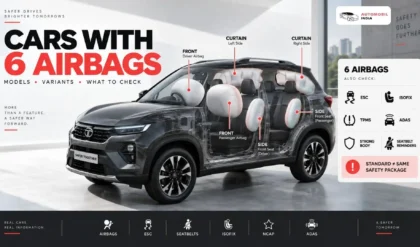
Mahindra also offers features such as ESC, curtain airbags and seat-belt reminders as standard according to the Bharat NCAP listing.
Tata Harrier Bharat NCAP Rating
The Harrier was tested under Bharat NCAP in 2023.
Its published score is:
- Adult Occupant Protection: 30.08/32
- Child Occupant Protection: 44.54/49
The Bharat NCAP fact sheet specifies the tested Safari/Harrier ADV+ configuration and notes that the rating applies to the variants listed in the annexure.
The current Harrier range has six airbags, stability control and tyre-pressure monitoring from the base Smart variant according to the current variant information.
How should these ratings be interpreted?
Both SUVs have five-star Bharat NCAP ratings, but the tests were conducted in different years and under the respective programme specifications applicable to those assessments.
Therefore, it is better to treat the ratings as evidence of strong crash-test performance rather than simply comparing the numerical scores as if they were conducted simultaneously.
Also, buyers should check whether the exact variant they intend to purchase falls within the published applicability.
XUV7XO vs Harrier: ADAS
Both SUVs offer advanced driver-assistance technology on higher variants.
The XUV 7XO’s top technology variants use a Level 2 ADAS package, with features including systems designed for lane keeping, adaptive cruise control and collision-related assistance. Mahindra has also highlighted dynamic visualisation for its ADAS system.
The Harrier also offers ADAS on higher variants, including functions such as:
- Forward collision warning
- Autonomous emergency braking
- Lane departure warning
- Lane keeping assistance
- Adaptive cruise control
- Traffic sign recognition
Tata’s own Harrier documentation cautions that ADAS is an assistance system and does not replace attentive driving.
XUV7XO vs Harrier: Ride and Handling
The two SUVs have different priorities in their chassis tuning.
The XUV 7XO retains the XUV700’s independent suspension layout and receives significant suspension revisions for 2026. Mahindra has introduced its DAVINCI suspension system as one of the headline changes, with the company positioning it around ride comfort and body control.
The Harrier uses Tata’s OMEGARC architecture derived from the D8 architecture and has traditionally focused on a stable, planted SUV driving experience.
The difference becomes particularly relevant on Indian roads.
City roads
Both have the dimensions and ground presence of large SUVs, so they require more care in tight parking areas than compact SUVs.
The Harrier is wider, while the XUV 7XO is longer and taller.
Highways
Both are designed for long-distance driving.
The XUV 7XO’s stronger petrol and diesel outputs make it particularly suited to buyers who value acceleration and loaded-road-trip performance.
The Harrier’s diesel provides substantial torque and its five-seat configuration can make it a straightforward family highway SUV.
XUV7XO vs Harrier: Ownership
Ownership is more than just fuel economy.
Warranty
Mahindra currently lists a 3-year/unlimited-kilometre standard warranty for the XUV 7XO.
Tata’s current Harrier brochure lists a 3-year/1 lakh km warranty, whichever comes first.
This is a meaningful difference for buyers with very high annual running.
A driver covering 30,000–40,000km a year should consider the warranty kilometre limit when comparing ownership plans.
Service and maintenance
Both vehicles use turbocharged engines, automatic transmissions and a substantial amount of electronics on higher variants.
That means ownership cost should not be estimated from fuel alone.
Potential cost factors include:
- Routine servicing
- Tyres
- Brake components
- Insurance
- Automatic gearbox maintenance
- Diesel emissions-system requirements
- ADAS and camera-related components
- Extended warranty
- Consumables
Actual service bills can vary considerably by dealership, city, variant and usage, so prospective buyers should ask for a variant-specific service-cost estimate before booking.
XUV7XO vs Harrier: Which Engine Should You Choose?
Choose petrol if:
- Your annual running is relatively low.
- Most driving is within a city.
- You want quieter petrol-engine operation.
- You do not regularly carry a full load.
- You want to avoid diesel-specific ownership considerations.
Choose diesel if:
- You regularly drive on highways.
- Annual running is high.
- You frequently carry passengers and luggage.
- Strong low- and mid-range torque matters.
- You expect to keep the SUV for several years.
The XUV 7XO adds another dimension because its diesel automatic can be paired with AWD on higher variants.
XUV7XO vs Harrier: Which One Makes More Sense for Families?
The answer depends primarily on family size.
For a family of four or five
The Harrier’s five-seat configuration gives you a dedicated two-row cabin and a 445-litre boot.
This can be preferable if the third row of a seven-seater would spend most of its life folded.
For six or seven people
The XUV 7XO becomes the more relevant choice because it offers both six- and seven-seat configurations.
However, buyers should physically test the third row with the intended passengers rather than judging space only from the brochure.
For chauffeur-driven use
The XUV 7XO’s six-seat configuration with captain chairs can be particularly relevant because it separates second-row occupants and creates easier movement through the cabin.
The Harrier’s five-seat arrangement is simpler but cannot provide this configuration.
XUV7XO vs Harrier: Which One Is More Practical?
Practicality depends on what “practical” means for your household.
XUV 7XO advantages
- Six- and seven-seat configurations
- Stronger petrol and diesel outputs
- Available diesel AWD
- Larger overall dimensions
- Extensive technology
- Triple-screen dashboard
- 540-degree camera
- Long warranty mileage limit
Harrier advantages
- Dedicated five-seat cabin
- 445-litre boot
- Wide cabin
- New petrol engine
- Strong diesel engine
- Extensive feature list
- 5-star Bharat NCAP rating
- Simpler two-row configuration
The XUV 7XO therefore has a clear packaging advantage for larger families, while the Harrier’s two-row layout is more straightforward for households that do not need seven seats.
XUV7XO vs Harrier: Variant Strategy
The XUV 7XO’s six-trim structure is:
- AX
- AX3
- AX5
- AX7
- AX7T
- AX7 Luxury
The AX5 is where features such as the panoramic sunroof and front/rear parking sensors become available, while AX7 adds features including blind-spot monitoring, driver-seat memory and powered rear-seat recline. AX7T adds technology such as adaptive cruise control, Harman Kardon audio and ventilated seats.
The Harrier’s variant structure is more extensive, with multiple combinations under Smart, Pure X, Adventure X/X+, Fearless X/X+ and Fearless Ultra.
This means the Harrier offers more individual configurations, while the XUV 7XO’s six main trim families make the overall hierarchy easier to understand.
XUV7XO vs Harrier: Key Differences at a Glance
| Area | Mahindra XUV 7XO | Tata Harrier |
|---|---|---|
| Current model | XUV700 successor | Current Harrier |
| Seating | 6/7 | 5 |
| Starting price | ~₹13.99 lakh | ~₹15.35 lakh |
| Petrol | 2.0L turbo | 1.5L turbo-GDI |
| Diesel | 2.2L turbo | 2.0L turbo |
| Maximum petrol output | 203hp / 380Nm | 170hp / 280Nm |
| Maximum diesel output | 185hp / 450Nm | 170hp / 350Nm |
| Automatic | 6AT | 6AT |
| Manual | 6MT | 6MT |
| AWD | Diesel AT | No |
| Length | 4,695mm | 4,605mm |
| Width | 1,890mm | 1,922mm |
| Wheelbase | 2,750mm | 2,741mm |
| Boot | Limited with third row up | 445L |
| Bharat NCAP | 5 stars | 5 stars |
| ADAS | Level 2 on higher variants | Higher variants |
| Standard warranty | 3 years/unlimited km | 3 years/1 lakh km |
| Best suited to | Larger families, performance, AWD | Five-seat family use |
XUV7XO vs Harrier: Which One Should You Choose?
Rather than declaring one SUV an overall winner, consider the following scenarios.
Choose the XUV 7XO if you need:
- Six or seven seats.
- Strong petrol performance.
- Strong diesel torque.
- Diesel automatic with AWD.
- A technology-heavy cabin.
- A 540-degree camera.
- A Level 2 ADAS package on higher variants.
- A 3-year/unlimited-kilometre standard warranty.
Consider the Harrier if you need:
- A five-seat SUV.
- A large 445-litre boot.
- A wide two-row cabin.
- A new 1.5-litre turbo-petrol.
- A proven 2.0-litre diesel option.
- A feature-rich premium interior.
- A five-star Bharat NCAP-rated SUV.
The decision becomes much easier once you answer three questions:
Do you need more than five seats?
If yes, the Harrier is immediately ruled out.
Do you need AWD?
If yes, the XUV 7XO’s diesel automatic AWD configuration becomes the relevant choice.
Do you mainly need a five-seat family SUV?
If yes, the Harrier’s dedicated two-row layout deserves a close look.
Frequently Asked Questions
1. Is the XUV700 still available in India?
The XUV700 has been replaced by the Mahindra XUV 7XO, which launched in January 2026 as the updated successor to the XUV700. It retains the XUV700’s core platform and powertrain philosophy while adding significant technology and suspension changes.
2. Is the XUV 7XO bigger than the Tata Harrier?
Yes. The XUV 7XO measures 4,695mm long and has a 2,750mm wheelbase, while the Harrier measures 4,605mm and has a 2,741mm wheelbase. The Harrier is wider at 1,922mm compared with the XUV 7XO’s 1,890mm.
3. Which has more seats, XUV 7XO or Harrier?
The XUV 7XO is available in six- and seven-seat configurations. The Tata Harrier is a five-seater.
4. Which has the more powerful engine?
The XUV 7XO has stronger outputs. Its 2.0-litre turbo-petrol produces 203hp and 380Nm, while its 2.2-litre diesel produces up to 185hp and 450Nm. The Harrier’s petrol produces 170hp/280Nm and its diesel 170hp/350Nm.
5. Does the Tata Harrier have a petrol engine?
Yes. The current Harrier gets a 1.5-litre turbo-petrol engine producing 170hp and 280Nm, with both six-speed manual and automatic transmissions.
6. Does the XUV 7XO have AWD?
Yes. AWD is available with the 2.2-litre diesel automatic on higher variants.
7. Which has better mileage, XUV 7XO or Harrier?
Mahindra has not published a fresh ARAI fuel-efficiency figure for the XUV 7XO. The older XUV700 figures were around 15km/l petrol manual, 13km/l petrol automatic, 17km/l diesel manual and 16.57km/l diesel automatic. The Harrier diesel is officially rated at 16.8km/l. These figures should not be interpreted as guaranteed real-world mileage.
8. Are both SUVs 5-star Bharat NCAP rated?
Yes. The current XUV 7XO has a five-star Bharat NCAP rating with 30.76/32 adult and 44.97/49 child protection scores. The Harrier/Safari assessment from 2023 recorded 30.08/32 and 44.54/49 respectively. The tests were conducted in different years, and rating applicability depends on the listed variants.
9. Which has more boot space?
The Harrier has a quoted 445-litre boot with its five-seat configuration. The XUV 7XO has substantially less usable luggage room when all three rows are occupied, which is a normal trade-off with three-row SUVs. Published third-party figures for the XUV 7XO quote around 240 litres, although the exact usable volume depends on measurement methodology and seating configuration.
10. Which should you buy: XUV700/XUV 7XO or Harrier?
There is no single choice that suits every buyer. The XUV 7XO is more relevant if you need six or seven seats, stronger engine outputs or diesel AWD. The Harrier is more relevant if you specifically want a five-seat SUV with a large dedicated boot and do not need a third row.