
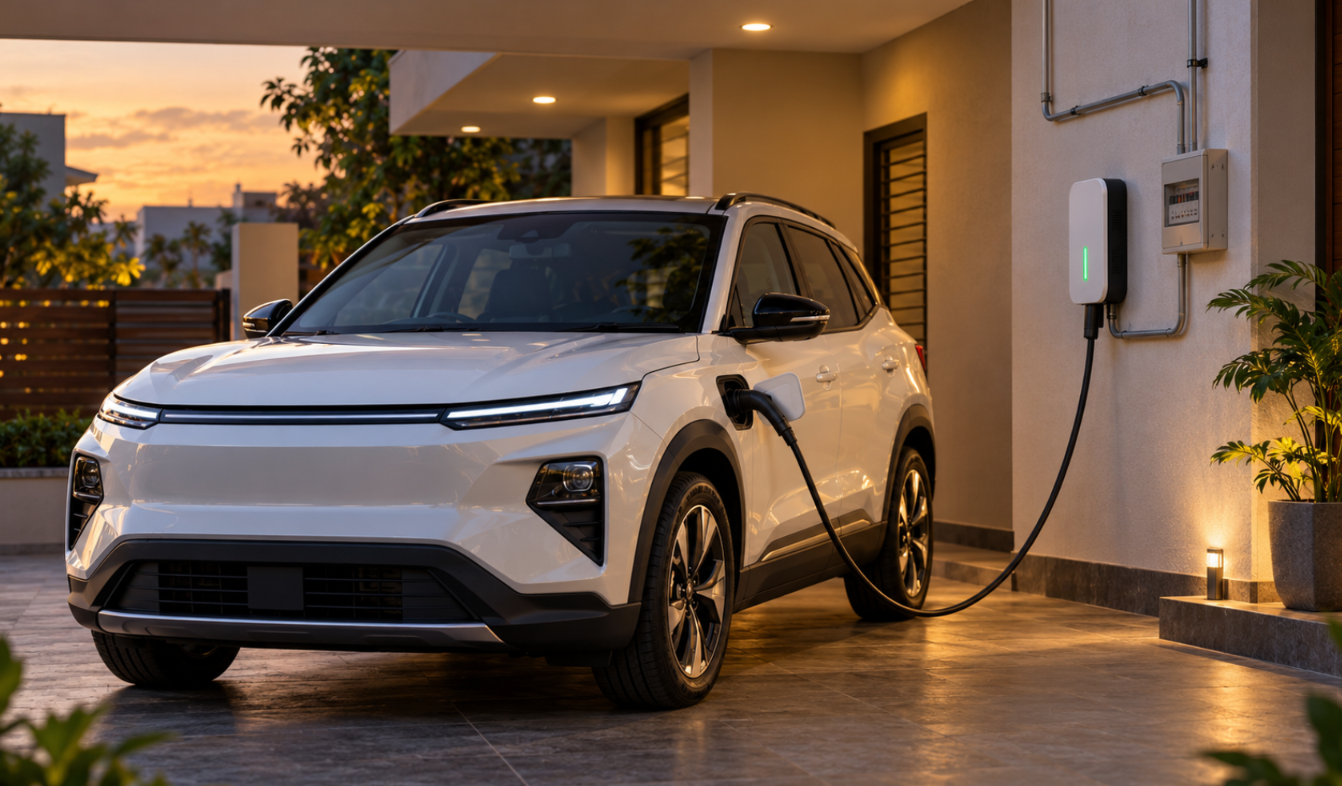
For most Indian EV owners, a proper home charger means a 7.4 kW single-phase AC wallbox on a dedicated, earthed circuit with its own breaker and a 30 mA earth-leakage device. Installer guides published in 2026 put the all-in cost of a standard single-phase job at roughly ₹25,000 to ₹80,000, with the charger brand and the cable run from your distribution board (DB) to the parking spot doing most of the moving. The slower portable charger that many EVs ship with can also work, but only on a correctly wired, dedicated point. An extension board is not that.
Home charging is AC charging, which is gentler and cheaper than public fast charging; our explainer on AC vs DC fast charging covers how the two differ. This guide focuses on what to buy, what it costs, what the wiring must include, what the rules say and how to keep the installation safe.
|
Quick answer Charger: a 7.4 kW single-phase AC wallbox with a Type 2 connector suits most owners. 11 kW and 22 kW units need a three-phase supply and a car that can accept that power. Cost: about ₹25,000 to ₹80,000 installed, depending on cable length, earthing and charger features. Wiring: dedicated circuit, 6 sq mm copper cable (10 sq mm for long runs), correctly rated MCB, 30 mA RCD or RCBO, and verified earthing. Rules: you can charge on your existing connection with no separate licence; apply to your DISCOM only if the sanctioned load must rise. |
Which home EV charger do you need?
Home chargers fall into three practical groups. The right one depends on your daily distance, your electricity supply and what your car can accept.
|
Charger |
Power and supply |
Best for |
Notes |
|
Portable 3.3 kW |
3.3 kW, about 15 A, single-phase |
Short daily runs, backup |
Often bundled with the car. It still needs a dedicated, correctly rated and earthed point. |
|
7.4 kW wallbox |
7.4 kW, about 32 A, single-phase 230 V |
Most owners, full overnight charge |
The usual recommendation. Wall-mounted and hard-wired to its own breaker. |
|
11 kW or 22 kW wallbox |
Three-phase supply |
Homes that already have three-phase and a car that accepts 11 kW or more AC |
Very few homes have three-phase. One price guide lists 11 kW units at roughly ₹35,000 to ₹55,000 before installation. |
A quick way to judge speed is power multiplied by time. A 3.3 kW charger running for twelve hours supplies about 40 kWh; a 7.4 kW unit supplies about 89 kWh in the same window, before charging losses. Your car’s onboard charger sets the ceiling, so a faster wallbox cannot push more than the car accepts. As reported in our guide to the fastest-charging electric cars in India, Tata lists a 7.2 kW wall-box option for the Harrier.ev, while Hyundai lists 11 kW AC charging for the IONIQ 5. Check your car’s AC limit and connector in the owner’s manual before you buy a charger.
For a typical city commuter who drives 30 to 50 km a day, even the bundled 3.3 kW cable usually refills the battery overnight. A 7.4 kW wallbox makes more sense with a large battery, high daily running or a household that shares one car between several drivers.
How much does home EV charger installation cost in India?
Published estimates vary widely because installers bundle different things. Putting several 2025 and 2026 guides side by side gives the following building blocks for a 7.4 kW single-phase job.
|
Cost item |
Indicative range |
What drives it |
|
7.4 kW wallbox (hardware) |
₹15,000 to ₹55,000 |
Brand, smart features, warranty. One brand launched a smart wall charger in November 2025 at an MRP of ₹50,000 with an introductory price of ₹32,514. |
|
Installation labour and materials |
₹5,000 to ₹25,000 |
Cable length, conduit, breaker and RCD, earthing accessories, mounting. Guides quote the low end for a 10 to 15 m run near the DB. |
|
Copper armoured cable, 6 sq mm |
₹180 to ₹290 per metre |
One installer’s published rate; longer runs add up quickly. |
|
MCB plus RCCB or RCBO |
About ₹2,500 to ₹4,500 |
Rating and type; EV-suitable devices cost more than a plain breaker. |
|
Extra earthing pit, if needed |
Quoted case by case |
Needed when the existing house earth is weak or untested. |
|
Sanctioned-load increase |
Set by your DISCOM |
Charges and process differ by state. |
|
Typical total, installed |
₹25,000 to ₹80,000 |
Most guides fall inside this band. A short cable run on sound wiring sits near the bottom; long runs, earthing work or a load upgrade push towards the top. |
Treat these as planning figures, not quotes. Ask at least two installers for a written quote after a site survey, and check that it lists cable size, breaker and RCD ratings, the earthing work and the charger warranty.
Also check what your car purchase already includes. Some makers bundle a portable cable or a wallbox; others do not. Mahindra, for example, states that its announced BE 6 Pack Two prices exclude the charger and installation, so budget for it separately.
What it costs to run
Home charging is billed at your normal domestic tariff, since the Ministry of Power’s 2024 guidelines say domestic rates apply to EV charging at home. Our EV charging in India guide puts home charging at about ₹6 to ₹9 per unit, roughly ₹1 to ₹1.5 per km, against ₹18 to ₹25 per unit at public DC chargers. A full top-up that costs about ₹300 at home can exceed ₹800 at a high-speed public corridor. To see what that means for your own driving, plug your numbers into the cost per km calculator.
Do you need permission to install a home EV charger?
Not from the government in the sense of a licence. The Ministry of Power’s Guidelines for Installation and Operation of Electric Vehicle Charging Infrastructure, 2024 (issued 17 September 2024) set out the position for residences:
-
Existing connection: owners can use their existing electricity connection to charge their EVs at home.
-
Separate connection: owners can request a separate metered connection with a dedicated EV charging tariff, within the timelines of the Electricity (Rights of Consumers) Rules, 2020.
-
Higher load: if the charger needs more power than your current sanctioned load, apply to the distribution licensee to raise it.
-
Tariff: domestic electricity rates apply to charging an EV at home.
Sanctioned load is the practical catch. A 7.4 kW charger drawing about 32 A can exceed the 3 to 5 kW sanctioned load that installer guides say many homes hold. Your options are to apply for a load increase, charge when other heavy appliances are off, or choose a charger with adjustable charging current so it can run at a lower rate. Ask the installer to do a load check before quoting.
Living in an apartment?
The same guidelines let residents of group housing societies install private charging points in their designated parking spaces, with supply from the resident’s existing meter or a separate sub-meter, as the consumer chooses. Societies can also set up shared community chargers. In practice, get written approval from your RWA or society before work starts, and agree who maintains the cable route. If you have no dedicated parking at all, plan around public chargers and use our EV charging stations finder to see what is near you.
Wiring requirements for a home EV charger
A charger draws a high current for hours at a stretch, far longer than a geyser or a mixer. That is why installers insist on a purpose-built circuit rather than borrowing an existing socket. The figures below are consolidated from several installer guides and the charger-maker norm of following the product manual; your electrician must size the final design for your site.
|
Component |
Typical recommendation for 7.4 kW |
Why it matters |
|
Supply |
Single-phase 230 V, about 32 A |
7.4 kW divided by 230 V is roughly 32 A of continuous load. |
|
Circuit |
Dedicated line from the DB, not shared with AC, geyser or other heavy loads |
Avoids overload and nuisance tripping. |
|
Breaker (MCB) |
32 A to 40 A, curve and rating as per the charger manual |
Protects the cable from overload and short circuits. |
|
Earth-leakage protection |
30 mA RCD or RCBO; installers advise Type A (or Type B if the charger manual asks) |
An MCB protects wiring; the RCD protects people from earth leakage. |
|
Cable |
6 sq mm copper, up to about 20 to 25 m; 10 sq mm for longer runs; no aluminium |
Undersized cable overheats under sustained load. |
|
Earthing |
Verified, low-resistance earth; chemical earthing pit if the house earth is weak |
The most neglected part of Indian home wiring. |
|
Surge protection |
SPD at the DB, as many installers recommend |
Guards the charger and car electronics against spikes. |
Dedicated circuit and breaker
Run a separate line from the main DB to the charger and give it its own breaker. Installer guides rate the MCB at 32 A to 40 A for a 7.4 kW unit, but follow the charger manufacturer’s installation manual for the exact rating and curve. Never share the circuit with an air conditioner or water heater; the combined load trips the breaker, and a hot, overloaded circuit is a fire risk.
Cable size
Installer guidance is consistent: copper, not aluminium, with 6 sq mm for a 7.4 kW charger on a run of about 20 to 25 m, stepping up to 10 sq mm for longer distances to limit voltage drop. A 4 sq mm cable on a 7.4 kW charger is a common cost-cutting mistake. Outdoor or exposed runs should be armoured or in conduit.
Earthing
Many older homes have weak or token earthing. If the house earth does not test well, installers fit a dedicated chemical earthing pit for the charger, and some specify an earth resistance below about 5 ohms. For charging stations, the Central Electricity Authority’s 2023 safety regulations also require an earth continuity monitoring system that disconnects the supply if the earth connection to the vehicle becomes ineffective, which is why a certified charger with this protection matters.
MCB, RCD and RCBO: what each does
An MCB guards against overload and short circuits. An RCD (also sold as an RCCB) detects current leaking to earth and cuts power in a fraction of a second, which is what protects a person touching a faulty charger. An RCBO combines both in one device, so a fault trips only the EV circuit, not the whole house. Installer guides warn that an ordinary Type AC RCCB, the default in many Indian DBs, can be blinded by the small DC leakage an EV charger may produce, so ask for a Type A device or the type the charger manual specifies. The CEA’s 2023 regulations cap RCD sensitivity at 30 mA in domestic installations.
Safety: what to do and what to avoid
-
Do not charge through an extension board, multi-plug or adaptor. The CEA’s 2023 regulations do not permit portable socket outlets for EV charging at charging stations; treat that as sound practice at home too.
-
Buy a BIS-certified charger. EV chargers sold in India are expected to meet the IS 17017 series, which is aligned with the international IEC 61851 charging standard. Avoid unbranded units with no certification.
-
Hire a licensed electrician and ask for the cable size, breaker and RCD ratings and the earth-test reading in writing.
-
Mount it right. The CEA rules require the socket-outlet of an EV charging point to sit at least 800 mm above finished ground level. Keep the unit out of waterlogging zones and choose a weather-rated model for outdoor spots.
-
Fix the wiring before reaching for a stabiliser. Voltage fluctuation is real in parts of India, but installers say a correct, earthed, protected dedicated circuit comes first.
-
Watch for warning signs. Repeated tripping, a warm or discoloured plug or cable, or a burning smell mean stop charging and call your electrician.
-
Test and inspect. Use the RCD test button as the manufacturer advises and have the earth resistance measured periodically, not just at commissioning.
Heat matters for the car as well as the cable. In the Geotab fleet data summarised in our battery degradation explainer, cars charged mostly at lower power lost about 1.5% of capacity a year, against about 3.0% for cars that often used high-power DC fast charging, and hot climates added roughly 0.4% a year. Overnight AC charging in shaded or covered parking is the gentle, low-cost routine.
Step-by-step: how a home charger gets installed
-
Check the car: confirm the AC charging limit and that it uses a Type 2 AC connector, as most mainstream EVs in India do.
-
Check the parking spot: measure the distance from the DB, note whether it is covered, and (in an apartment) get society approval in writing.
-
Check the electrical load: compare existing load plus the charger against your sanctioned load; apply to the DISCOM if it must rise.
-
Get a site survey and a written quote that lists cable, breaker, RCD, earthing and warranty.
-
Install: dedicated circuit, MCB or RCBO, earthing, surge protection and mounting. Installer guides quote about two to five hours for the physical work, though parts and society approvals can stretch the schedule to days.
-
Commission and test: check earth continuity and the RCD, set the charger’s current limit, pair the app, and keep the invoice and warranty papers.
Is there a subsidy for home chargers?
We found no central subsidy for a private home wallbox. The PM E-DRIVE scheme’s ₹2,000 crore charging component is aimed at public charging stations, with tiered support for public-access sites, and electric cars are not covered by its demand incentives. Some states or DISCOMs may run their own schemes or offer a dedicated EV tariff, so ask your electricity provider before you pay for a separate connection.
Which setup suits which owner?
|
Your situation |
Sensible choice |
|
House with covered parking, 30 to 50 km a day |
Bundled 3.3 kW charger on a dedicated, earthed, RCD-protected point, or a 7.4 kW wallbox if you want margin. |
|
Large battery, high daily running or two drivers |
7.4 kW single-phase wallbox with a load check first. |
|
Home with three-phase and a car that accepts 11 kW AC |
11 kW wallbox is possible, but confirm the car’s onboard charger and the extra cost. |
|
Apartment with allotted parking |
Society approval, then a wallbox or portable charger on a dedicated point from your meter or a sub-meter. |
|
No dedicated parking |
Rely on workplace and public AC charging; use DC fast charging as a top-up. |
|
Thinking about your next EV? Budget for the charger before you sign the booking form. Browse new cars on AutomobilIndia to compare electric models, prices and variants, then confirm with your dealer whether a charger and installation are included. |
Disclaimer: Prices, specifications, regulations, tariffs and incentives can change. Cost figures are indicative market estimates, not quotes, and electrical work must be designed and carried out by a licensed electrician following the charger manufacturer’s instructions and local DISCOM rules. Confirm current details with the manufacturer, your electricity provider and an authorised dealer before you buy or install.