
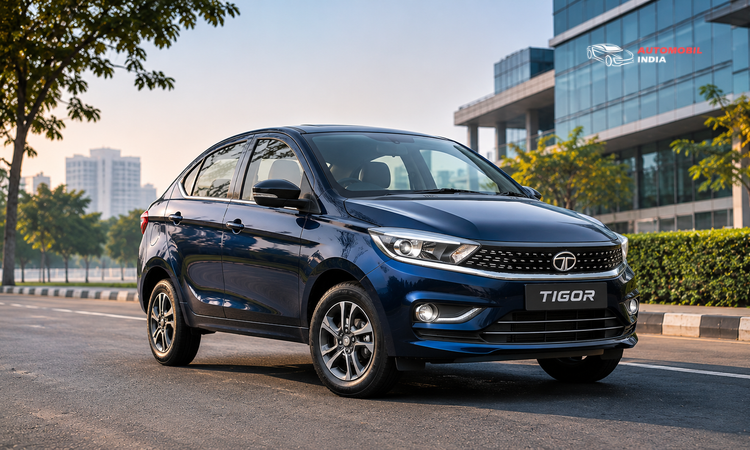
The compact sedan has a particular place in the Indian car market. It offers the familiar footprint and easy manoeuvrability of a small car, while adding a separate boot and the more formal proportions many buyers still prefer. The Tata Tigor has followed that formula since its arrival, positioning itself as an accessible sedan for families who want everyday practicality without moving into a larger, more expensive car.
For 2025, Tata Motors refreshed the Tigor with subtle exterior revisions, a revised cabin theme, new colours and a stronger technology package on selected variants. The update did not introduce a new engine or a major platform change. Instead, it focused on making the existing compact sedan feel more contemporary and better equipped against newer rivals such as the Maruti Suzuki Dzire, Hyundai Aura and Honda Amaze.
This is a look at the 2025 model as it was introduced. The Tigor nameplate was later replaced in Tata’s personal-car line-up by the Tata Aeris in September 2026, so buyers researching the car today should treat this as a guide to the 2025 Tigor and check current availability, used-car condition and local support before making a purchase.
A familiar silhouette with a sharper finish
The Tigor’s strongest visual distinction is its compact three-box profile. Unlike a hatchback with an extended tailgate, the sedan’s boot is integrated into the body, giving it a more conventional saloon-like appearance. The roofline flows into the boot in a gently sloping shape, helping the car avoid the upright, add-on look that can affect some entry-level sedans.
The 2025 update was evolutionary rather than dramatic. Tata revised details around the grille and front bumper, introduced fresh colour choices and made small design adjustments to keep the car visually current. The boot-lid spoiler on selected trims and the updated wheel treatment add a little more definition, while the overall proportions remain familiar.
That restraint is part of the Tigor’s appeal. It does not try to look like a premium executive sedan; instead, it offers a compact, distinctive design that is easy to place in crowded city streets and parking spaces. Its sub-four-metre length also keeps it within the compact-sedan category that has traditionally appealed to first-time sedan buyers.
A cabin focused on useful upgrades
Inside, the 2025 Tigor received a refreshed interior presentation, including a revised colour theme and an illuminated steering-wheel treatment. Higher variants bring a dual-tone leather-finish steering wheel, while the dashboard layout remains straightforward and familiar. The cabin is designed around function rather than visual drama, with controls placed within easy reach.
The front seats offer a conventional driving position, and the rear bench is intended for everyday family use. As with most cars in this class, three adults across the rear seat will be a tighter fit than two adults and a child. Buyers should check rear knee room, headroom and seat comfort in person, particularly if the car will regularly carry adult passengers on longer journeys.
The Tigor’s boot is one of its key practical advantages over a hatchback. The petrol version offers a claimed 419-litre luggage capacity, which is useful for airport runs, shopping and weekend travel. CNG packaging affects luggage space, so buyers who regularly carry suitcases should inspect the actual boot arrangement and assess whether it meets their needs.
Technology: the 2025 update’s biggest talking point
The most noticeable equipment upgrade arrived in the higher variants. The XZ+ received a 26.03 cm (10.25-inch) floating touchscreen infotainment system, wireless Apple CarPlay and Android Auto connectivity, an HD reverse camera and a more advanced digital instrument display. This gives the top half of the range a more modern technology experience than the earlier model.
The XZ+ Lux adds a 360-degree surround-view camera, alloy wheels, tyre-pressure monitoring and additional charging convenience, including Type-A and Type-C ports at the front and rear. These features can make daily use easier, especially for drivers who frequently park in tight urban spaces or travel with multiple passengers and devices.
Equipment is variant-dependent. The entry-level trims prioritise essential functions, while the higher trims add the larger display, connected smartphone features, automatic climate control, automatic headlamps, rain-sensing wipers and other convenience equipment. Buyers should compare the exact variant equipment list rather than assuming every feature is standard across the range.
Petrol and CNG: familiar, accessible powertrains
The 2025 Tigor continued with Tata’s 1.2-litre, three-cylinder Revotron petrol engine. In petrol form, it produces 86 PS and 113 Nm. Transmission choices include a five-speed manual and a five-speed AMT, depending on the trim. The engine is tuned for everyday commuting rather than outright performance, with its naturally aspirated character favouring predictable responses and straightforward ownership.
The factory-fitted iCNG version uses the same 1,199 cc engine adapted for petrol and compressed natural gas operation. Tata’s published technical material lists 74.5 PS and 96.5 Nm in CNG mode. The CNG option is aimed at buyers with high monthly running who have convenient access to refuelling infrastructure and want to reduce fuel expenditure.
The AMT is an automated manual transmission, not a conventional torque-converter automatic or a continuously variable transmission. It removes the need for a clutch pedal and can make stop-start traffic less tiring, but its shift behaviour is different from a smoother conventional automatic. A test drive in the traffic conditions you normally face is the best way to decide whether it suits you.
Official brochure figures and real-world consumption should not be treated as interchangeable. Driving style, traffic, air-conditioning use, passenger load, tyre pressure and road conditions all influence fuel economy. Prospective owners should compare independently tested figures and speak to existing owners, while treating any mileage claim as a reference rather than a guarantee.
Safety: a strong structural reputation, with equipment varying by trim
The Tigor has a four-star Global NCAP rating under the older test protocol. It is an important part of the model’s reputation, but the rating should be read in context: crash-test protocols evolve, and results from different years are not directly comparable. Buyers should not interpret the older rating as proof that the car has been assessed under the latest, more demanding test requirements.
The 2025 range includes essential safety equipment such as dual front airbags, ABS with EBD, rear parking sensors and seat-belt reminders. Higher variants add equipment such as electronic stability control, hill-hold control, ISOFIX child-seat mounts, a reverse camera and, on the top trim, a 360-degree camera and tyre-pressure monitoring system. The exact availability depends on variant and model-year specification.
A camera system is a parking aid, not a substitute for mirrors, direct observation or careful manoeuvring. Likewise, electronic stability control can help a driver retain control in certain situations, but it cannot overcome excessive speed, poor tyres or unsafe driving decisions. Families should check that all occupants have correctly fitted seat belts and that child seats are compatible with the available ISOFIX points.
Which Tigor variant makes the most sense?
The right variant depends on how much technology you genuinely use. The XM is aimed at buyers who want the core sedan package and are comfortable with a simpler infotainment setup. The XT adds convenience equipment and a more usable music system, making it a more rounded choice for daily driving.
The XZ is a meaningful step up for buyers who want a touchscreen, reverse camera and additional safety and comfort equipment. The XZ+ is the technology-led option, bringing the larger touchscreen, wireless smartphone integration and digital instrument display. The XZ+ Lux is for buyers who value the 360-degree camera, TPMS, alloy wheels and extra charging ports.
CNG buyers should compare the cost difference between petrol and CNG variants with their expected monthly distance, local fuel prices and access to CNG stations. A higher upfront price only makes financial sense if the fuel savings over the expected ownership period justify it. Also consider the luggage compromise and whether the selected CNG variant offers the transmission you prefer.
How does it compare with its rivals?
The compact-sedan segment has long been shaped by the Maruti Suzuki Dzire, Hyundai Aura and Honda Amaze. The Dzire is a major competitor for buyers prioritising efficiency, resale confidence and a wide service network. The Aura appeals with its compact dimensions and available CNG powertrain, while the Amaze has traditionally targeted buyers seeking a more premium-feeling cabin and a conventional automatic option in selected versions.
The Tigor’s case rests on its design, boot practicality, petrol and CNG choices, feature-rich upper trims and its established safety credentials. However, its naturally aspirated engine is not intended to deliver sporty performance, and buyers should compare rear-seat comfort, transmission behaviour, after-sales support and total ownership cost before choosing.
A fair comparison should use equivalent variants and model years. Equipment, prices and powertrain availability change over time, so a 2025 Tigor should not be compared against a rival’s newer facelift using outdated price lists or feature sheets.
Verdict: substance over spectacle
The 2025 Tata Tigor was a measured update to a compact sedan with a clear purpose. Its refreshed styling helped keep the design relevant, while the larger touchscreen, wireless smartphone connectivity and 360-degree camera brought useful technology to the higher variants. The petrol and CNG powertrains continued to offer buyers a choice between familiar everyday usability and potentially lower running costs.
It was not a wholesale reinvention. The engine and basic driving character remained familiar, and the Tigor’s strengths continued to be its manageable size, separate boot, practical cabin and equipment-led top trims. For buyers considering a used 2025 example, condition, service history, variant and price matter more than the original launch positioning.
The Tigor’s replacement by the Aeris marks the next chapter for Tata’s compact-sedan offering. But as a 2025 model, the Tigor remains an interesting example of how a modest update can improve the technology and convenience package of an established, value-focused sedan.