
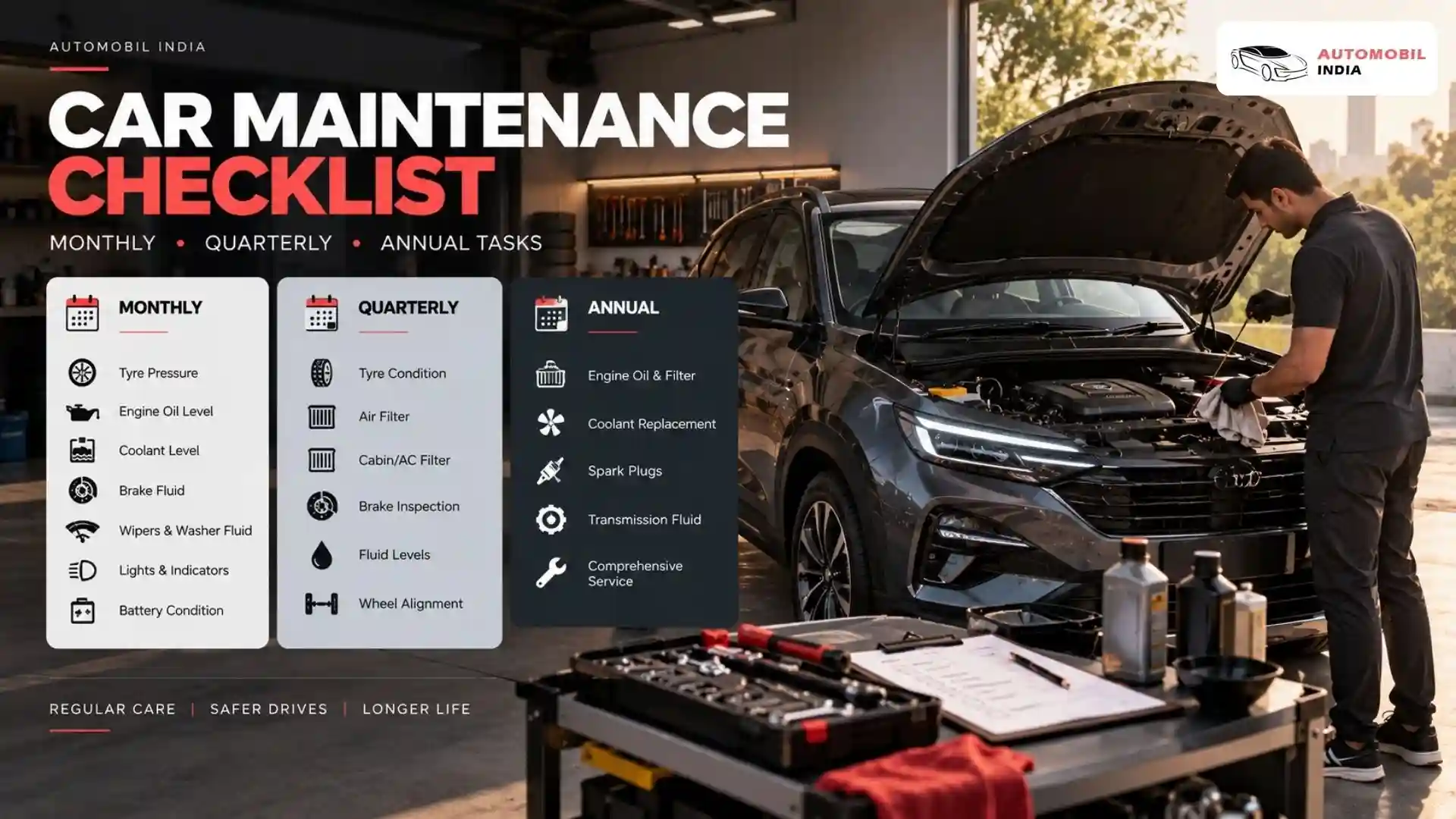
A good car maintenance checklist should cover more than scheduled servicing. Regular checks of tyre pressure, fluids, brakes, lights, battery, wipers and warning indicators can help identify problems before they become expensive repairs.
The exact service interval varies by car, engine, fuel type and manufacturer. Your owner's manual should always take priority over a generic checklist. Manufacturers such as Maruti Suzuki explicitly recommend following the periodic maintenance schedule in the owner's manual and carrying out routine visual checks.
For most Indian car owners, the easiest approach is to divide maintenance into monthly checks, quarterly checks and annual or scheduled-service tasks.
Car maintenance checklist at a glance
|
Maintenance task |
How often |
Why it matters |
|
Tyre pressure and condition |
Monthly / before long trips |
Safety, tyre life and efficiency |
|
Engine oil level |
Monthly or as specified |
Lubrication and engine protection |
|
Coolant level |
Monthly |
Helps control engine temperature |
|
Brake fluid |
Monthly visual check |
Detects low level or possible leaks |
|
Wipers and washer fluid |
Monthly |
Visibility during rain |
|
Lights and indicators |
Monthly |
Visibility and road safety |
|
Battery condition |
Monthly/quarterly |
Starting reliability |
|
Air filter |
As per service schedule |
Engine airflow and efficiency |
|
Cabin/AC filter |
As specified |
Airflow and cabin comfort |
|
Brake pads/discs |
At service or when symptoms appear |
Braking performance |
|
Wheel alignment/balancing |
When required / as specified |
Handling and tyre wear |
|
Engine oil and filter |
As per owner's manual |
Preventive engine maintenance |
|
Coolant replacement |
Manufacturer schedule |
Cooling-system protection |
|
Spark plugs |
Manufacturer schedule |
Petrol-engine ignition |
|
Transmission fluid |
Manufacturer schedule |
Transmission lubrication |
|
Annual service |
As specified |
Comprehensive inspection |
These intervals are general guidance, not universal service intervals. Manufacturer schedules can differ substantially between models. For example, Hyundai states that brake fluid should be inspected at every service and gives a model-specific replacement interval, while manufacturer manuals can specify different intervals for individual components.
Why regular car maintenance matters
Routine maintenance is primarily about preventing small problems from becoming expensive failures.
A tyre that is slightly under-inflated may not immediately feel defective, but incorrect pressure increases rolling resistance and can accelerate tyre wear. Maruti Suzuki specifically advises regular tyre-pressure checks and notes that under-inflation can increase fuel consumption and tyre wear.
Similarly, a low fluid level, worn brake component, weak battery or damaged wiper may initially seem minor but can become a safety or reliability problem if ignored.
For Indian driving conditions, maintenance also needs to account for:
-
Heavy stop-and-go traffic
-
High summer temperatures
-
Monsoon water and humidity
-
Dusty roads
-
Potholes and rough surfaces
-
Long periods of idling
-
Frequent short-distance trips
-
Highway driving
Monthly car maintenance checklist
You do not need to be a mechanic to perform most basic monthly checks. A few minutes with the car parked on level ground can help identify obvious problems.
1. Check tyre pressure
Check all four tyres and the spare tyre.
Use the pressure recommended by the manufacturer rather than the maximum pressure printed on the tyre sidewall. The recommended pressure is usually found on the driver's-door sticker or in the owner's manual.
Also inspect for:
-
Uneven tread wear
-
Cuts
-
Cracks
-
Bulges
-
Embedded objects
-
Slow punctures
If the steering feels different or the car pulls to one side, have the tyres, wheels and alignment inspected.
Maruti Suzuki recommends checking tyre condition and pressure as part of routine vehicle care.
Why this matters
Correct pressure affects:
-
Braking
-
Cornering
-
Ride comfort
-
Tyre life
-
Fuel consumption
2. Check engine oil level
For cars that provide a conventional dipstick, check the engine oil with the vehicle parked on level ground and follow the procedure specified in the owner's manual.
Look for:
-
Oil level below the recommended range
-
Unusual oil consumption
-
Oil leaks underneath the vehicle
-
Warning lights
Do not simply add oil because the level looks low without checking which oil specification your manufacturer recommends.
Using the wrong oil grade can affect engine operation and efficiency. Maruti Suzuki advises owners to use recommended lubricants and check the owner's manual for the appropriate oil grade.
3. Check coolant level
Check the coolant reservoir when the engine is cold.
Do not open a hot radiator or cooling-system cap. A pressurised cooling system can cause serious burns.
Look for:
-
Low coolant level
-
Visible leaks
-
Damaged hoses
-
Unusual coolant loss
If coolant repeatedly needs topping up, the issue should be investigated rather than repeatedly adding coolant.
4. Inspect brake-fluid level
Check the brake-fluid reservoir visually.
A falling level can have several causes, including brake-pad wear or a leak. If the level is unusually low or the brake pedal feels different, get the braking system inspected.
Brake fluid is a critical component of a hydraulic braking system. Hyundai recommends inspecting it during servicing and specifies replacement intervals according to its maintenance guidance.
5. Check lights and indicators
Test:
-
Headlights
-
DRLs
-
Tail lamps
-
Brake lamps
-
Indicators
-
Hazard lights
-
Reverse lamps
-
Number-plate lamps
-
Fog lamps, if equipped
A failed brake light or indicator can create a safety problem and may also attract enforcement action.
6. Check wipers and washer fluid
Inspect the wiper blades for:
-
Cracking
-
Hardening
-
Streaking
-
Skipping
-
Poor cleaning
Keep the washer-fluid reservoir filled with the recommended fluid.
Poor wipers become particularly problematic during India's monsoon season.
7. Look underneath the car
After parking, occasionally look underneath the vehicle.
Watch for unexplained:
-
Oil
-
Coolant
-
Brake fluid
-
Fuel
-
Water beyond normal AC condensation
A new fluid stain deserves investigation rather than being ignored.
Quarterly car maintenance checklist
Every few months, go beyond basic fluid and tyre checks.
1. Inspect the battery
Check for:
-
Corrosion around terminals
-
Loose connections
-
Physical damage
-
Swelling
-
Leakage
Modern cars depend heavily on their electrical systems, so battery health matters even if the engine itself is mechanically healthy.
If starting becomes noticeably slower, have the battery and charging system tested.
2. Check the air filter
The engine air filter prevents dust and other contaminants from entering the engine's intake system.
Dusty Indian operating environments can make air-filter condition particularly important. Maruti Suzuki recommends regular air-filter maintenance and notes that a dirty filter can contribute to increased engine wear and fuel consumption.
Do not automatically replace the filter at every visit. Follow the manufacturer's schedule and inspect it where appropriate.
3. Inspect the AC and cabin filter
Check whether the air conditioner:
-
Cools normally
-
Produces adequate airflow
-
Has unusual smells
-
Makes unusual noises
A clogged cabin filter can restrict airflow and reduce cabin comfort.
If airflow has become noticeably weaker, the filter should be inspected.
4. Inspect brakes
Pay attention to changes such as:
-
Squealing
-
Grinding
-
Steering vibration while braking
-
Longer stopping distances
-
Brake-pedal changes
-
Vehicle pulling during braking
Brake pads, discs, drums and related components should be inspected according to the manufacturer's schedule.
Do not wait for a warning sound if braking performance has changed.
Manufacturer maintenance schedules commonly include brake-fluid checks, brake-pad/disc inspections and checks for leaks or damage.
5. Check suspension and steering
Indian roads can put considerable stress on suspension and steering components.
Look for:
-
New knocking sounds
-
Excessive bouncing
-
Uneven tyre wear
-
Steering vibration
-
Steering pulling
-
Excessive play
-
Fluid leakage from applicable components
If the car has recently encountered a deep pothole, inspect the wheels, tyres and suspension even if there is no immediate warning light.
Annual car maintenance checklist
An annual inspection should be more comprehensive than a quick visual check.
1. Follow the scheduled service
Do not use "one year" as a universal service interval. Many manufacturers specify maintenance by time or kilometres, whichever comes first.
Your owner's manual is the correct reference for:
-
Engine oil replacement
-
Oil filter replacement
-
Air filter
-
Spark plugs
-
Fuel filter
-
Transmission fluid
-
Coolant
-
Brake fluid
-
Belts
-
Other model-specific components
For example, manufacturer service schedules can include detailed inspections covering the engine, fuel system, transmission, brakes, wheels, suspension, steering, electrical system, body and air-conditioning system.
2. Check wheel alignment and balancing when necessary
Alignment and balancing are not necessarily annual tasks for every car.
They become particularly relevant if you notice:
-
Steering vibration
-
Uneven tyre wear
-
Steering pulling
-
Steering-wheel vibration at certain speeds
-
The vehicle feeling unstable after a pothole impact
Maruti Suzuki notes that wheel balancing may be required after a puncture and according to the vehicle's maintenance schedule.
3. Inspect belts, hoses and rubber components
During scheduled servicing, ask the technician to inspect relevant:
-
Drive belts
-
Coolant hoses
-
Rubber bushes
-
Suspension components
-
CV boots
-
Mounts
Cracked or damaged rubber components can eventually lead to larger mechanical problems.
4. Inspect the battery and charging system
A battery can appear normal but still have reduced capacity.
If your car has:
-
Slow cranking
-
Flickering electrical equipment
-
Frequent battery discharge
-
Battery warning lights
have the battery and charging system tested.
5. Check the AC system before summer
Do not wait until the hottest month to discover that the AC is not working properly.
Check:
-
Cooling performance
-
Compressor operation
-
Blower operation
-
Cabin filter
-
Unusual smells
-
Unusual noises
This is particularly useful before long summer road trips.
Car maintenance checklist for Indian weather
Summer
High temperatures can put additional stress on:
-
Battery
-
Cooling system
-
Tyres
-
AC system
Check coolant level and tyre condition, and pay attention to battery performance.
Monsoon
Before and during the rainy season, focus on:
-
Tyres
-
Wipers
-
Washer fluid
-
Brakes
-
Lights
-
Defogger
-
Electrical components
Good tyre tread and functioning wipers are particularly important when visibility and road grip deteriorate.
Winter
In colder regions, pay greater attention to:
-
Battery health
-
Coolant
-
Tyres
-
Defogging/defrosting systems
The exact requirements depend on the climate where the vehicle is used.
Maintenance checklist before a long road trip
Before a highway trip, perform a quick inspection even if the car was recently serviced.
Essential checks
-
Tyre pressure
-
Spare tyre
-
Puncture-repair kit
-
Engine oil
-
Coolant
-
Brake fluid
-
Washer fluid
-
Wipers
-
Headlights
-
Brake lights
-
Indicators
-
Battery condition
-
Fuel level
-
Warning lights
Also check that you have:
-
Vehicle documents
-
Insurance details
-
Emergency contact information
-
Jack and wheel-removal tools, if supplied
-
Reflective warning triangle, where applicable
Maruti Suzuki's preventive-maintenance guidance similarly recommends daily/pre-drive checks and inspecting tyres, leaks, wipers and other basic vehicle components before driving.
Warning signs you should not ignore
Some symptoms should trigger an inspection rather than waiting for the next scheduled service.
|
Warning sign |
Possible area to inspect |
|
Engine warning light |
Engine/emissions/electronics |
|
Battery warning light |
Charging system |
|
Brake warning light |
Brake system |
|
Engine overheating |
Cooling system |
|
New fluid leak |
Engine/cooling/brake/fuel system |
|
Grinding brakes |
Brake components |
|
Steering vibration |
Wheels/tyres/suspension |
|
Car pulls to one side |
Alignment/brakes/suspension |
|
Excessive smoke |
Engine/exhaust system |
|
Sudden drop in mileage |
Engine/tyres/brakes/drivetrain |
|
Weak AC |
AC/filter/refrigerant/system |
|
Slow engine cranking |
Battery/starting system |
If a warning lamp appears, check the owner's manual for its meaning. Some warning lights indicate conditions that require immediate attention.
How driving habits affect maintenance
Maintenance is not only about parts replacement. Driving style also affects wear.
Frequent short trips
Repeated short journeys can be harder on some vehicles because the engine and associated systems may spend less time at their normal operating temperatures.
If most of your driving consists of very short trips, discuss the appropriate maintenance schedule with the manufacturer or authorised service centre.
Heavy traffic
Stop-and-go traffic can increase:
-
Brake use
-
Clutch wear in manual cars
-
Fuel consumption
-
AC load
Avoid unnecessary clutch riding in manual cars. Maruti Suzuki specifically advises drivers to use the clutch only when changing gears.
Rough roads
Repeated pothole impacts can affect:
-
Tyres
-
Wheels
-
Alignment
-
Suspension
-
Steering components
A new vibration after a major pothole should not be dismissed as normal.
DIY maintenance vs professional service
Some maintenance tasks are reasonable for an owner to perform.
Suitable for basic DIY checks
-
Tyre-pressure check
-
Visual tyre inspection
-
Checking washer fluid
-
Checking fluid levels according to the manual
-
Testing lights
-
Inspecting wipers
-
Visual leak inspection
Better left to a qualified technician
-
Brake repairs
-
Wheel alignment
-
Suspension repairs
-
Engine oil replacement where proper disposal is required
-
Transmission work
-
Electrical diagnostics
-
Air-conditioning repairs
-
Cooling-system repairs
-
ADAS calibration
Modern vehicles contain increasingly complex electronic systems. Attempting repairs without the required equipment can create additional problems.
Does regular maintenance improve mileage?
It can help a vehicle operate as intended, but maintenance should not be treated as a guaranteed mileage booster.
Tyre pressure, brake drag, dirty filters, engine condition and incorrect lubricants can all affect efficiency. Maruti Suzuki specifically identifies under-inflated tyres, unnecessary loads, binding brakes and dirty air filters as factors that can affect fuel consumption.
However, real-world mileage also depends heavily on:
-
Traffic
-
Driving style
-
Vehicle load
-
Road conditions
-
AC usage
-
Speed
-
Fuel quality
-
Weather
-
Vehicle condition
So a maintenance checklist supports efficiency; it does not guarantee a particular fuel-economy figure.
What should you keep in your car maintenance record?
Keep a simple record containing:
-
Service date
-
Odometer reading
-
Engine oil specification
-
Parts replaced
-
Tyre replacement date
-
Battery replacement date
-
Major repairs
-
Warranty work
-
Next recommended service
-
Any recurring symptoms
This becomes particularly useful when selling a used car because it provides a clearer maintenance history.
The most important rule: follow the owner's manual
A generic car maintenance checklist is useful for remembering common checks, but it should never replace the manufacturer's maintenance schedule.
Different cars use different:
-
Engines
-
Transmission systems
-
Coolants
-
Brake fluids
-
Filters
-
Batteries
-
Service intervals
-
Lubricants
Manufacturer service guidance therefore takes precedence over a universal schedule. Maruti Suzuki, for example, directs owners to the vehicle's owner's manual for periodic maintenance requirements and provides model-specific manuals.
Disclaimer: This article provides general automotive maintenance information for Indian car owners and is not a substitute for the manufacturer's owner's manual or advice from a qualified technician. Maintenance intervals, specifications and replacement requirements vary by vehicle. Always follow the manufacturer's recommended schedule and use the specified fluids and parts.